Retail Investors in Samsung, SK Hynix at Breaking Point as Shares Sink Again; Kospi Falls Below 5,000
Summary
- The Kospi plunged below 5,000, while Samsung Electronics and SK Hynix were down 49% and 61%, respectively, from their peaks.
- Views diverged between fears of another sharp drop driven by falling memory prices and expectations that AI-led supply shortages will persist, leading to a wide gap between target-price forecasts from Nomura and Morgan Stanley.
- Some brokerages said the recent plunge should not be seen as a direct sign of worsening earnings because memory spot prices have fallen, but contract prices, which drive earnings, are still rising.
Forecast Trend Report by Period


Kospi breaks below 5,000, lowest since Jan. 20
Samsung down 49% from its peak, SK Hynix off 62%
“Memory prices are turning down” vs. “Contract prices that drive earnings remain firm”
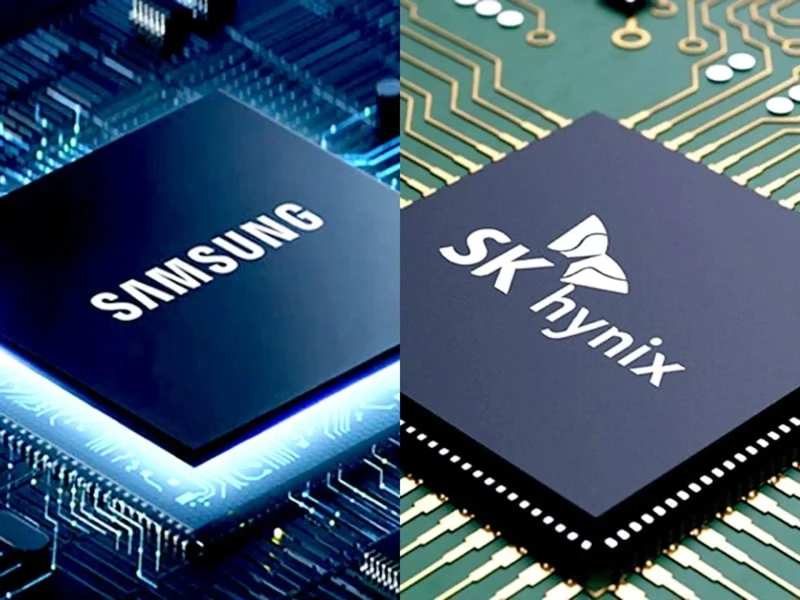
Samsung Electronics Co. and SK Hynix Inc. both slumped on Friday, deepening the anguish of investors who had been waiting for a rebound after what traders called a “Black Friday.” Sentiment deteriorated as funds gravitated toward the Anthropic listing, while allegations surrounding AMD’s dealings with a Chinese company and concerns over AI circular financing added to the pressure. Analysts are split between warnings that falling memory prices could trigger another leg down and arguments that semiconductor earnings remain solid.
According to the Korea Exchange, the Kospi closed at 4,882.35, down 255.54 points, or 4.97%, from the previous session. It was the lowest close since Jan. 20, when the index ended at 4,885.75.
Samsung fell 7.01% to 183,100 won, while SK Hynix dropped 5.92% to 1.113 million won. Based on closing prices, Samsung has slid 49.49% from its June 18 peak of 362,500 won, while SK Hynix has fallen 61.87% from its June 22 high of 2.919 million won.
The immediate blow came from overnight weakness in U.S. technology shares. Anthropic closed its first trading day at $97.17, up 17.1% from its offering price. Even so, the Nasdaq Composite fell 2.25% and the Philadelphia Semiconductor Index lost 2.41%.
One market view is that the blockbuster listing worsened funding pressure on other tech stocks. Seo Jeong-hoon, an analyst at Samsung Securities, said investors likely sold other names to buy Anthropic shares in the open market. More than 1,200 institutions took part in the IPO subscription, but more than half were not allocated a single share.
Fresh negatives compounded the selloff. AMD fell 7.7% amid allegations linking it to dealings with a Chinese company under U.S. sanctions and controversy over circular financing. AMD denied the allegations, but unease spread across the semiconductor sector, with Nvidia also down 3.30%. The worry is that if funding support shrinks in a structure where AI companies invest in one another and buy equipment from one another, memory orders could also be hit.
The bigger question for investors is whether this correction is a temporary supply-and-demand shock or a sign that the semiconductor boom is ending. Lee Ju-wan, an industry analyst who had presented fair-value targets of 70,000 won for Samsung and 200,000 won for SK Hynix, said on a YouTube broadcast on Nov. 18 that “the full-scale crash hasn’t started yet.” His argument is that if memory prices fall, securities firms will follow with cuts to earnings forecasts.
Global investment banks are also divided on when the supply shortage will ease. Nomura maintained last month its target prices of 670,000 won for Samsung and 4.7 million won for SK Hynix. It said AI demand would outpace supply growth, keeping the market undersupplied through at least 2028. Morgan Stanley, by contrast, cut its targets on Nov. 9 to 309,000 won and 1.6 million won, respectively. Its view is that profitability could weaken after 2028 if new production facilities begin operating from late next year and data-center construction slows.
In South Korea, some analysts are also not ruling out a price correction. Even if supply stays tight, that does not necessarily mean customers can keep paying ever-higher prices for memory. Son In-jun, an analyst at Eugene Investment & Securities, said memory prices could still decline because of customer budget constraints and resistance to higher prices, even if the physical supply shortage is not resolved.
Still, there is strong pushback against linking the recent drop in spot prices directly to weaker earnings. Kim Dong-won, an analyst at KB Securities, said the earnings of Samsung and SK Hynix are driven not by spot prices but by contract prices. Over the past month, memory spot prices have fallen, but contract prices have kept rising.
As the selloff deepened, retail investors responded with a mix of exhaustion and self-mockery. Posts on stock forums for Samsung and SK Hynix included comments such as, “Every time I buy, it falls,” “I don’t even have cash left to average down,” “There’s a limit to how long I can hold on,” and “What nightmare is waiting on Monday?”
Kim Yeon-ji, Hankyung.com reporter kongzi@hankyung.com

Korea Economic Daily
hankyung@bloomingbit.ioThe Korea Economic Daily Global is a digital media where latest news on Korean companies, industries, and financial markets.