AI Boom Faith Shaken as Goldman Sees Up to $80.6 Billion of Selling, Sparking Retail Panic
Summary
- Anxiety and fear around AI investment are rising as flagship AI stock Nvidia plunged, the Nasdaq fell 10.02%, and the VIX broke above 40.
- Questions over Big Tech’s AI infrastructure investment commitments and the techno-dollar cycle are fueling weakness in semiconductor shares and concern over damage to global liquidity.
- Investors are weighing the Fed’s additional tightening, Goldman Sachs’ $80.6 billion selling forecast, and the risk of an AI stock collapse, while some still point to the chance of a technical rebound and corporate earnings as reasons for optimism.
Forecast Trend Report by Period


The “techno-dollar” underpinning the AI boom is wobbling
Confidence in Big Tech’s long-term contracts is fraying as the fear gauge jumps to pandemic-era levels
Global stock markets in turmoil
Nasdaq sank 10% last week
Big Tech AI spending → South Korea and Taiwan chip exports → reinvestment in AI stocks
Doubts about the durability of that spending are damaging the virtuous cycle, with tighter policy threatening even deeper fear
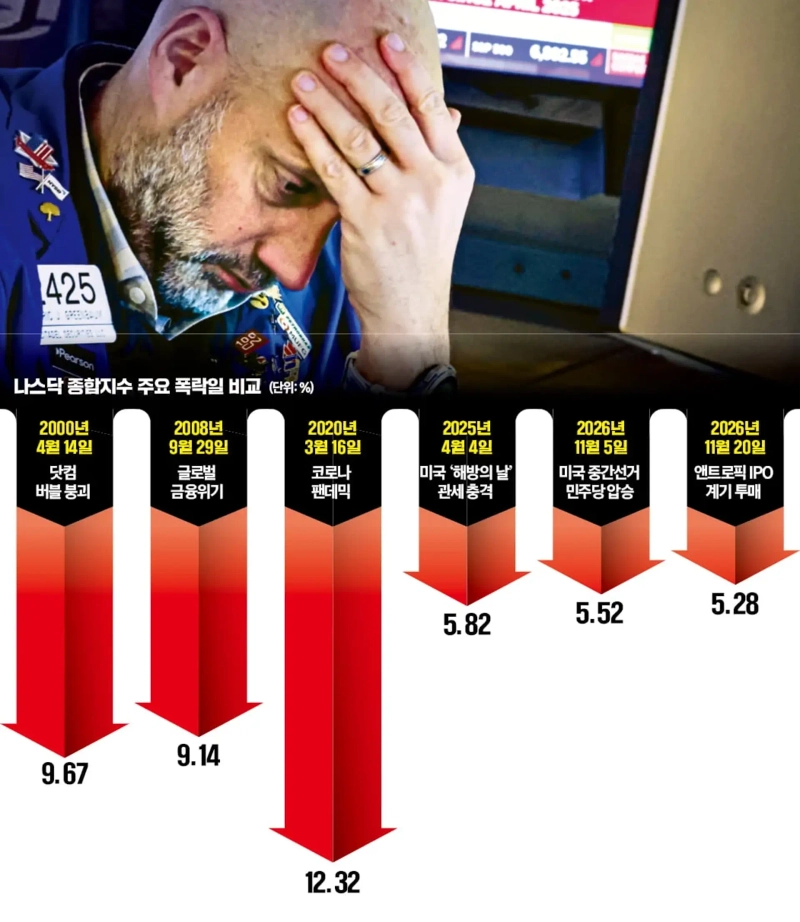
The tech-heavy Nasdaq Composite plunged 5.28% on November 20. Major New York stock indexes also fell, with the S&P 500 down 3.7% and the Dow Jones Industrial Average off 1.93%. Nvidia, the flagship AI stock, tumbled 14.01%, leaving the shares down about 50% from last month’s peak. The Nasdaq lost 10.02% for the week, its worst weekly drop since March 2020, at the start of the Covid-19 pandemic. The selloff raised concern that cooling appetite for AI stocks could disrupt the funding flows behind the “techno-dollar,” which has helped drive the market rally of the past four years.
Money tied to Big Tech’s AI infrastructure buildout has flowed back into U.S. equities since that spending ramped up in 2022. The cycle runs through export booms in South Korea and Taiwan, then back into U.S. AI shares as Asian investors flush with cash put money into those stocks. That capital helped fund Big Tech equity offerings and bond sales, while also supporting record-breaking initial public offerings by companies including SpaceX and Anthropic. Wall Street dubbed the phenomenon the “techno-dollar,” borrowing from the idea of the petrodollar, in which oil-exporting countries recycle dollar earnings into U.S. Treasuries.
That foundation is now under strain as anxiety grows over whether Big Tech will follow through on about $8 trillion of commitments through 2031. The unease is already showing up in weaker share prices for semiconductor companies, which have been among the biggest beneficiaries of that spending.
Anthropic’s listing, which many investors had hoped would ease those concerns, instead became a catalyst for broader selling across technology shares. Investors focused on $900.9 billion in spending commitments, worries about circular financing tied to equity investments by customers, and slowing revenue growth. Skepticism toward AI investment deepened. Anthropic shares rose 17% on their first trading day, then fell 8.5% the next day.
If the techno-dollar cycle that has underpinned the AI boom breaks down, related stocks will struggle to escape structural weakness. Malika Sachdeva, an analyst at Deutsche Bank, said slower AI investment demand could destabilize cyclical global capital flows.
Concern is also emerging that the equity slump could spill into the broader economy. Michael Hartnett, Bank of America’s chief strategist, said tighter policy on top of the selloff could worsen a credit squeeze and economic slowdown while eroding corporate earnings.
A pullback in tech investment that has supported U.S. stocks could hurt global liquidity
Goldman says as much as $80.6 billion could be sold this week; a Fed pivot may be needed for a turnaround
One question keeps surfacing at recent investor relations events hosted by major chipmakers including Micron and SK Hynix: whether long-term agreements, or LTAs, with Big Tech clients could be canceled. The market has begun to question Big Tech’s pledge to spend about $887 billion on AI infrastructure this year alone, according to Goldman Sachs estimates, and roughly $8 trillion through 2031.
As confidence in the AI rally fades, fear is rising. The Nasdaq Composite, led by technology shares, has fallen nearly 20% from its recent high.
◇ Fear gauge enters danger zone
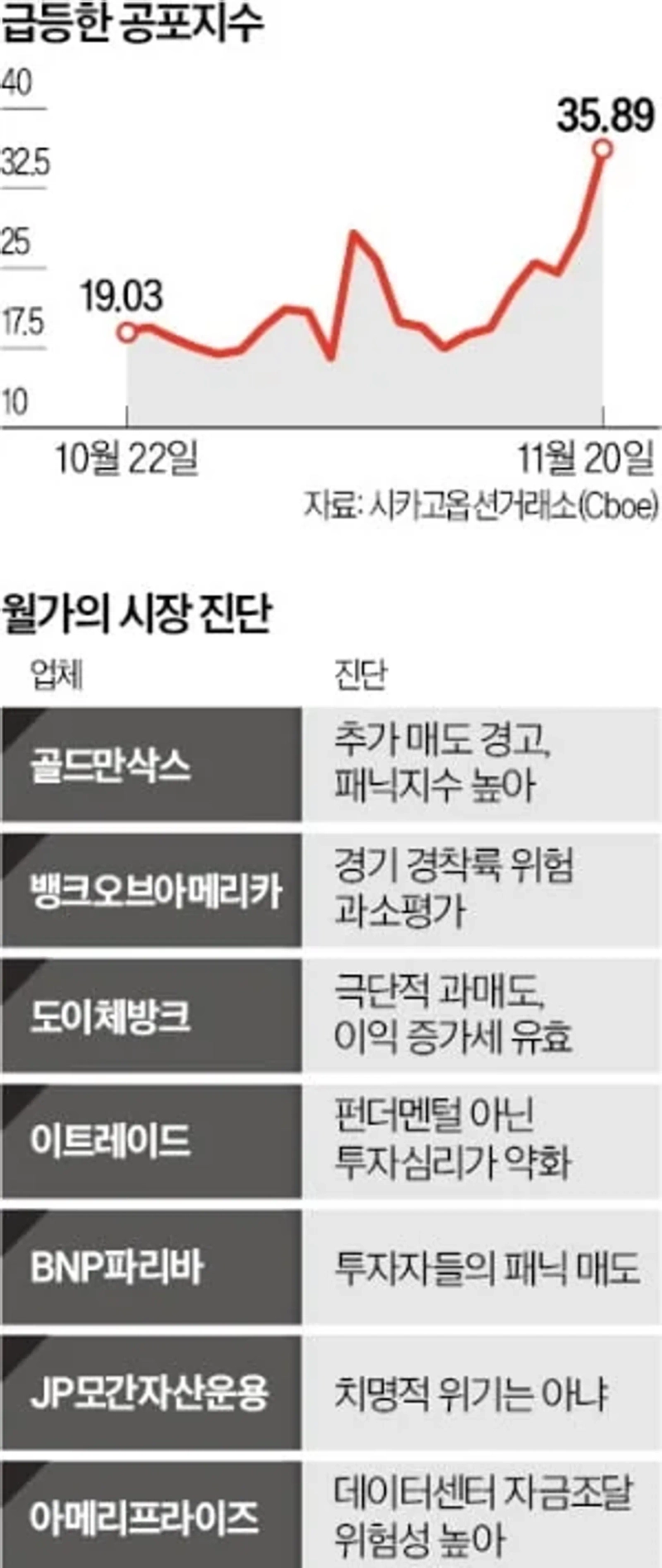
On November 20, when major New York stock indexes fell across the board, the Cboe Volatility Index, or VIX, climbed as high as 40 during the session. It later pared gains but still closed at 35.89, up 26.2% from the previous day. The VIX measures expected volatility in U.S. equities and is widely known as Wall Street’s fear gauge.
A reading of 40 signals that investor anxiety has risen to levels seen during past periods of severe market stress. In the market’s view, the current level of fear is comparable to the European sovereign debt crisis in April 2010, the U.S. credit-rating downgrade in August 2011, and the Covid-19 pandemic in March 2020.
Behind the market plunge and the jump in the VIX is investor distrust over AI spending plans. Expectations that those investments would translate into profits are giving way to worries about oversupply and order cancellations. Nvidia’s troubles have added to the anxiety, compounded by CEO Jensen Huang’s departure and a U.S. Securities and Exchange Commission investigation into the adequacy of its revenue disclosures.
◇ Market liquidity is drying up
More experts are now talking about the end of the techno-dollar era that helped power the AI-driven stock boom. The term refers to money from Asian economies including South Korea and Taiwan, which post annual trade surpluses of more than $200 billion thanks to Big Tech’s infrastructure spending, flowing into U.S. equities. Because rising AI investment has supported both semiconductor exports from Asia and gains in U.S. stocks, any slowdown in that spending would inevitably disrupt those capital flows.
Expectations for further tightening by the Federal Reserve and concern over a slowing economy are also weighing on sentiment. Minutes from the Federal Open Market Committee’s October meeting, released on November 18, showed that most officials judged additional rate increases may be needed to bring inflation back to 2%. Some officials discussed a half-point increase, or a big step, and as many as four more rate hikes through the first half of next year.
Higher rates for longer are a burden on AI technology shares. They reduce the present value of profits expected years into the future. They also raise interest costs for companies funding investment with borrowing.
Warnings have also grown louder over a wave of stock and bond supply tied to large IPOs including Anthropic, the limits of market liquidity, and rising China-related risks.
◇ Could the crisis spread to the real economy?
Some financial firms, including Goldman Sachs and Bank of America, say a collapse in AI stocks could become a broader risk for the economy. Shares in the S&P 500 outside the AI trade have also fallen more than 6% from their highs, suggesting worries over an AI bubble are beginning to affect other industries.
The stock slide could continue this week. Ben Snider, Goldman Sachs’ chief U.S. equity strategist, said hedge funds may step up selling in response to weaker returns. Goldman’s trading desk estimates that systematic investors who buy and sell shares mechanically in response to market conditions could unload as much as $80.6 billion of stock this week.
There is a counterargument. Some investors say the market is now in an extreme fear-driven selling phase, leaving room for a technical rebound. Morgan Stanley said corrections of more than 10% have not always turned into bear markets of more than 20%, and solid corporate earnings could help the market hold up. On Wall Street, a recovery in confidence in AI-company profits and a dovish shift by the Fed are seen as necessary to change the market mood.
Hwang Jung-soo, New York correspondent, Korea Economic Daily hjs@hankyung.com

Korea Economic Daily
hankyung@bloomingbit.ioThe Korea Economic Daily Global is a digital media where latest news on Korean companies, industries, and financial markets.