South Korea Moves to Allow Domestic Coin Issuance, Paving Way for Crypto IBs and Asset Managers
Summary
- The proposed Digital Asset Act would institutionalize dealing, brokerage, custody and management businesses for digital assets, opening the door for crypto-focused investment banks (IBs) and asset managers to emerge.
- Domestic initial coin offerings (ICOs) would be allowed subject to disclosure requirements, and won-denominated stablecoins could initially be issued by consortia in which banks hold a majority stake.
- Exchange stakes would be capped at 20% for a single shareholder, though banks and other financial firms could own as much as 34% with approval, while corporate investment in digital assets would be pursued in line with the pace of Digital Asset Act legislation.
Forecast Trend Report by Period


Digital-asset exchange stakes
Banks may own up to 34%
FSC begins work on Digital Asset Act
Issuance and management to enter regulatory framework
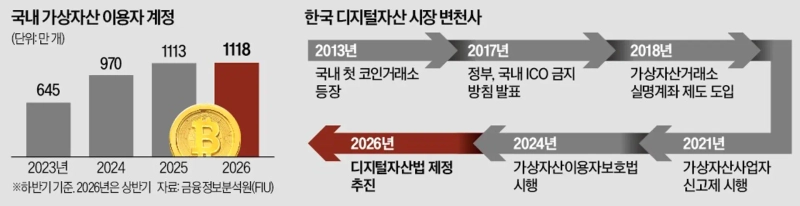
South Korea is preparing legislation to govern the full digital-asset industry, 13 years after the country’s first crypto exchange was established. The plan would lay the groundwork for a market long centered on retail coin trading to expand into a broader financial industry spanning issuance, distribution and asset management.
The Financial Services Commission on Nov. 24 discussed a legislative plan for the proposed Act on Innovation and User Protection in the Digital Asset Industry, or Digital Asset Act, at a virtual asset committee meeting chaired by Vice Chairman Kim So-young.
At the heart of the bill is a plan to divide the digital-asset business into four categories: dealing, brokerage, custody and management. It would also introduce a separate designation system for exchanges. The proposal would institutionalize specialized services that have yet to gain traction in South Korea, including over-the-counter trading for institutional investors, liquidity provision and discretionary investment management.
Domestic initial coin offerings would be allowed subject to disclosure requirements. Won-denominated stablecoins could initially be issued by consortia in which banks hold a majority stake. Fintech and technology companies could also participate as the largest individual shareholder.
Exchanges would be subject to governance and internal-control standards comparable to those for financial firms. More than half of board members would have to be outside directors, and exchanges would be required to establish audit committees. To prevent any one shareholder from exerting excessive influence, a shareholder and related parties would in principle be limited to a 20% stake in an exchange. Banks and other financial companies, however, could own as much as 34% with FSC approval. Authorities are also reviewing whether banks’ investments in digital-asset businesses should be exempted from the Banking Act’s 15% cap on investments in non-financial subsidiaries.
The bill is notable because it would expand the regulatory focus beyond anti-money-laundering and investor protection to include industry development and financial services more broadly. Kim said the government would institutionally support innovation and growth in the digital-asset industry to help create new value.
Market Structure Dominated by Exchanges Set for Overhaul as Groundwork Is Laid for Institutional Entry
Providers to Face Financial-Firm-Level Regulation, With Compensation Required for Hacking Losses Even Without Negligence
US crypto exchange Coinbase offers services ranging from block-trade execution to custody through Coinbase Prime, its platform for institutional investors. BlackRock, the world’s largest asset manager, has also expanded institutional digital-asset services through its partnership with Coinbase. In the UK, Wintermute specializes in liquidity provision, posting buy and sell quotes on global crypto exchanges to help keep trading smooth.
A range of companies and specialized services have grown in overseas digital-asset markets, but South Korea has lagged behind. The lack of a clear legal basis made it difficult for new firms to enter the market and prevented innovative business models from emerging. That is why exchanges catering to retail coin traders have long dominated the industry.
◇From Regulation-Centered Oversight to Industry Promotion
The Digital Asset Act proposal discussed by the FSC on Nov. 24 is aimed at changing that market structure. By institutionalizing dealing, brokerage, custody and management as separate digital-asset businesses, the government wants to open the door for crypto-focused investment banks and asset managers to emerge in South Korea.
The first step is to formalize specialized trading services for institutions. When an institution places a large coin order on an exchange, sending it all at once can trigger a sharp price surge. Under the proposal, specialist dealers and brokers would be able to find counterparties directly for block trades or compare prices across multiple venues to execute orders on better terms.
Professional market making would also be allowed. Under that model, a dealer would sign contracts with an exchange or token issuer and continuously post bid and ask quotes to support trading. Financial authorities, in turn, plan to regulate unfair practices such as front-running and require exchanges to disclose their liquidity-provision records.
◇Rules for New Entrants Also Set to Change
The bill would also create new opportunities in asset management. A new digital-asset management business category would allow customers to entrust investment decisions on their coin holdings to professionals or receive advice on investment strategies. Custody would cover the safekeeping of clients’ coins and the private keys needed for transactions. Staking services, in which customers deposit coins and receive rewards for helping validate blockchain transactions, would also fall under custody. Together, those businesses could make it possible to offer prime brokerage services that combine trade execution, asset custody and investment advice for institutional investors.
Market-entry rules would also change. Dealing, brokerage and custody businesses would need FSC authorization, while management firms would need to register. Dealing, brokerage and custody firms handling general digital assets would need at least 2 billion won ($1.4 million) in equity capital, while management firms would need at least 500 million won ($360,000). Existing exchanges such as Upbit and Bithumb would also need authorization for the three business lines and then a separate exchange designation.
◇Push for Swift Legislation
South Korea’s digital-asset market has grown rapidly since Korbit, now DigitalX, debuted in 2013 as the country’s first crypto exchange. But the regulatory framework has focused more on controlling risk than on fostering the industry. The government announced a ban on domestic initial coin offerings in 2017, introduced a real-name bank account system for exchanges the following year, rolled out a reporting regime for virtual asset service providers in 2021, and tightened rules again in 2024 with the Virtual Asset User Protection Act.
This bill differs in that it would set business scopes and entry requirements by provider while laying the foundation for new services to grow. Domestic ICOs, effectively blocked since 2017, would be allowed if issuers meet disclosure requirements. Token issuers would have to file a white paper with the FSC detailing the use of proceeds, issuance volume and business risks.
Providers would also face internal-control obligations on par with those imposed on financial companies. They would bear strict liability for user losses caused by hacking or system failures, even without negligence. The aim is to allow new financial services while strengthening provider accountability to build trust in the market. Corporate investment in digital assets would be pursued in line with the pace of Digital Asset Act legislation.
The Digital Asset Act could pass the National Assembly as early as the beginning of next year.
Cho Mi-hyun and Park Si-on, Korea Economic Daily reporters mwise@hankyung.com

Korea Economic Daily
hankyung@bloomingbit.ioThe Korea Economic Daily Global is a digital media where latest news on Korean companies, industries, and financial markets.