BOK Expands Deposit Token Use, Plans 2027 Pilot for Tokenized Government Bonds Under Project Hangang
Summary
- The Bank of Korea said it is expanding the use of deposit tokens through Project Hangang while testing blockchain programming functions such as conditional payments.
- The Bank of Korea said it plans to pursue a pilot demonstration for tokenized government bonds linked to wholesale central bank digital currency (CBDC) in 2027, aiming to secure stable settlement assets and legal settlement finality.
- Sung said details surrounding the Financial Services Commission's proposed stablecoin legislation, including reserve asset composition, won-denominated settlement methods and the broader payment and settlement structure, are expected to be clarified further.
Forecast Trend Report by Period


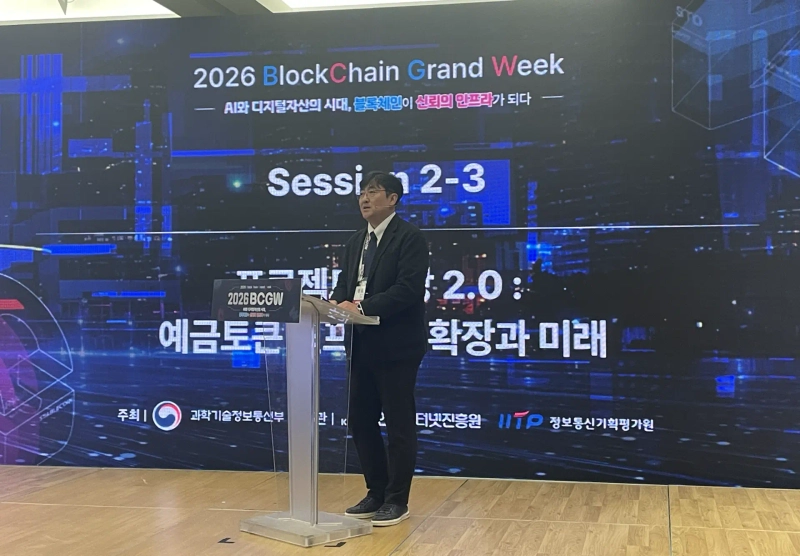
The Bank of Korea is expanding the use of deposit tokens through Project Hangang, its digital currency pilot. The central bank is also testing blockchain programming functions such as conditional payments and plans to launch a pilot demonstration of tokenized government bonds in 2027.
Sung Joon-yi, head of the Digital Currency Infrastructure Team in the Bank of Korea's Digital Currency Department, outlined the progress of the deposit-token pilot and the future direction of digital payment infrastructure on Nov. 25 at a session titled "Project Hangang 2.0: Expansion and Future of Deposit Token Infrastructure" during 2026 Blockchain Conference Week, or 2026 BCGW, at Coex in Seoul.
As part of the second phase of Project Hangang, the Bank of Korea is testing ways to apply deposit tokens to subsidies for installing electric-vehicle charging facilities and to business expense accounts. Under the model, subsidies would be paid automatically once the purchase and installation of eligible chargers are verified. Use of business expenses outside approved rules would be blocked at the payment stage.
Sung described deposit tokens as "digital cashier's checks." In interbank transfers, the sending bank burns the token and the receiving bank issues a new one, while obligations between banks are settled immediately with wholesale central bank digital currency.
Stablecoins work differently. The token itself moves between wallets without a separate burn-and-mint process, transferring a claim on the issuer. Users of deposit tokens hold a deposit claim on their own bank, while stablecoin holders retain a claim on the original issuer even when the transaction counterparty changes.
Sung also introduced the progress of Project Agora, an initiative to improve cross-border payments. The project applies distributed-ledger technology to the correspondent banking system to reduce remittance delays and high transaction fees. Its core structure links a single shared ledger with jurisdiction-specific ledgers operated by central banks to improve liquidity management and enable atomic settlement. Scenario-based live transaction tests were completed in August 2026.
The Bank of Korea also plans to pursue in 2027 a pilot demonstration for tokenized government bonds linked to wholesale CBDC. The aim is to secure stable settlement assets and legal settlement finality for large-value transactions between institutions.
Sung also commented on a digital-asset bill announced on Nov. 24 by the Financial Services Commission. He said the proposal requires reserve assets equal to more than 100% of outstanding stablecoins, but does not yet specify the composition of those assets. Details including the reserve asset mix, the structure for won-denominated settlement in merchant payments using stablecoins, and the entities responsible for redemptions and repurchases are expected to be fleshed out further.

Minseung Kang
minriver@bloomingbit.ioBlockchain journalist | Writer of Trade Now & Altcoin Now, must-read content for investors.