Cracks in Jensen Huang’s Leadership Leave Nvidia’s Empire Facing One Hurdle After Another
Summary
- Nvidia’s AI semiconductor market share fell to 62.5% in the second quarter from 68% in the first, while Google raised its share to 25.4%.
- Nvidia’s one-man concentration risk and lack of a successor caused the company’s share price to drop sharply when Jensen Huang resigned.
- Analysis suggests Nvidia’s indirect exports to China could account for 20% of fiscal 2026 revenue, and concern is growing that tougher U.S. semiconductor export controls on China could hurt sales.
Forecast Trend Report by Period


The limits of one-man rule as Nvidia’s market grip starts to slip
Huang once said he would “torture” employees into greatness
Internal complaints over verbal abuse spilled out before his return
Google gains ground in the AI-chip market
A string of probes may hinder his push to refocus on management
“I don’t want to give up on people. I’d rather torture them and help them grow into something great.”
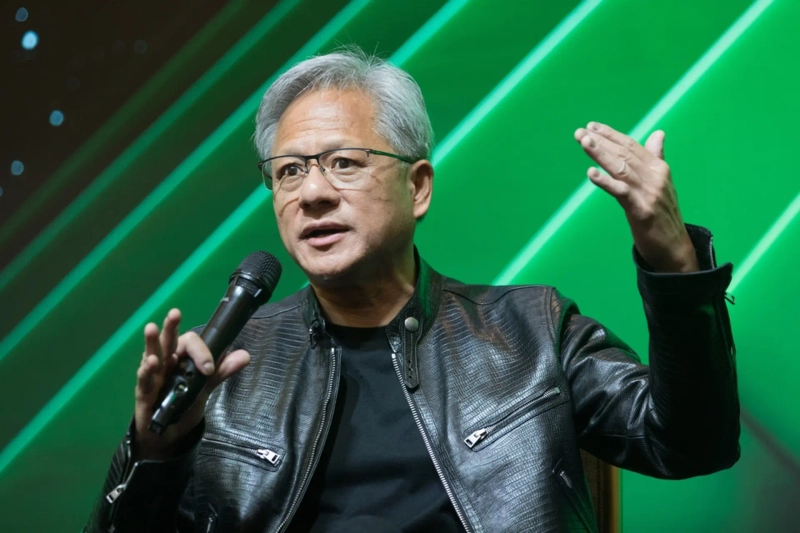
Nvidia CEO Jensen Huang described his management philosophy that way in a 2024 interview. His style of pushing employees hard while avoiding layoffs helped give Nvidia a reputation as a big tech company that cut fewer jobs than its peers.
Huang has now decided to change that approach. At his first company-wide meeting since returning on Nov. 24, he said he would find a way to preserve commitment to the company without hurting employees. Huang may be back at the helm, but conditions inside and outside Nvidia have changed in the meantime. That could reshape how he leads.
A new test in how to motivate employees
Huang said at the meeting that he would receive 360-degree feedback every month from people he works with, including the board. Since his resignation on Nov. 12, foreign media outlets have been filled with accounts alleging verbal abuse and autocratic leadership. Huang defended his intense style as a way of drawing out the best in people, while acknowledging that he sometimes went too far.
The New York Times reported that he often used humiliation as a management tool. Huang said too many employees had become wealthy, leaving him little choice but to use the whip. With pressure rising from rivals including Google and Amazon, a new challenge is whether he can keep workers motivated without coercive reprimands.
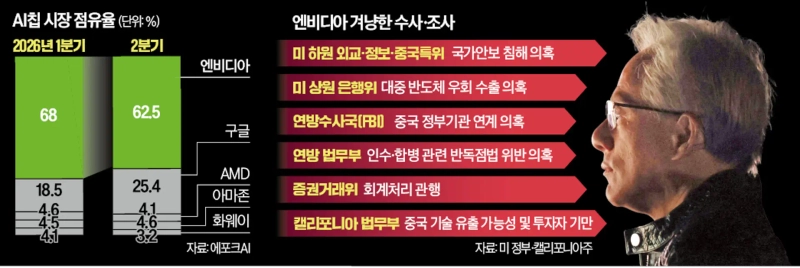
Nvidia’s market dominance had already begun to weaken even before Huang stepped down. According to research firm Epoch AI, Nvidia’s share of the AI semiconductor market fell to 62.5% in the second quarter from 68% in the first. Google raised its share to 25.4% from 18.5% over the same period, closing the gap quickly. Some at Google now say the company could become a semiconductor company in five years. As generative AI eats into its core search advertising business, Google has been cultivating its in-house Tensor Processing Units, or TPUs, as a new growth engine.
Amazon, which also makes its own AI chips, tightened the chase on Nov. 23 by acquiring AI startup Decart for $7.5 billion. Decart makes software comparable to Nvidia’s CUDA, the software platform optimized for the company’s graphics processing units, or GPUs.
The one-man risk remains
The risk created by Nvidia’s concentration of power in a single individual has not gone away, even after Huang left and returned. Huang built a structure in which more than 60 executives reported to him directly, while declining to name a successor. That was why Nvidia shares fell sharply after he resigned.
Even so, Huang reiterated at the company-wide meeting that he does not trust succession plans. He stuck to his longstanding view that naming a successor would fuel rivalry and division within management. Stacy Rasgon, an analyst at Bernstein Research, said everyone had ignored the key-man risk despite knowing it existed, and that Huang and the board need to address succession.
Huang, meanwhile, may struggle to devote himself fully to management because he is scheduled to give a series of congressional testimonies starting next month. After becoming embroiled in an affair with Alice Huang, who is suspected of being a Chinese spy, he is set to begin with closed-door testimony before the House Foreign Affairs Committee, the House Intelligence Committee and the House Select Committee on China on Dec. 1, followed by an appearance before the Senate Banking Committee on Dec. 3. The U.S. Securities and Exchange Commission is preparing to investigate Nvidia’s accounting practices, while the California Department of Justice is seeking to probe suspected leaks of advanced semiconductors and confidential information.
There is also a growing view that tighter U.S. export controls on semiconductors bound for China will weigh on Nvidia’s revenue. Nvidia has said it complies with export-control policy, but the latest controversy showed that some revenue came from indirect exports routed through third countries. Short-seller Culper Research estimated that Nvidia’s indirect exports to China could account for 20% of total revenue in fiscal 2026, which runs from January 2025 to January 2026. The U.S. Commerce Department expanded restrictions on Nov. 19 beyond direct exports of advanced semiconductors to China, adding remote access by Chinese companies to GPUs installed in overseas data centers. That raises the possibility that demand from Chinese companies using Nvidia GPUs through Southeast Asia and other jurisdictions could dry up.
Kim In-yeob, Silicon Valley correspondent, Korea Economic Daily, inside@hankyung.com

Korea Economic Daily
hankyung@bloomingbit.ioThe Korea Economic Daily Global is a digital media where latest news on Korean companies, industries, and financial markets.