PiCK
[Exclusive] South Korea Moves to Expand Market-Stabilization Fund as Kospi Slides Again
Summary
- The Kospi plunged 6.16%, falling below 4,700 as volatility intensified, with Samsung Electronics’ market capitalization dropping below 1,000 trillion won and SK Hynix sliding 11.05%.
- The government and Korea Development Bank sent letters to financial companies to gauge their capacity for additional contributions to expand the stock market stabilization fund.
- Views are divided over the fund’s effectiveness because the existing 10.76 trillion won stabilization fund amounts to less than 0.3% of the Kospi’s market capitalization, limiting its ability to respond to large-scale foreign selling.
Forecast Trend Report by Period


Samsung Electronics Market Cap Falls Below 1,000 Trillion Won
SK Hynix Drops 11%; Uncertainty Deepens
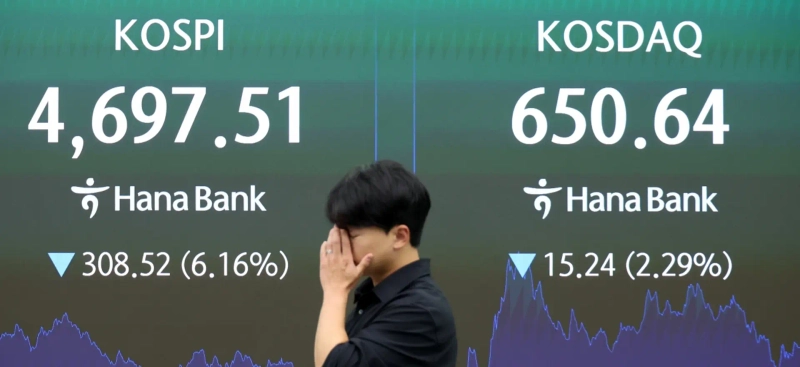
The Kospi rally sparked by Nvidia Chief Executive Officer Jensen Huang’s return ended after just one day. Samsung Electronics and SK Hynix, the South Korean market’s two biggest bellwethers, tumbled 10% and 11%, respectively, pushing the index back below 4,700. As concerns over the profitability of artificial intelligence-related companies weighed on the market, the government moved to expand its stock market stabilization fund.
The Kospi closed 6.16% lower at 4,697.51 on Nov. 25, wiping out all of the previous day’s gains after reclaiming the 5,000 level. Samsung Electronics fell 9.87% to 170,700 won. Its market capitalization dropped to 997.9598 trillion won, slipping below 1,000 trillion won for the first time in eight months. SK Hynix also slid 11.05% to 1.03 million won, after coming close to falling below 1 million won during the session.
Overnight on Wall Street, Nvidia fell 5.86%, while Advanced Micro Devices dropped 8.86% and Micron Technology lost 11.01%.
The government has begun preliminary steps to expand funding for the market stabilization fund. Korea Development Bank recently sent official letters to major securities firms, banks and insurers to gauge how much they could contribute. The letters asked how much additional capital each company could provide on top of the amounts pledged in 2020. The move comes amid criticism that the fund set up six years ago, at 10.7 trillion won, amounts to less than 0.3% of the main board’s market capitalization and would have little effect in stabilizing the market.
Government Sends Securities Firms Letters Seeking Stabilization Fund Contributions
Officials See 10.7 Trillion Won as Too Small to Defend Market
The market stabilization fund is a mechanism to support stocks during sharp selloffs by using money jointly raised by financial companies and securities-related institutions to buy shares. During the coronavirus outbreak in 2020, institutions pledged a total of 10.76 trillion won to the fund. At the time, Korea Development Bank committed 2 trillion won, the five largest financial groups pledged 4.7 trillion won, and the financial investment industry committed 1.5 trillion won.
But as South Korea’s stock market has expanded sharply over the past six years, calls have grown to increase the size of the fund. The existing pledged amount is now less than 0.3% of the Kospi’s market capitalization. It is also roughly equal to foreign investors’ net selling on the main board during the week of Nov. 2 through Nov. 6, which totaled 10.4 trillion won. That has raised concerns that the current pool would be inadequate to counter large-scale foreign selling.
An expansion of the fund is seen positively because it would signal the government’s strong resolve to stabilize the market. In a steep selloff where buyers have disappeared, the existence of a large pool of standby funds alone could help calm investor fears. Experts are divided, however, over how effective it would be. In a report on Nov. 23, Lee Hyo-seop, a senior research fellow at the Korea Capital Market Institute, wrote that although South Korea has moved five times since 1990 to create or reactivate such funds, their effect in lifting stock prices has not been clearly confirmed empirically.
Lee Sun-a and Oh Yu-rim, Korea Economic Daily reporters suna@hankyung.com

Korea Economic Daily
hankyung@bloomingbit.ioThe Korea Economic Daily Global is a digital media where latest news on Korean companies, industries, and financial markets.