Samsung, SK Hynix Sink as Battle Over Memory-Cycle Peak Intensifies
Summary
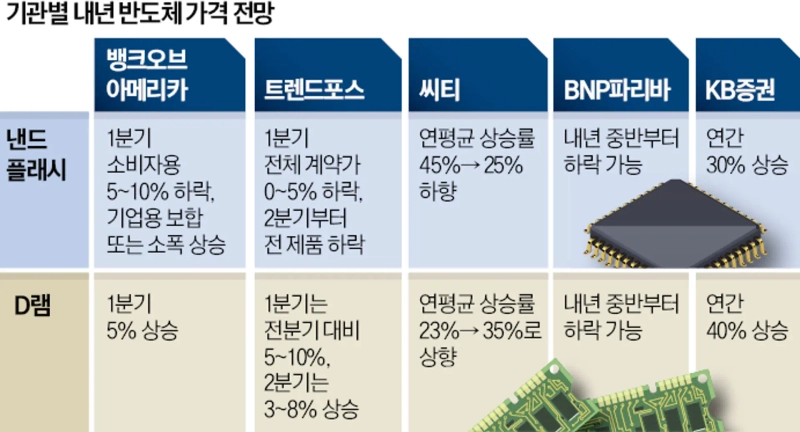
- BNP Paribas said it cut its target price on Micron by 54.4% and brought forward its forecast for DRAM and NAND supply-demand balance to the middle of next year.
- TrendForce said spot and contract prices for NAND are weakening and forecast that all NAND segments, including eSSD, will enter a price-decline cycle in the second quarter of next year.
- Analyst Lee Min-hee said weakness in NAND signals a coming downturn in DRAM, while TrendForce expects commodity DRAM contract prices to rise next year because of the impact of HBM.
Forecast Trend Report by Period


Samsung Electronics, SK Hynix Sink
BNP Sees Memory Downturn by Mid-2027
Some Say NAND Weakness Leads DRAM Cycle
Dell Says AI Server Backlog at Record High
Supply Still Tight, Prices to Keep Rising
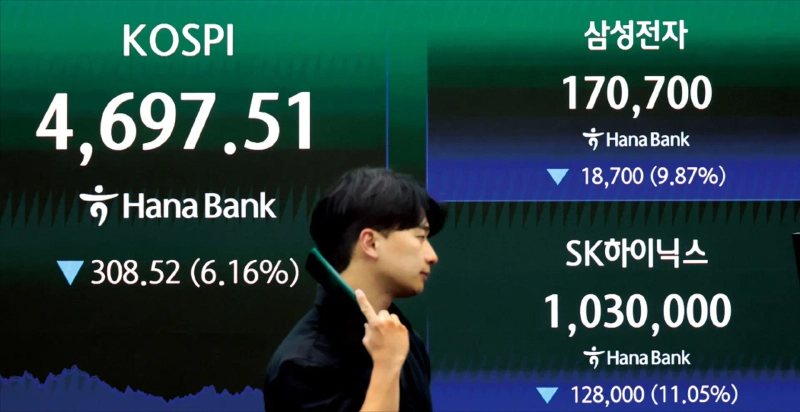
A debate is intensifying across global brokerages over whether the memory-chip supercycle will begin to fade next year. After Goldman Sachs and Citi cut their target prices for Samsung Electronics and SK Hynix, BNP Paribas slashed its price target on Micron Technology by more than half. The bank also made a bold call that supply and demand in NAND flash and DRAM will move close to balance by the middle of next year. Even so, many in the industry say there is still no clear evidence that weakness in spot NAND prices will lead to contract-price cuts next year or spread beyond smartphone and PC NAND to enterprise NAND and DRAM used in artificial intelligence data centers.
BNP Pulls Supply-Demand Rebalancing Forward by a Year
Jeff Clarke, vice chairman and chief operating officer at Dell Technologies, told a fiscal 2027 third-quarter conference call on Nov. 24 that he sees no signs prices for enterprise NAND and server DRAM are set to fall.
“Looking at the supply situation and the outlook, there is no indication that pricing for enterprise NAND and server DRAM will decline,” Clarke said. “Price gains next year may not match this year’s pace, but we still expect prices to rise.”
The remarks directly pushed back against a growing view that memory-chip prices are headed lower. BNP Paribas on the same day cut its target price on Micron to $775 from $1,700, a 54.4% reduction, and downgraded the stock to neutral from outperform. The bank said DRAM and NAND would move close to supply-demand balance in mid-2027 rather than its previous forecast of mid-2028, bringing the timeline forward by a year. It cited possible permitting delays at large data centers due to begin operations in 2028, lower high-bandwidth memory content in AI servers and expanding production capacity at chipmakers. Micron shares plunged about 11% that day.
A sharp drop in spot NAND prices has added to the concern. Spot NAND prices have fallen about 20% since the middle to late part of October. PC and smartphone makers, struggling to absorb the surge in memory prices, have cut storage capacity per device or scaled back component purchases.
Expectations are also spreading that gains in contract prices will slow. TrendForce cut its forecast for fourth-quarter NAND contract-price increases to 8% to 13% from 15% to 20%. It expects prices to be flat or fall as much as 5% in the first quarter of next year.
Is NAND Weakness a Preview of DRAM?
A key question is whether weakness in consumer NAND will spread to enterprise solid-state drives, or eSSDs. Memory makers have so far offset weak PC and smartphone NAND demand by selling more high-capacity, higher-margin SSDs used in AI data centers. TrendForce, however, expects all NAND categories, including eSSDs, to enter a price-decline cycle starting in the second quarter of next year. US cloud service providers are increasing eSSD orders for next year to build AI agents and general-purpose servers, but the firm said falling orders from Chinese customers will more than offset that increase. JPMorgan, by contrast, estimated memory supply fulfillment at 60% to 70% based on recent meetings with Samsung Electronics, SK Hynix and Kioxia.
Views also diverge on whether weaker NAND prices are a warning sign for commodity DRAM. Lee Min-hee, an analyst at BNK Investment & Securities who recently set a target price of 1.05 million won for SK Hynix, said NAND has historically led DRAM.
“Based on experience, NAND market conditions move ahead of DRAM,” Lee said. “NAND is turning weak first, and DRAM will eventually enter a downturn as well.”
There is also a strong counterargument. This cycle differs from past ones because high-bandwidth memory, or HBM, has become a constraint on supply for commodity DRAM. HBM requires more wafer capacity than conventional DRAM with the same storage density. For that reason, TrendForce expects commodity DRAM contract prices to keep rising next year even as NAND prices decline.
Lee Sun-a, Korea Economic Daily reporter, suna@hankyung.com

Korea Economic Daily
hankyung@bloomingbit.ioThe Korea Economic Daily Global is a digital media where latest news on Korean companies, industries, and financial markets.