PiCK
BOK’s Shin Says Chip Stocks Look Undervalued, With Market Cap Only 3 Times Annual Profit
Summary
- Governor Shin Hyun-song said semiconductor companies’ profit of about $500 billion and market capitalization of about $1.43 trillion were “only three times” apart, indicating stock prices are low relative to earnings.
- Shin said semiconductor prices matter more than chip stock prices when assessing the industry, and that a sharp correction in prices could increase uncertainty over share prices.
- Shin said semiconductor operating profit of about $500 billion would spread through investment and dividends to support next year’s growth and consumption, and that the benchmark-rate increase was aimed at responding to inflation.
Forecast Trend Report by Period


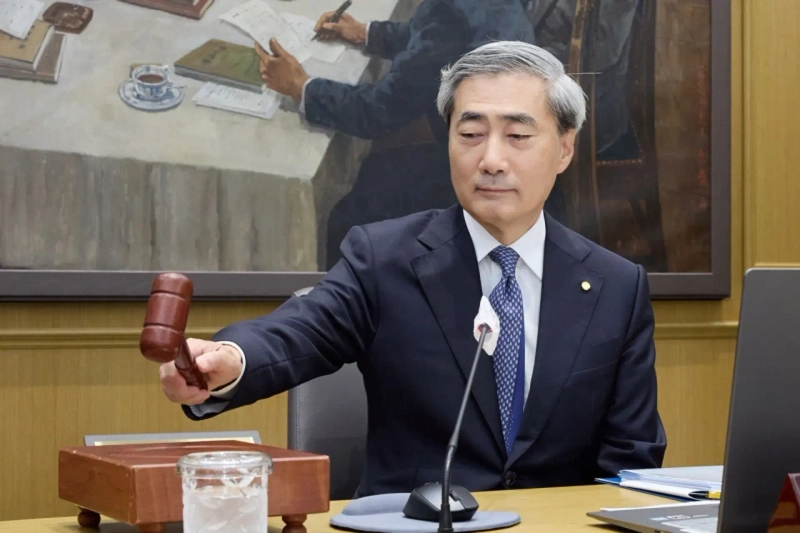
Bank of Korea Governor Shin Hyun-song said semiconductor companies’ earnings and share prices appear out of sync. He said the stock-market slump is weighing on private consumption, but chip-sector profits should flow through investment and dividends to support growth and spending next year.
Speaking at a news conference after the Monetary Policy Board’s rate decision on Nov. 26, Shin compared semiconductor companies’ estimated profit of about $500 billion this year with their market capitalization of about $1.43 trillion. “It is hard to explain that it is only three times,” he said, arguing that stock prices are low relative to earnings. Equity markets, he added, are heavily driven by investor sentiment.
Shin said product prices matter more than share prices when judging the semiconductor cycle. “Rather than semiconductor stock prices, you need to look at semiconductor prices,” he said. If those prices undergo a sharp correction, uncertainty over chip shares could also rise. He added that the growth trend remains solid and that there is still room for the stock market to broaden that momentum.
He also addressed the effect of weak equity markets on the real economy. The stock-market downturn has been a factor weakening private consumption in the second half of this year, he said. The BOK, South Korea’s central bank, cut its forecast for private-consumption growth this year to 1.8% from 2.1%, but projects a 2.4% increase next year.
As the basis for a recovery in consumption next year, Shin pointed to the broader spillover from semiconductor profits. He said nominal gross domestic product will easily exceed $2.14 trillion this year, and estimated semiconductor companies’ operating profit at about $500 billion, or roughly one-fifth of national income. “That $500 billion in operating profit does not disappear into a black hole. It flows into corporate taxes and performance bonuses,” he said. It takes time for accumulated funds to return to the broader economy through investment and dividends, he added.
The BOK on Nov. 26 raised its forecast for economic growth this year to 3.9% from 3.3%, and next year’s outlook to 4.1% from 2.9%. Shin said the central bank is also reviewing an upward revision to its estimate of potential growth and plans to announce it next month. Potential growth refers to the pace at which the economy can expand without fueling inflation.
Still, he said the central bank will continue responding to inflation separately from the growth outlook. The Monetary Policy Board raised the benchmark interest rate by a quarter point to 3.25% from 3.00% on Nov. 26. Shin said inflation is projected to converge with the target only in 2028, and described the latest increase as both a preemptive response and a response to inflation pressures that have already emerged.
“We need to keep responding until we are confident inflation is converging stably to the target,” Shin said. He said the timing of any further increase will be decided after reviewing the paths of growth and inflation. On support for vulnerable borrowers, he said a fiscal-backed financial policy would be the appropriate response.

YM Lee
20min@bloomingbit.ioCrypto Chatterbox_ tlg@Bloomingbit_YMLEE