Busan Port, Linked by Blockchain, to Become a Vast Test Bed for Physical AI
Summary
- The Busan Port Authority said its blockchain-based Transshipment Transportation System (TSS) connected 10 terminals and helped boost transshipment cargo volume.
- The Busan Port Authority said it is pursuing a 45 billion won ($32.6 million) project to demonstrate AMR-based physical AI and related components and integrated-control technology by 2029.
- The Busan Port Authority said it plans to verify weight information through blockchain, issue digital VGM documentation, and build a cargo truck weight information platform linking port and inland logistics by 2030.
Forecast Trend Report by Period


Replacing Driverless Transporters That Follow Fixed Routes
Robots That Find Their Own Way to Be Demonstrated by 2029
Korea’s Robotics Technology Companies Join Forces
Beyond the Port, Into Inland Logistics
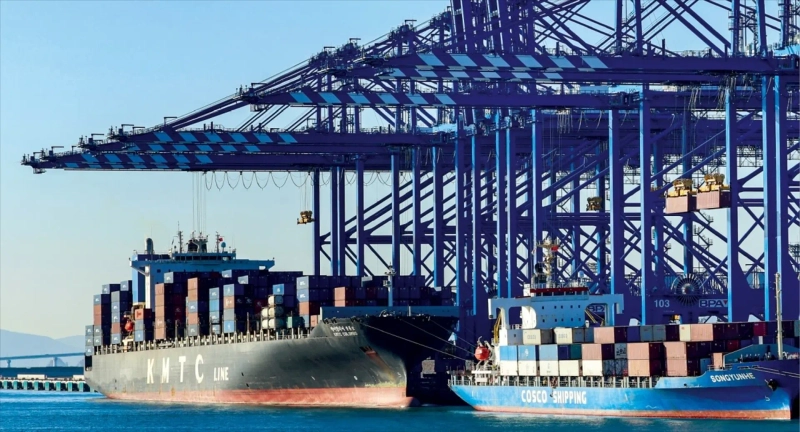
A physical AI experiment spanning ship berthing and inland logistics is set to unfold at Busan Port. The port is also becoming the hub of an ecosystem to develop autonomous mobile robots, or AMRs, expanding the operating range now covered by automated guided vehicles, or AGVs, that travel along sensors embedded in the ground.
Blockchain has laid the groundwork for that push into physical AI. A wide range of port stakeholders — from shipping lines, cargo owners and terminal operators to transport companies and truck drivers — have built trust in sharing information because blockchain technology prevents access beyond each party’s own data. Port data accumulated through blockchain is now evolving into physical AI.
Linking 10 Terminals With Blockchain
The Busan Port Authority developed a transshipment transportation system, or TSS, that uses blockchain’s information-sharing features to connect order information between terminal operators and transport companies in real time. The system is linked to truck drivers’ smartphone app, Allcon-e, and sends information on multiple vehicles and cargoes at once. It also automatically matches containers with truck drivers. When a truck enters a terminal, the system assigns the optimal container and dispatch order.
As of August, TSS usage had reached 47,137 cases, nearly four times the 12,365 recorded a year earlier. The system has also been credited with overcoming a structural limitation at Busan Port, where 10 terminals are run by 10 different operators. According to the Busan Port Authority, transshipment cargo accounted for 41.1% of the port’s total cargo volume in January through October, up 2.5 percentage points from a year earlier. Transshipment volume rose about 10% from a year earlier, far outpacing the 3.50% growth in overall cargo volume, which includes imports and exports.
AMR-Based Physical AI Brings Together Korea’s Technology Ecosystem
The Busan Port Authority has moved to expand into physical AI, which connects AI decision-making to the movement of real machines. The Korea Automotive Technology Institute and the city of Busan began work in July on a 45 billion won ($32.6 million) project to develop an autonomous-driving smart-port mobility platform. The program aims to develop AMR driving, electrification and integrated control systems and demonstrate them at Busan Port by 2029.
AGVs are currently operating at Pier 7 of Busan New Port. They move along fixed routes guided by sensor-based devices installed on the road surface. That makes it difficult to avoid obstacles, and equipment has to be reinstalled when terminals change. AMRs are designed to recognize the movements of containers, workers and vehicles and recalculate routes. The goal is to create common technology that can be applied across multiple terminals. The technology is drawing attention as a way to replace AGVs, which carry heavy maintenance costs.
An ecosystem for AMR development is also taking shape. SmartM2M, which is in charge of autonomous-driving technology, will link ChainPortal with vehicle and sensor data. A key technology is collaborative perception AI, which uses sensors on surrounding facilities to detect blind spots such as the area behind containers. The company will also develop a port environment map that reflects work zones and road conditions in real time.
Wearbe, a company spun out of a Hyundai Motor in-house venture, will handle end-to-end autonomous-driving AI that connects situational awareness with route planning. Aceworks Korea will develop integrated control technology that turns AI decisions into actual steering, braking and driving commands. The project also includes safety controls to respond to emergency stops and communication failures.
MTR will lead vehicle-body development. Hyosung Electric will develop a low-speed, high-torque motor with maximum output of 150 kilowatts and a silicon carbide inverter. Sungwoo Hitech will develop a 260-kilowatt-hour battery pack and a redundant battery management system. Chaevi and the Korea Automotive Technology Institute will take charge of megawatt-class charging equipment and automatic charging technology using a robotic arm. All of those remain development targets that will need to go through future testing.
The physical AI ecosystem will also cover integrated control. OnMakers will build a data hub that collects AMR operating information and a digital-twin support system. CyberLogitec will develop technology to connect work orders from the terminal operating system, or TOS, to AMRs. The aim is shared learning, allowing driving and hazard data from one pier to be used to improve AI at another. Demonstration will begin in Phase 2-5 of the new port and later expand to Phase 2-6 and other areas.
Connecting Inland and Maritime Logistics With AI
The effort to connect information and equipment inside the port will extend to inland logistics. The Busan Port Authority plans to push ahead through 2030 with a cargo truck weight information platform and an inland-port linkage demonstration project backed by the Ministry of Land, Infrastructure and Transport and the Ministry of Oceans and Fisheries. The Korea Expressway Corp. is leading the 36.2 billion won ($26.2 million) project, which involves 17 institutions.
Cargo weight information affects both port productivity and vessel safety. Verified gross mass, or VGM, for containers to be loaded onto ships must be reported under the Safety of Life at Sea convention, or SOLAS. But when that information arrives just before loading, ports have to move containers that have already been stacked in the yard. Knowing in advance where heavy cargo is located allows operators to determine loading order more efficiently.
The project will develop high-precision automated and unmanned weighing equipment as well as smart onboard vehicle scales. It will verify weight at public weighing stations on roads and track changes in cargo loads on vehicles. The structure is designed to verify and distribute weight information through blockchain. The work will be divided into five detailed tasks: measurement equipment development, vehicle weight detection, a data platform, legal and institutional improvements, and port-linked demonstration.
In the port-linkage segment, which includes the Busan Port Authority and SmartM2M, weighing information will be connected to Allcon-e and ChainPortal. Verified weight information will be issued as digital VGM documentation and provided to transport companies, cargo owners, shipping lines and terminals. The plan is to reduce repeated weighing to a single process and build a system in which all parties share the same data instead of relying on paper certificates.
Ports will be able to verify weight before containers arrive and adjust yard placement and loading order in advance. That will help reduce rehandling, where containers have to be taken out and moved again, and improve vessel loading safety. On land, the weight data can be used to identify overloaded vehicles and manage the risk of damage to roads and bridges. AI-based analysis of overloading risk and support for road maintenance are also part of the development target.
“Busan Port is a massive test bed for physical AI,” Busan Port Authority President Song Sang-keun said. “We will expand the data accumulated through blockchain into a logistics system that connects the port with inland transport.”
Busan = Min Geon-tae, Korea Economic Daily reporter, minkt@hankyung.com

Korea Economic Daily
hankyung@bloomingbit.ioThe Korea Economic Daily Global is a digital media where latest news on Korean companies, industries, and financial markets.