PiCK
Hotter US Inflation, Growth Raise Fed Tightening Fears as Bitcoin Tests $58,000 Support: Kang Min-seung’s Trade Now
Summary
- Strong U.S. inflation and growth indicators have heightened concerns over additional Fed tightening, keeping pressure on risk assets.
- Large outflows from U.S.-listed spot Bitcoin ETFs and weak spot demand are keeping Bitcoin downside risks firmly in place.
- Analysts said whether Bitcoin can hold $58,000 is the key variable, and a break below could open the way for further declines toward $49,000.
Forecast Trend Report by Period



Stronger-than-expected U.S. inflation and growth data are fueling concerns that the Federal Reserve could tighten policy further. Bitcoin has rebounded above $60,000, but downside pressure remains as spot Bitcoin ETFs continue to see outflows and U.S. spot demand stays weak. Analysts say support around $58,000 could determine whether losses deepen, while any rebound would first require a recovery of $62,400.
As of 5:33 p.m. on Nov. 26, Bitcoin was trading at $60,601 on Binance's USDT market, up about 2.08% from a day earlier. On Upbit, it was trading at about $58,900. The kimchi premium, which measures the price gap between South Korean and overseas exchanges, stood at about 0.98%.
Inflation, Growth Both Run Hot as Fed Tightening Fears Re-Emerge
U.S. inflation and growth data both came in strong, reviving concerns about additional Fed tightening. Worries over overheated AI investment, tariffs and Middle East geopolitical uncertainty are adding to the pressure on risk assets.
The U.S. personal consumption expenditures price index for October, released on Nov. 25, rose 3.8% from a year earlier, accelerating from the previous month. Core PCE, which excludes food and energy, climbed 3.3%, above the market forecast of 3.2% and the highest since November 2023. Revised third-quarter gross domestic product growth, released the same day, was raised to an annualized 4.3% from 3.4%. With inflation still sticky and growth stronger than expected, the prospect of further Fed tightening has moved back into focus.

The rebound sparked by Nvidia Chief Executive Officer Jensen Huang's return is already losing steam in equities. Nvidia and the Nasdaq jumped after Huang returned 11 days after stepping down, but technology shares weakened again as concerns resurfaced over excessive AI investment, profitability and corporate governance. Selling in Nvidia and semiconductor shares has continued, amplifying volatility across the tech sector.
Tariff risks and geopolitical uncertainty in the Middle East are also weighing on risk assets. The Office of the United States Trade Representative has signaled the possibility of additional tariffs targeting South Korea, China, Japan and the European Union. In the Middle East, concerns persist over disruptions to oil shipments through the Strait of Hormuz. If tariffs and higher oil prices add to inflation pressure, investors fear the Fed's restrictive stance could last longer.
Markets are increasingly pricing in another Fed move. CME FedWatch showed the probability of a rate increase in December at 97.2% on Nov. 26, with the odds of a pause at just 2.8%. Gold, a traditional haven asset, has also weakened as concerns over another rate increase mount. Investor focus is shifting beyond a December hike to the possibility of additional increases next year.
ETF Outflows, Weak U.S. Buying Keep Bitcoin Downside Risks Alive
U.S.-listed spot Bitcoin ETFs posted net outflows of $1.7899 billion last week, from Nov. 16 to Nov. 20. Another roughly $1.2541 billion has left over the first three days of this week, a sign institutional money is still pulling back.
Even with stocks rebounding, Bitcoin has struggled to hold its gains, underscoring weak recovery momentum. Bitfinex said equities surged after Nvidia CEO Jensen Huang returned, but Bitcoin gave back most of its gains the same day. The exchange added that the rebound is being driven mainly by futures trading as ETF and spot demand remain weak. Bargain buying using leverage is picking up again, but further price declines could trigger long-position liquidations and intensify selling pressure. Downside bets have also risen sharply in the options market, underscoring investors' caution.
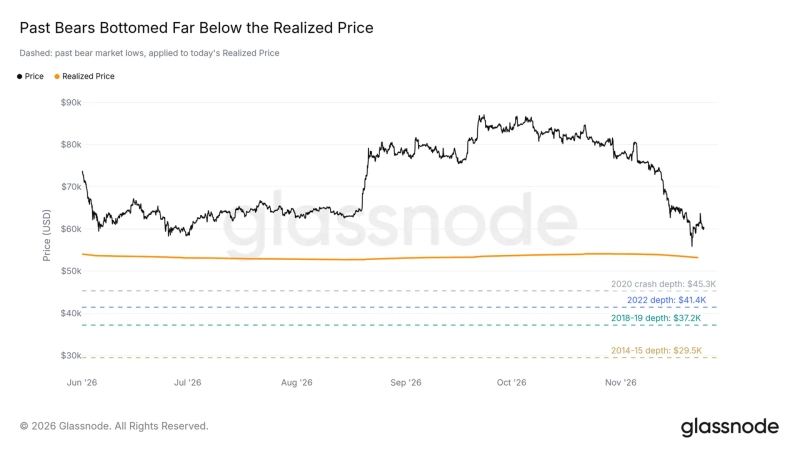
With U.S. buying yet to recover, Bitcoin still faces the risk of further declines, on-chain analytics firm Glassnode said. The firm said investors' realized losses have widened to their largest since the 2022 FTX collapse, while spot demand centered on the U.S. market remains weak. It added that if Bitcoin gives up the $60,000 level again and closes below its June low of $58,500, the downtrend could deepen. In past bear markets, Bitcoin has fallen below its realized price, and the current realized price of about $53,200 could emerge as the next major floor, Glassnode said.
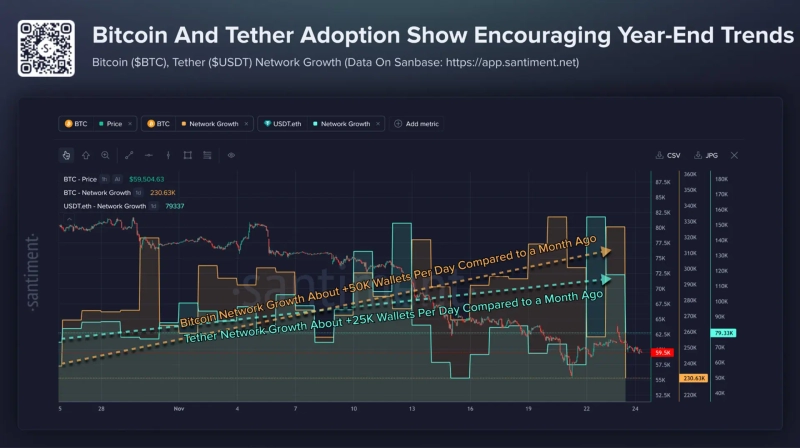
Despite weaker prices, new wallet addresses for Bitcoin and Tether are increasing. According to on-chain analytics firm Santiment, Bitcoin's daily new addresses have risen to about 230,000, up by about 50,000 from a month earlier. Daily new addresses for USDT issued on the Ethereum network climbed to about 79,000, up about 25,000 over the same period. Santiment said expanding network activity despite falling prices is a positive sign and could support a broader market recovery if the trend continues.
Over the next month, MSCI index changes and key economic data could drive further volatility. Bitfire Research said MSCI will remove Strategy (MSTR) from its U.S. and global indexes after the market close on Nov. 30, prompting passive fund rebalancing. The process could affect not only Strategy's share price but also sentiment toward Bitcoin, it said. In December, the U.S. jobs report, the Federal Open Market Committee meeting and the consumer price index will all be released in quick succession. If inflation data and Fed expectations turn more hawkish, the liquidity strain on risk assets could persist.
Bitcoin Faces $58,000 Test; Break Below Could Open Door to $49,000
Analysts view Bitcoin's ability to hold the $58,000 level as the key near-term variable. If support holds, it could lay the groundwork for a medium- to long-term rebound. If that floor breaks, however, additional losses toward $49,000 could come into play.
For Bitcoin to rebound, it first needs to reclaim $62,400. Julien Pineda, a market analyst at Forex.com, said $58,100 is the key short-term support level and that a break below it would raise the risk of further declines. On a rebound, Bitcoin would first need to recover $62,400 and then climb to $66,600 before downward pressure begins to ease, he added.
A more bearish scenario also remains on the table. Muhammad Umair, chief analyst at FXEmpire, said $49,000 could become the next major support if Bitcoin falls below $58,000. A break below $49,000 would make further declines hard to rule out, he added.
Longer term, some analysts still see room for a rebound. Katie Stockton, founder of Fairlead Strategies, said Bitcoin remains in a short-term downtrend and there are no clear signs yet that the correction is over. Long-term technical indicators, however, are still showing a somewhat positive trend. If Bitcoin secures support in the $58,000 to $60,000 range, it could form a base for a medium- to long-term recovery, she said.
Kang Min-seung, Bloomingbit reporter minriver@bloomingbit.io

Minseung Kang
minriver@bloomingbit.ioBlockchain journalist | Writer of Trade Now & Altcoin Now, must-read content for investors.