PiCK
[Exclusive] Korea-Style Sovereign Fund May Be Allowed to Become Top Shareholder in Crypto Exchanges
Summary
- Under the proposed Digital Asset Act, public asset-management institutions would be allowed to hold more than 20% of virtual-asset exchanges, opening the way for a Korea-style strategic sovereign fund to participate as a major shareholder.
- Controlling shareholders of South Korea’s five major won-based exchanges would have to cut their stakes to 20%, and with company valuations ranging from hundreds of millions of dollars to several billion dollars, securing long-term investors capable of taking large stake sales would be a key task.
- Public asset-management institutions such as sovereign funds could hold as much as 34% of exchange shares, allowing returns from dividends and equity-value gains to flow back to the public sector, but the plan is also raising concerns over infringement of private property rights and the transfer of loss risk to the public.
Forecast Trend Report by Period


Digital Asset Act Carves Out Exception to Ownership Cap
Debate Looms Over Use of Public Funds
A proposed “Korea-style strategic sovereign fund” to be created within Korea Investment Corp., or KIC, may be allowed to hold more than 20% of a virtual-asset exchange.
The opening comes because a Digital Asset Act bill being pushed by the government and ruling party includes an exception to ownership limits for public asset-management institutions.
Under Article 75 of the proposed Digital Asset Act, institutions designated by presidential decree that manage or invest assets funded or entrusted by the government and other public bodies would be allowed to own more than 20% of an exchange, according to the National Assembly and financial authorities on Nov. 26.
A leading candidate is the Korea-style strategic sovereign fund that the government plans to establish within KIC. KIC manages assets entrusted by the government and the Bank of Korea. While the institution principally invests overseas, the government is also pursuing a separate strategic investment account that would allow direct investment in companies in domestic strategic industries.
The exception is widely seen as reflecting the practical burden of dispersing exchange ownership. Existing controlling shareholders would need investors with deep pockets to absorb large blocks of shares if they are to reduce their holdings to 20% or less. That leaves room for sovereign funds and other institutions with a long-term investment horizon.
The institutions eligible for the exception will be specified by enforcement decree. The strategic sovereign fund’s detailed investment scope and targets are also set to depend on its operating plan. The prospect of using public money to acquire stakes in private exchanges is also poised to spark debate.
Five Major Korean Crypto Exchanges Face Ownership Reshuffles as K-Sovereign Fund Scenario Gains Traction
Plan to Cap Controlling Shareholders at 20% Puts Focus on Buyers for Large Stake Sales
A plan to cap controlling shareholders of virtual-asset exchanges at 20% is sharpening attention on who would buy the large blocks of shares likely to come to market. Ownership at most of South Korea’s five largest won-based exchanges is concentrated in a small number of shareholders, meaning buyers would need substantial financial firepower. The government and ruling party’s decision to carve out an exception for public asset-management institutions is seen as reflecting that burden.
Controlling Shareholders Must Cut Stakes
If the Digital Asset Act takes effect, all five major domestic won-based exchanges would be forced to overhaul their governance structures, financial-industry officials said on Nov. 26. The bill would bar any single shareholder from owning more than 20% of voting shares in an exchange in order to secure public accountability and neutrality. Holdings of related parties would be counted together.
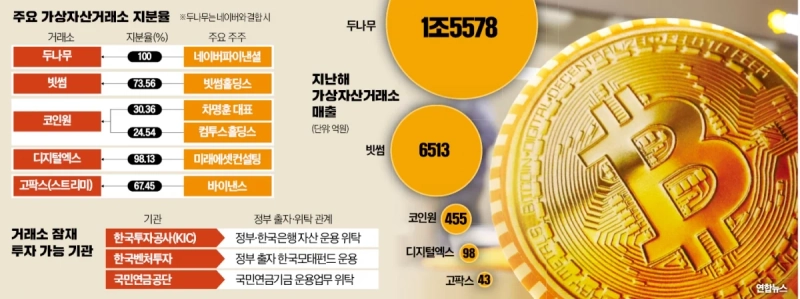
Dunamu, the operator of Upbit, would become a wholly owned subsidiary of Naver Financial once their comprehensive share swap is completed. At Bithumb, the largest shareholder, Bithumb Holdings, owns 73.56%. At DigitalX, Mirae Asset Consulting holds 98%. At Coinone, the group led by Chief Executive Officer Cha Myung-hoon owns more than 30%. Streami, the operator of Gopax, is 67.45% owned by Binance.
Given that exchange valuations range from hundreds of millions of dollars to several billion dollars, the volume of shares for sale is likely to be substantial. The Digital Asset Act gives existing shareholders a three-year grace period and allows an extension of as much as three more years if certain conditions are met. Even so, finding investors willing to buy those stakes at appropriate prices during that period remains a key challenge.
Hopes for a Long-Term Investor Role
That reality also helps explain why the government and ruling party recognized an exception to the ownership cap for public asset-management institutions. The measure creates a path for institutions with long-term investment capacity to participate as key shareholders as exchange ownership is dispersed. Public asset-management institutions designated by presidential decree would be allowed to hold as much as 34%.
The Korea-style strategic sovereign fund most often mentioned in this context is being pursued through a separate strategic investment account within KIC. While KIC has traditionally focused on overseas assets, the strategic sovereign fund would be designed to make direct investments in domestic strategic industries using government capital. That is why it is emerging as a potential long-term investor in the process of dispersing exchange ownership. The government has also specified key industries such as finance and infrastructure as investment targets for the sovereign fund. Domestic virtual-asset exchanges, with more than 10 million users, have grown into major digital financial infrastructure and could therefore be discussed as potential investment targets.
Some politicians also argue that the public should share in the large fee income generated by virtual-asset exchanges. The five largest domestic exchanges posted combined revenue of about $1.64 billion last year. Most of that came from fees on retail trading. If sovereign funds and other public investment institutions hold exchange stakes, returns from dividends and gains in equity value could be funneled back into the public sector. “Virtual-asset exchanges generate enormous fee income, so those profits should also benefit the public,” a senior ruling-party official said.
Will Criticism of State Intervention Grow?
Critics say it would infringe on private property rights to effectively force controlling shareholders of exchanges to sell down their stakes while allowing public institutions to hold large positions. The concern is that the law would reorganize the ownership of exchanges built by private capital while also opening the way for greater influence by public funds.
There is also concern that if a sovereign fund buys the shares being sold, public money would end up supporting the recovery of existing shareholders’ investments. That has raised worries that future losses could ultimately be borne by the public. “It makes little sense to effectively force the sale of exchange stakes built up through private investment while allowing public institutions to hold large positions,” an industry official said.
Cho Mi-hyun/Park Si-on/Lee Si-eun/Kim Ik-hwan, Hankyung.com reporters mwise@hankyung.com

Korea Economic Daily
hankyung@bloomingbit.ioThe Korea Economic Daily Global is a digital media where latest news on Korean companies, industries, and financial markets.