

[Exclusive] Coinone, DigitalX on Alert as Capital Rules Join Ownership Curbs in Exchange Licensing
Summary
- The proposed Digital Asset Act would tighten minimum equity capital requirements for cryptocurrency exchanges, increasing pressure on small and mid-sized platforms.
- If the 100 billion won ($72 million) minimum equity capital standard used for regular securities exchanges is applied, three of South Korea’s five major won-based exchanges, excluding Upbit and Bithumb, would face greater pressure to raise capital.
- Coinone, DigitalX and Gopax are still grappling with losses and weak equity capital, leaving large capital increases and capital maintenance as key challenges for meeting licensing requirements.
Crypto Exchanges Face 100 Billion Won ($72 million) Minimum Equity Bar
Some May Need Large Capital Raises

South Korea’s small and mid-sized cryptocurrency exchanges are under pressure as proposed rules would impose capital requirements on top of limits on equity ownership. Some exchanges may have little choice but to pursue large capital increases to meet a minimum equity threshold. There are also concerns that exchanges posting persistent losses could struggle to maintain licensing requirements even after raising capital.
According to the National Assembly and financial authorities on Nov. 26, a proposed Digital Asset Act would classify cryptocurrency exchanges as “digital asset platform operators” and establish separate designation requirements under Article 70. To be designated by the Financial Services Commission, a platform would need authorization for trading, brokerage and custody, as well as a certain level of equity capital and market-operating capacity. The minimum equity requirement for general digital-asset businesses is 2 billion won ($1.4 million), but the threshold for exchanges would be set separately by presidential decree.
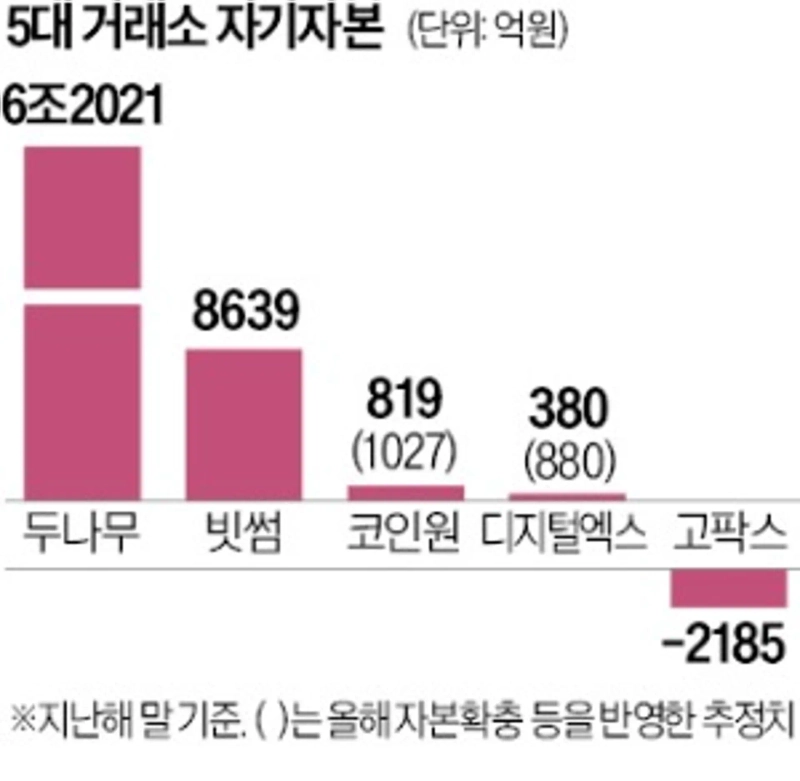
Under the Capital Markets Act, a regular securities exchange must have at least 100 billion won ($72 million) in equity capital. If the same standard is applied to cryptocurrency exchanges, three of South Korea’s five major won-based exchanges, aside from Upbit and Bithumb, would face a heavier capital burden.
Coinone had equity capital of 81.9 billion won ($59 million) at the end of last year. It raised about 54.8 billion won ($39.5 million) this year from Korea Investment & Securities and OKX Ventures, but continued losses mean its current equity is estimated to be only slightly above 100 billion won ($72 million).
DigitalX, acquired by Mirae Asset Group, had equity capital of 38 billion won ($27.4 million) at the end of last year. It received a 50 billion won ($36 million) capital injection in August and is due to receive an additional in-kind contribution of about 30.5 billion won ($22 million) in January 2027. Still, after posting a net loss of 15.8 billion won ($11.4 million) last year, preserving capital even after the increase remains a challenge.
Gopax operator Streami was fully capital-impaired at the end of last year, with equity capital of negative 218.5 billion won ($157 million). Dunamu, the operator of Upbit, and Bithumb are in relatively stronger positions. “If tighter equity requirements are added to limits on major shareholder stakes, the burden on small and mid-sized exchanges will inevitably rise,” an industry official said.
Cho Mi-hyun, Hankyung.com reporter mwise@hankyung.com

Korea Economic Daily
hankyung@bloomingbit.ioThe Korea Economic Daily Global is a digital media where latest news on Korean companies, industries, and financial markets.