BOK Warns Korea’s Growth Could Drop to 2.1% in 2028 Under Triple Semiconductor Shock
Summary
- The Bank of Korea said South Korea’s economic growth rate could slow to 2.1% in 2028 if delayed AI investment, tighter financial conditions and an expansion in China’s memory output occur together.
- In that scenario, memory chip prices could be 51% below the baseline forecast in 2028 and semiconductor exports could fall by $30.75 billion.
- The BOK said South Korea could fall into a prolonged low-growth phase if it fails to secure a growth engine after the semiconductor boom, and said changes in global AI investment conditions, financial markets and technological competitiveness need to be watched closely.
Forecast Trend Report by Period


Variables Shaping the Bank of Korea’s View of South Korea’s Growth Outlook
Delayed AI Investment, Tighter Financial Conditions, China Memory Output Expansion
“Growth Could Fall to 2.1% in 2028 Under a Combined Semiconductor Shock”
“New Growth Engines Needed After the Semiconductor Boom”
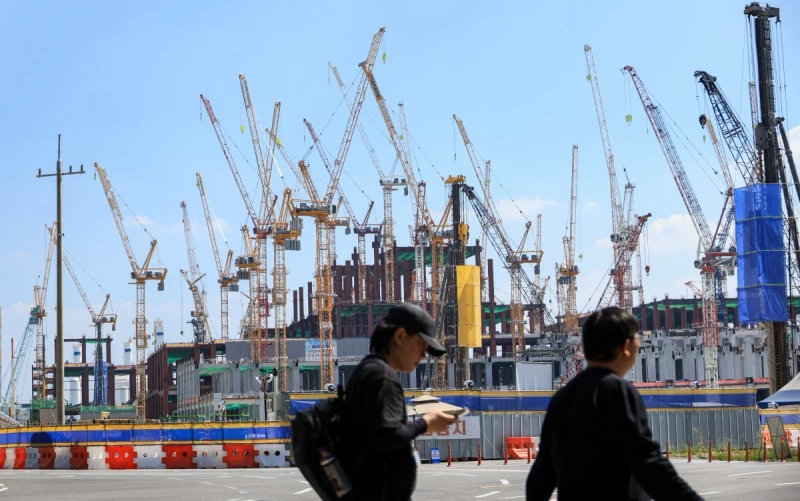
The Bank of Korea said South Korea’s economic growth could slow to the low-2% range by 2028 if delayed artificial intelligence investment, tighter financial conditions and increased Chinese memory-chip output hit at the same time. The central bank warned that the same forces driving the semiconductor boom — expanding AI investment and a sharp rise in memory prices — could eventually become the trigger for a downturn.
In a report released on Nov. 26 titled “The AI-Led Semiconductor Boom: Distinctive Features and Future Outlook,” the BOK estimated that South Korea’s economy would grow 3.4% next year and 2.1% in 2028 under a downside scenario in which all three shocks occur simultaneously. That would be 0.7 percentage point and 0.9 percentage point below the central bank’s forecasts released the same day of 4.1% for next year and 3.0% for 2028.
The BOK assumed data-center demand would be 10% lower than expected through the end of 2028 because of delays in AI investment. It also modeled a scenario in which demand drops as much as 15% as financial conditions worsen before partially recovering. In addition, it assumed China’s share of the commodity memory market rises by another 10 percentage points by the end of 2028.
Under that scenario, memory-chip prices would be 15% lower than the baseline forecast next year and 51% lower in 2028. Semiconductor exports would decline by $12.94 billion and $30.75 billion, respectively. The BOK said the recent semiconductor export boom has depended heavily on volatile price gains rather than volume growth, leaving the sector vulnerable to shifts in supply and demand.
The central bank said the current semiconductor boom differs from past cycles because it is based on future demand that has not yet materialized. During the spread of PCs and smartphones, rising demand for end products drove the chip cycle. More recently, the boom has been fueled by companies’ preemptive investment aimed at future AI demand. If AI services are slow to generate returns, or if electricity shortages delay data-center construction, semiconductor demand would also weaken.
The stronger link between the semiconductor cycle and financial markets also marks a break from the past. Bond issuance by five major big-tech companies — Amazon, Alphabet, Microsoft, Meta and Oracle — surged to $16.91 billion in the first half of this year from $2.04 billion in the first half of last year, an increase of more than eightfold in a year. In the second half of this year, capital spending is also expected to exceed cash generated from operating activities.
That means big tech, which in the past continued investing during periods of rising interest rates on the back of ample cash flow, may now be more reliant on external funding. As a result, the semiconductor cycle could become more sensitive to changes in financial markets. The BOK said deteriorating financial conditions alone could shave 0.4 percentage point off South Korea’s growth next year by disrupting funding for AI investment.
The central bank also sees a risk that the semiconductor boom is helping Chinese companies catch up. As Samsung Electronics and SK Hynix expanded high-bandwidth memory, or HBM, production, supply of commodity memory tightened and prices surged, benefiting Chinese rivals. ChangXin Memory Technologies, or CXMT, increased its global DRAM market share to 10% from 4% over the past year. Unlike past semiconductor price wars, when steep price declines kept latecomers from entering the market, this cycle’s price spike is boosting Chinese companies’ capacity to invest.
Still, the research team said the semiconductor upswing could last longer than initially expected because the medium- to long-term expansion in AI demand is still at an early stage. It also said demand could grow further for advanced memory products made by South Korean companies with superior power efficiency, so long as the technology gap with Chinese rivals is maintained.
“The slowdown in the memory cycle is likely to have a significant impact on exports, the current account, gross domestic product and corporate operating profit,” the BOK said. A rigorous assessment of the economic outlook, it added, will require close attention to changes in global AI investment conditions, financial markets and the technological competitiveness of domestic companies.
An industry official said South Korea’s economy remains highly dependent on semiconductor exports, meaning any end to the supercycle would likely hit growth, the current account and corporate earnings at the same time. That is why brokerages and market experts remain cautious about the outlook beyond 2028: No one can accurately predict when AI investment will begin to pay off, how much memory supply capacity will be added, or how quickly Chinese companies will close the technology gap.
The official added that if South Korea fails to secure new growth engines for the post-boom period, the broader economy could slip into a prolonged period of low growth.
Kang Kyung-ju, Hankyung.com reporter memory@hankyung.com

Korea Economic Daily
hankyung@bloomingbit.ioThe Korea Economic Daily Global is a digital media where latest news on Korean companies, industries, and financial markets.