Stocks, Gold and Crypto Are All Falling — Wall Street Sees the Real Rebound Starting Around Dec. 15
Summary
- Wall Street and Seoul brokerages said a real rebound is likely only around Dec. 15, after the Fed signals a slower pace of tightening at the early-December FOMC meeting.
- The simultaneous drop in stocks, gold and crypto reflects a sharp decline in excess liquidity, and reversing that trend will require the Fed to ease its hawkish stance.
- Global investment banks and South Korean brokerages pointed to long-term upside for the S&P 500 and Kospi, while warning against going all-in on semiconductors and recommending concentrated exposure to quality stocks.
Forecast Trend Report by Period


Fed vs. the Market: Who Blinks First
Global financial markets are locked in a sharp standoff with hawkish central banks, including the Federal Reserve and the Bank of Korea. Stocks, gold, cryptocurrencies and commodities are all sliding at once, and warnings are mounting that liquidity is drying up quickly. On Wall Street and in Seoul, the prevailing view is that markets can begin to form a floor only if the Fed signals a slower pace of tightening at the early-December Federal Open Market Committee meeting. The real rebound, in that view, would come after mid-December, when technical distortions in market flows begin to ease.
Stocks Catch Their Breath on Holiday Effects and Burry’s Position Shift, but Bottom Signals Still Fall Short
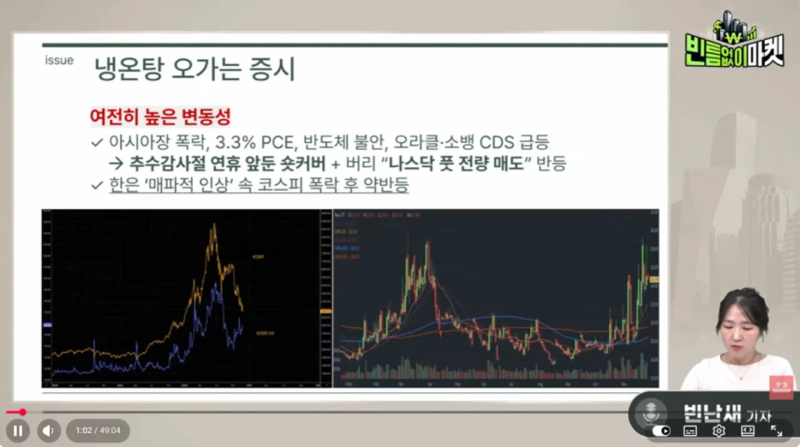
Korean and global equities have remained trapped in extreme volatility. The Kospi gave back in a single session the gains it had posted during the so-called Jensen rally. In New York, stocks also tumbled intraday before recovering much of the loss near the close. The Dow Jones Industrial Average fell nearly 1,100 points at one stage before turning higher, while the S&P 500 and Nasdaq ended down less than 1% after earlier drops of 3% to 4%.
The late rebound on Wall Street was driven in part by lighter trading ahead of the US Thanksgiving holiday, with markets shut on Nov. 26 and closing early on Nov. 27, as well as short covering. Since 1960, the S&P 500 has risen eight out of 10 times on the day before Thanksgiving, reflecting a seasonal pattern. Sentiment also steadied after Michael Burry, the investor who inspired the film “The Big Short,” said he had closed all of his put options betting against the Nasdaq 100 and was temporarily “all long.” He kept put options on Palantir and MetLife, however, and said Nvidia only looks cheap at current levels, adding that he would consider shorting it again around $200.
In South Korea, the stock market briefly tried to rebound nearly 3% intraday, but heavy foreign selling left the Kospi up just 0.3% at the close. The Bank of Korea raised its benchmark rate and signaled it remains open to further hikes next year, a hawkish stance that weighed on appetite for risk assets.
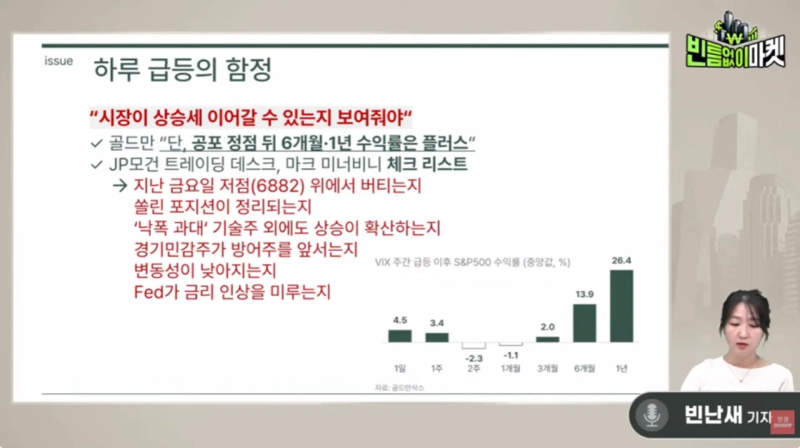
Analysts broadly agree it is too early to call this rebound the true bottom. Technical and sentiment indicators used to confirm a market floor remain unstable.
·Volatility is still elevated: The VIX, often called Wall Street’s fear gauge, has retreated from around 30 to 24.7. But it remains above 20, a level often viewed as a line for market stability. Volatility in the Kospi also remains high.
·Broken support levels and weak market breadth: The Nasdaq 100, S&P 500 and Kospi have all fallen below their 200-day moving averages. Investors now need to see whether prior lows in the S&P 500 at 6,882 and the Kospi in the low-4,600 range hold as support. Mark Newton of Fundstrat said a healthy rebound usually requires at least two sessions in which advancing stocks or trading volume exceed 90%. That has failed to happen for two straight days, and order books remain thin.
·Capitulation is incomplete, while inflation and credit concerns persist: Hedge funds have already cut a large share of their positions, but long-term investors remain concentrated in AI-related technology stocks. Continued inquiries from institutional investors about when to start buying the dip suggest true panic selling has not yet run its course. Newton still sees room for a retest of the lows through the first week of December and said the S&P 500 needs to reclaim 7,350 before investors can feel more comfortable. Goldman Sachs also urged caution on dip buying. The bank cited stronger-than-expected October core personal consumption expenditures inflation, which has effectively locked in a rate hike at the Dec. 9-10 FOMC meeting and pushed the odds of another increase in January to 60%. It also pointed to high-yield bond spreads tied to names such as CoreWeave and Oracle that have widened by nearly 70 basis points since early October.
“The Effect of Four Hikes Is Already There” as Markets Warn Central Banks
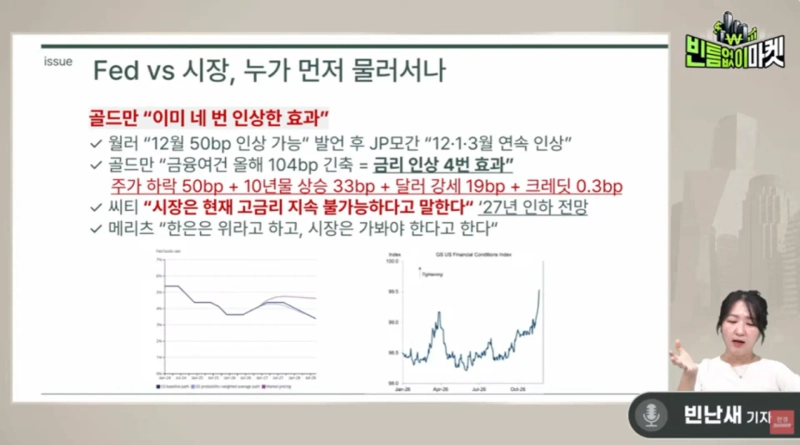
Monetary policy has become the market’s dominant pressure point. After Fed Governor Christopher Waller raised the possibility of a 50-basis-point increase in December, major Wall Street investment banks including JPMorgan, Bank of America and Deutsche Bank revised their forecasts to call for three straight hikes in December, January and March. JPMorgan had previously expected only one increase in December.
The problem is that financial conditions are already extremely tight. Goldman Sachs estimates that this year’s drop in stock prices, rise in the 10-year Treasury yield and strength in the dollar have already produced the equivalent of 104 basis points of tightening. That is roughly the same effect as four 25-basis-point rate increases. Conditions have worsened sharply since late October, and falling stock prices alone have generated tightening of about 50 basis points.
That has fueled a clear pushback in markets over whether central banks can keep raising rates in this environment. Citigroup said in a recent report that the stock-market selloff itself signals current interest-rate levels are unsustainably high. Even if the Fed raises rates in December, Citi expects it will ultimately have to cut them next year. Bank of America said the Fed may not abandon its tightening path unless the S&P 500 gives back all of this year’s gains, underscoring the tug-of-war between policymakers and investors.
A similar contest is playing out in South Korea. The Bank of Korea raised its policy rate to 3.25%, the highest in about two years, and its dot plot pointed to the possibility of further hikes next year to 3.5% to 3.75%, along with an upgraded growth outlook. Yoon Yeo-sam, an analyst at Meritz Securities, said additional hikes next year may prove difficult despite the BOK’s intentions, given the sharp tightening in financial conditions caused by falling stock prices and uncertainty surrounding semiconductors, a core driver of growth.
2018 Déjà Vu and Kevin Warsh’s Dilemma: Two Conditions for a Pivot
Wall Street has increasingly compared the current market to 2018, the second year of Donald Trump’s first term. Back then, stocks plunged after the midterm elections as the Fed continued to raise rates, before recovering the following year after then-Chair Jerome Powell signaled a halt to tightening.
Warsh, now the Fed chair, wrote a Wall Street Journal opinion piece in 2018 with Stanley Druckenmiller under the headline that the Fed should not tighten at that moment. He argued that raising rates based only on lagging indicators such as employment and growth could damage the economy and that policymakers should heed warnings coming from stocks and credit spreads. After the Fed pushed ahead with a hike, the S&P 500 dropped 6% over four to five sessions through Christmas Eve.
Warsh is considered hawkish on inflation and quantitative easing, but he also believes in the productivity effects of AI. At the October FOMC meeting, he said it is not the Fed’s job to “throw sand in the gears of the economic engine.” Still, he faces a tougher dilemma than in 2018, when inflation was in the 2% range. Now it is running in the 3% range, making a pause harder to justify.
The market’s preferred scenario is a 25-basis-point hike at the December FOMC meeting paired with a dovish message that signals a slower pace ahead. Druckenmiller, a mentor to both Warsh and Treasury Secretary Scott Bessent, has also added to that pressure. After entering this year fully long in January, he recently shifted to neutral net stock exposure and a short position in copper, effectively warning of an economic slowdown in the second half of next year.
What, then, would force the Fed to retreat from tightening? Wall Street Journal reporter Nick Timiraos and former Boston Fed President Eric Rosengren have argued that a stock-market correction alone will not be enough to move the Fed. The key variables are credit markets and inflation.
·Credit spreads: Spreads on speculative-grade, or junk, corporate bonds are well above the median of the past three years. But spreads on BBB-rated debt, the lowest tier of investment grade, are still around the three-year median and remain below levels seen during last year’s tariff shock. That leaves room for the Fed to conclude the economy is not yet under severe strain. But if yields on BBB-rated corporate bonds also surge and fears of cascading credit stress rise, policymakers may have little choice but to change course.
·Cooling inflation: There is a broad expectation that the sharp decline in oil prices since the October midterm elections will start to show up in November inflation data, easing price pressures. Goldman Sachs expects PCE inflation to reach 2.3% by the end of next year, while UBS sees 2.4% to 2.5%, both implying inflation has already peaked. John Williams, president of the Federal Reserve Bank of New York, has also signaled that arguing for a 50-basis-point hike based only on backward-looking data would be excessive.
If Treasury yields and credit spreads fall together, stocks could rebound on hopes of a soft landing. But if yields fall while spreads continue to widen, markets are more likely to read that as a recession signal, limiting any benefit for equities.
Why Stocks, Gold and Crypto Are Falling Together: Excess Liquidity Is Drying Up
One notable feature of the recent correction is that even gold, traditionally a safe-haven asset, has fallen alongside equities, cryptocurrencies and copper. That suggests the move is less about classic risk aversion than about a liquidity squeeze in which investors are selling whatever they can because the cash available to buy assets is itself running out.
Bloomberg columnist Simon White has focused on an “excess liquidity” gauge derived by subtracting economic growth from real money-supply growth across the world’s 10 largest economies. Excess liquidity, a measure of spare cash left in the economy after spending needs are met, typically leads stocks by three to six months. His view is that the metric began to turn sharply lower in May and then triggered deleveraging and a stock-market correction after late June. Unlike in the past, big technology companies are now pouring huge sums into real-world capital expenditures such as AI semiconductors, land and data-center construction. That is rapidly absorbing excess liquidity that might otherwise flow into risk assets. Reversing that trend, in this view, will require the Fed to ease its hawkish stance.
2027 Targets and Sector Strategy: Avoid Going All-In on Semiconductors, Favor Quality Stocks
With the exception of JPMorgan, which still expects three consecutive hikes, Wall Street and South Korean brokerages generally believe the Fed will not be able to tolerate a recession or a deeper market selloff indefinitely and will eventually stop tightening. Citigroup expects rate cuts in June next year. Goldman Sachs forecasts hikes in December this year and March next year, followed by cuts in December next year. Meritz Securities sees room for cuts by the end of next year, while Mirae Asset Securities expects rates to stay on hold next year. Both see the US 10-year Treasury yield stabilizing lower.
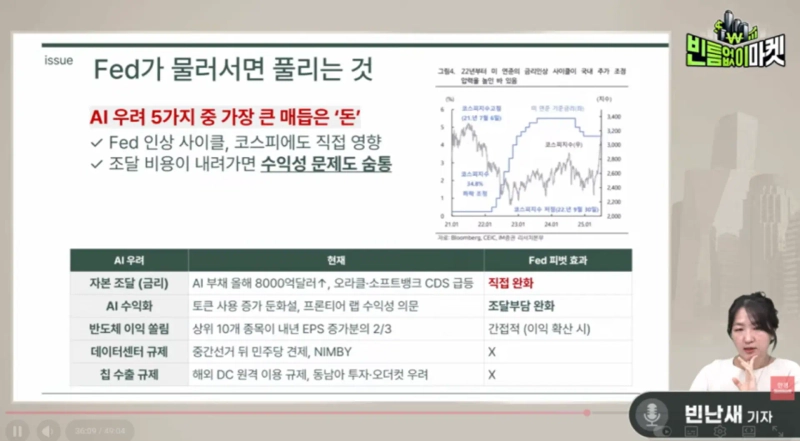
Based on that assumption, major global investment banks have set 2027 S&P 500 targets at 9,000 for Deutsche Bank, 8,700 for Goldman Sachs and Morgan Stanley, and 8,200 for JPMorgan and UBS. For the Kospi, South Korean brokerages mostly see a range of 8,000 to 9,000, while Goldman Sachs and JPMorgan project levels in the 7,000s. If the Fed pivots, financing pressure on AI companies would ease, giving them more time to hold out until tangible monetization metrics emerge amid concerns over slowing token usage and profitability debates following Anthropic’s listing.
Even so, caution is building around an all-in semiconductor trade. JPMorgan listed as one of next year’s risks a market structure in which memory-chip makers capture margins as high as 80%. A sharp rise in memory prices could hurt demand for smartphones and PCs while also worsening profitability for AI model and service companies with limited financial resources. Analysts say outright order cuts have not yet appeared, but the kind of explosive stock gains seen in the past may be harder to repeat.
The common advice from institutional firms is to concentrate portfolios in quality names that can withstand an extended period of high rates. That means companies with strong free cash flow, solid balance sheets, low leverage and robust shareholder returns.
“The Real Rebound Starts After Dec. 15” as a Late-Stage Shakeout Nears Its End
From a flow and seasonal standpoint, some analysts say the worst phase may be nearing an end. Goldman Sachs said mechanical trend-following funds, or CTAs, sold $70 billion of global equities over the past week. After another round of selling next week, those flows are expected to peak, with technical dislocations beginning to unwind from early December. Data dating back to 1928 also show that 80% of the year-end Santa rally’s gains have come after Dec. 14. Combined with the December FOMC schedule, that suggests the period around Dec. 15 could mark the true point of bottom confirmation and rebound.
Moon Nam-joong, an analyst at Daishin Securities, said in a recent report that the current market is not a recession-driven or financial-crisis-style bear market. Instead, he described it as a bull-market correction driven by stretched valuations and Fed tightening. Because such corrections typically take one to three months to recover from, investors should avoid making aggressive directional bets until the early-December FOMC outcome is clear and instead endure the final stretch of pain with a cautious, fundamentals-based approach.
Bin Nan-sae, Hankyung.com reporter binthere@hankyung.com

Korea Economic Daily
hankyung@bloomingbit.ioThe Korea Economic Daily Global is a digital media where latest news on Korean companies, industries, and financial markets.