

Exchange Rate Rises by 17 Won, Then Falls by 10 Won... Lee Chang-yong "Observing the Market" [Hankyung Forex Market Watch]
Summary
- The won-dollar exchange rate has recently fallen to the 1420 won range but remains at a high level.
- Lee Chang-yong, Governor of the Bank of Korea, predicted that it would be difficult for the exchange rate to return to its previous level for the time being.
- He emphasized the importance of cooperation between the government and the ruling and opposition parties for exchange rate stability.
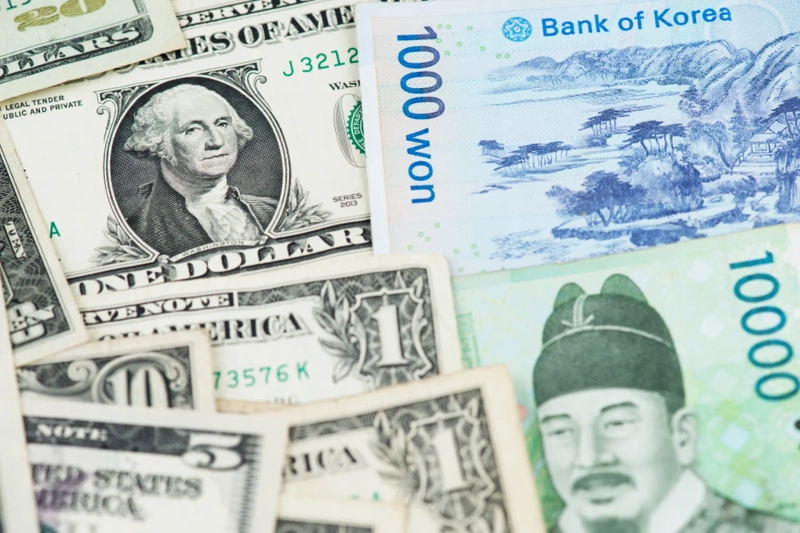
The won-dollar exchange rate fell by more than 10 won (appreciation of the won) to the 1420 won range. Although the sharp upward trend from the previous day was somewhat reversed, it remained at a high level compared to before the declaration of martial law. Lee Chang-yong, Governor of the Bank of Korea, pointed out that "it is difficult to return to the previous level for the time being" regarding the recent exchange rate trend.
On the 10th, the won-dollar exchange rate in the Seoul foreign exchange market (as of 3:30 p.m.) ended weekly trading at 1426 won 90 jeon, down 10 won 10 jeon from the previous day. It was the first time in seven trading days since the 29th of last month that the exchange rate fell compared to the previous trading day.
The decline in the exchange rate on this day is analyzed to be due to the assessment that the increase the previous day was somewhat excessive. The exchange rate rose by 17 won 80 jeon in one day as concerns about increased uncertainty due to the prolonged impeachment situation were reflected.
The stronger market stabilization message from the foreign exchange authorities in the morning also had an impact. Choi Sang-mok, Deputy Prime Minister and Minister of Strategy and Finance, evaluated the recent increase in financial and foreign exchange market volatility as "somewhat excessive compared to the solid fundamentals and external soundness of our economy."
The favorable domestic stock market and the decline in the yuan exchange rate were also analyzed to have contributed to the stabilization of the exchange rate. On this day, the KOSPI rebounded by 2.43%, and the yuan exchange rate fell offshore after the announcement of China's stimulus measures. The dollar index, which shows the value of the dollar against the currencies of six major countries, also fell by 0.13% from the previous day to 106.041.
However, this exchange rate level is still high compared to before the declaration of martial law. The exchange rate was 1402 won 90 jeon at 3:30 p.m. on the 3rd, which is 24 won lower than the exchange rate on this day (1426 won 90 jeon).
The foreign exchange authorities believe that it will be difficult for the exchange rate to quickly return to its previous state for the time being. Lee Chang-yong, Governor of the Bank of Korea, mentioned in a meeting with opposition party members of the National Assembly's Planning and Finance Committee at the Bank of Korea's main building in Namdaemun-ro, Seoul, that "it is difficult for the exchange rate to return to the previous level for the time being." He said, "The market is in a state of observation," and "it is difficult to say that the exchange rate has entered a stable phase now."
Governor Lee also emphasized that "efforts should be made for the ruling and opposition parties to agree on next year's budget," and "regardless of the political situation, the government and the ruling and opposition parties should show cooperation on economic issues to foreign investors."
Reporter Kang Jin-kyu josep@hankyung.com

Korea Economic Daily
hankyung@bloomingbit.ioThe Korea Economic Daily Global is a digital media where latest news on Korean companies, industries, and financial markets.