

Exchange Rate Nears 1,400 Won in Q4... Highest Since Financial Crisis
Summary
- The won/dollar exchange rate has risen to its highest level since the financial crisis, expected to impact corporate financial statements.
- While the exchange rate increase could benefit export companies, there are concerns it could lead to a rise in raw material prices.
- The financial sector is affected differently by exchange rate fluctuations depending on whether foreign currency assets and liabilities are hedged.
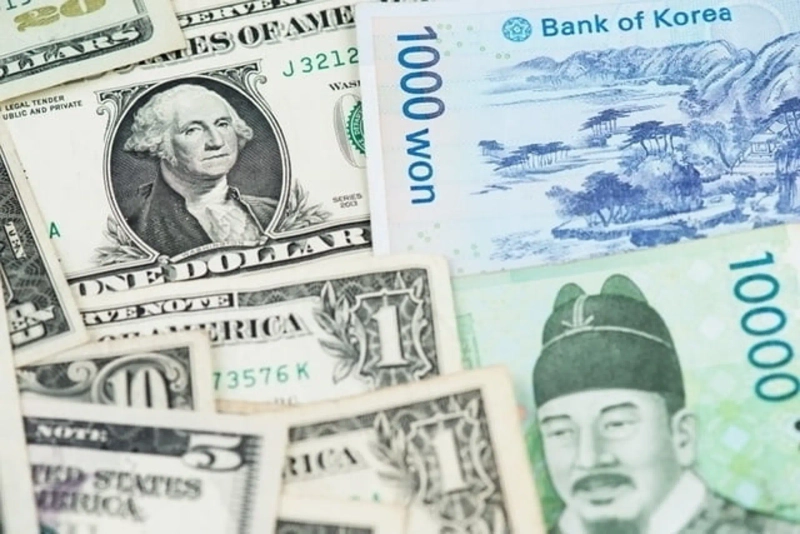
The won/dollar exchange rate recently surged close to 1,500 won, pushing the average exchange rate for the fourth quarter (October to December) to its highest level since the financial crisis.
According to the Bank of Korea's Economic Statistics System (ECOS) on the 31st, the average won/dollar exchange rate (based on daily closing prices) for the fourth quarter was recorded at 1,398.75 won.
This is the highest in 15 years and 9 months since the first quarter of 2009 (1,418.30 won) during the financial crisis. The only time it was higher was during the foreign exchange crisis in the first quarter of 1998 (1,596.88 won).
The quarterly average exchange rate rose from 1,329.4 won in the first quarter of this year to 1,371.24 won in the second quarter, then fell to 1,358.35 won in the third quarter, but rose again to near 1,400 won in the fourth quarter.
The Korean won weakened due to increased political instability following the declaration of martial law this month after former U.S. President Donald Trump's re-election success. The expectation that the U.S. Federal Reserve (Fed) will slow down its rate cuts is also a factor for the strong dollar.
This year's weekly closing price (1,472.5 won) is the highest on an annual closing basis in 27 years since 1997 (1,695.0 won).
The same applies to the base rate announced by the Seoul Foreign Exchange Brokerage. The base rate is the market average exchange rate calculated by weighting the spot trading volume of U.S. dollars traded through foreign exchange brokerage companies and serves as the exchange rate standard when companies prepare financial statements.
The average base rate for the fourth quarter until the 30th was 1,395.64 won, the highest since the first quarter of 2009 (1,415.22 won).
As a result, the exchange rate applied when companies prepare their financial statements at the end of the year also rises. When the exchange rate rises, it is reflected in dollar-denominated assets and liabilities, affecting profitability.
However, the impact varies by industry, with export-heavy sectors such as semiconductors, automobiles, and shipbuilding benefiting from the exchange rate increase in the short term. However, in the long term, the exchange rate increase could lead to a rise in raw material prices.
Industries with high raw material imports, such as steel or construction, are likely to see increased costs due to the exchange rate rise, leading to a decline in profitability.
In the financial sector, some financial holding companies have hedged foreign currency assets and liabilities, while others have not.
A financial industry official stated, "If foreign currency assets and liabilities are hedged in line with the timing of business report preparation, the impact of exchange rate fluctuations is not significant."
Reporter Geun-A Park twilight1093@wowtv.co.kr

Korea Economic Daily
hankyung@bloomingbit.ioThe Korea Economic Daily Global is a digital media where latest news on Korean companies, industries, and financial markets.