

PiCK
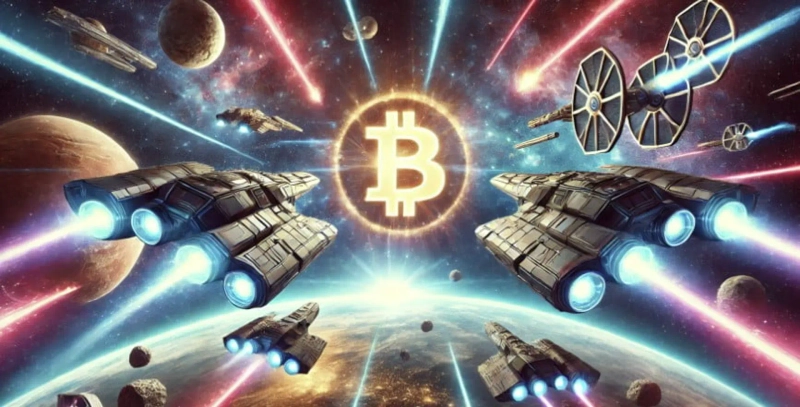
The Trump Era Opens in 2025... 'Bitcoin Space War' Begins [Hankyung Koala]
Summary
- After the approval of the Bitcoin spot ETF, Bitcoin is reportedly being rapidly adopted by institutional finance and global companies.
- With Trump elected as the U.S. president, it is expected that the virtual asset market will receive more attention.
- The U.S. aims for digital hegemony, and a Bitcoin space race is expected to intensify.
Kim Min-seung's ₿ficial
Hopes for 2025
In early 2024, after the approval of the Bitcoin spot ETF, Bitcoin quickly began to be adopted by institutional finance and global companies. In November 2024, 'Crypto President' Trump was elected as the next president of the United States, and the Democratic Party, which maintained an anti-virtual asset stance, lost its dominance not only in the White House but also in both houses of Congress. In the new year, a 'crypto revolution' led by the U.S. administration and legislature is expected to take off worldwide.
As a result, in 2025, more people from all walks of life will become interested in virtual assets, both personally and professionally. Here are some summaries that may be helpful for those who are starting to study the virtual asset market and industry in the new year.
Coins Are Not Bad
Before 2024, coins were not recognized as legitimate assets, and everything related to coins was treated as 'bad.' Whether prices went up or down, it was bad. Whether it garnered public attention or not, it was bad. People who got rich from coins were considered bad, and those who lost money were also considered bad.
Coins are not bad. It's the people who do bad things with coins that are bad. As a relatively new asset class, there isn't much empirical knowledge accumulated, and since it applies cutting-edge technologies like cryptography and distributed computing, the technical understanding is difficult. Scammers sometimes exploit this knowledge gap. However, such scams appear wherever there are advanced technologies, like natural resource development or new drug development in lesser-known countries. Just as natural resource development or new drug development itself isn't bad, coins themselves aren't bad either.
There's also a prejudice that coins are heavily used for money laundering and financial crimes. The most used medium for money laundering is not coins but cash. It's the people who launder money and send funds to terrorist organizations using coins that are bad, not the coins themselves. If coins are bad, then cash, dollars, and won should all be considered bad too.
Blockchain is just a neutral technology, and coins are just neutral investment assets. The idea that blockchain and coins themselves are bad is wrong.
Coins Are Not Stocks
Many people dismiss coins as a new kind of peculiar stock just because they have fluctuating prices, charts, tickers, and exchanges. This is where most misunderstandings arise. Coins were made to be 'not stocks.' Even Bitcoin, the ancestor of all coins, does not have the characteristics of securities, and since the era of Initial Coin Offerings (ICOs), governments like the U.S. have tried to regulate the coin market by applying securities laws, so coins have focused on removing any characteristics that could be mistaken for securities.
Those who take on coin-related tasks often have long careers in the securities market. As a result, they consider coins as a type of security and point out things happening in the coin market that would be 'unthinkable if they were stocks.' This is a wrong approach. Coins are not stocks, nor are they securities. They are a completely different asset class created for entirely different purposes and with a completely different history. Approaching coins with the knowledge and biases of domestic stocks traded under regulations honed over decades on a single domestic exchange is not appropriate.
In a Lawless Area, Bad Drives Out Good
Many problems in the coin market arise from the absence of legislation and regulation. Prohibition and blocking are sufficient. The problem is the lack of legal definitions of 'what can be done.' In our country, many aspects related to coins are in the realm of lawlessness or illegality. Coins resemble finance, and our country's finance operates under a negative regulatory system. In other words, you can't do anything unless it's explicitly allowed.
Since 2017, while the government has turned its back with a 'no way' stance, reliable businesses like domestic financial institutions and large corporations have been unable to engage in coin and blockchain-related businesses. Technology companies that tried to lead with their technological prowess were even blocked from cashing out coins. Thus, the domestic blockchain ecosystem is withering day by day.
In the realm of lawlessness and illegality, sound businesses cannot operate, while businesses with suspicious backgrounds enter with a one-time gain in mind. When consumer damage occurs in the virtual asset industry, public opinion worsens, and the industry's social standing weakens further. This is a typical situation where bad drives out good, and it has persisted for a long time.
Instead of regulations that say 'don't do this,' we need forward-looking guidelines that say 'do it this way.' We must remember that around 2018, major corporations like Samsung, LG, SK, KT, and Lotte completed their own blockchain developments, but there have been no noticeable business achievements since then. Trustworthy businesses that could have raised future industries wasted seven years while the government turned its back.
The Domestic Coin Market is a Galapagos
Thus, the domestic blockchain ecosystem is only maintaining its existence through the coin trading market. Even this is becoming Galapagos-like, blocked by peculiar regulatory environments. Corporate and institutional entry into the trading market is blocked, and the Foreign Exchange Transactions Act creates a kimchi premium. The monopoly issue in the trading market is worsening day by day, and there have been instances where the trading volume of a single virtual asset exchange exceeded that of the KOSPI market.
The coin market is no longer just a playground for a few young people in their 20s and 30s. According to the Financial Services Commission's survey on virtual asset business operators in the first half of 2024, the actual number of users of domestic virtual asset exchanges, excluding duplicates, is 7.78 million. According to this data, there are 1.44 million users in their 20s, 2.27 million in their 30s, 2.19 million in their 40s, 1.39 million in their 50s, and 490,000 over 60. There are as many users in their 40s as in their 30s, and as many users in their 50s as in their 20s. According to data on virtual asset trading status submitted by Democratic Party of Korea lawmaker Lim Kwang-hyun from the Bank of Korea, as of the end of November, there are 15.59 million investors with accounts in the top five domestic virtual asset exchanges, including duplicates.
The trading volume of domestic virtual asset exchanges often exceeds the combined trading volume of KOSPI and KOSDAQ. The coin market is now the sentiment of at least 7.78 million voters. We need to closely examine how the U.S. SEC treated coins as 'bad' under the Biden Administration and the Democratic Party's direction, consistently applying excessive regulations, and how the U.S. virtual asset industry actively supported Republican and pro-crypto presidential and congressional candidates in a democratic and American way, ultimately leading to a red sweep in the 2024 U.S. election.
The Trump Era, 'Bitcoin Space Race' Unfolds
This year will be very important for the virtual asset industry and market. With the inauguration of the Trump 2nd administration, a 'Bitcoin space race' led by the U.S. will unfold. Just as the U.S. and the Soviet Union competed in the arms race by launching spacecraft during the Cold War, major countries will compete to secure Bitcoin supplies. If powerful governments like the U.S. purchase Bitcoin, it's a foreseeable future that global companies and financial institutions will rush to participate in that competition.
Although it's already quite late, this year, legislation and reasonable regulation for fostering and promoting the virtual asset and blockchain industry are more urgent than ever. The U.S. has declared its intention to take digital hegemony, and while Europe, Singapore, Hong Kong, and Japan have completed national frameworks to respond, our country has only completed exchange regulations with the 'Phase 1 Legislation' Digital Asset User Protection Act, and further progress is still uncertain.
If you search for the author's name with the subtitle of this article on Google, you can find the author's writings and related media reports on the subject. I sincerely hope for wise judgment and foresight from those who will be responsible for virtual asset tasks and decision-making in the new year.

Kim Min-seung, Director of Korbit Research Center...
He is a founding member and director of the Korbit Research Center. He works to simplify and communicate complex events and concepts occurring in the blockchain and virtual asset ecosystem, helping people with different perspectives understand each other. He has experience in blockchain project strategic planning and software development.
▶This article is an external contributor column introduced to provide various perspectives to cryptocurrency investment newsletter subscribers and does not represent the position of Hankyung.
Reporter Jo Mi-hyun mwise@hankyung.com

Korea Economic Daily
hankyung@bloomingbit.ioThe Korea Economic Daily Global is a digital media where latest news on Korean companies, industries, and financial markets.