

PiCK
Busan's '6 Trillion Investment Jackpot'... All-in on Fostering Advanced Industries like Blockchain
Summary
- Busan City announced that it attracted corporate investments of 6 trillion won last year, laying the foundation for fostering high value-added industries such as blockchain and bio.
- It was reported that the city is promoting the designation of a 1.88 million ㎡ future mobility special zone and the expansion of a 2.78 million ㎡ free economic zone.
- Busan City announced plans to focus on fostering a digital transformation ecosystem centered on the financial industry and data centers.
Last year's 6.2 trillion attraction... Record high
Accumulated investment of 15.5 trillion over 4 years
Establishing blockchain and bio ecosystems
Designation of 1.88 million ㎡ future mobility special zone
Promotion of expanding free economic zone to 2.78 million ㎡
Fostering advanced new industries and attracting companies
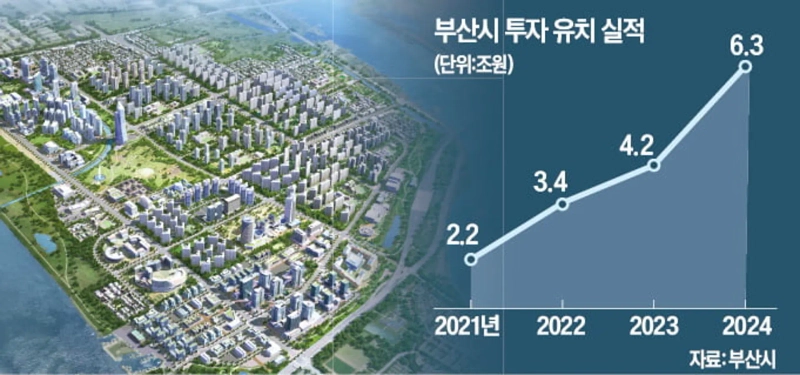
Last year, Busan City attracted corporate investments of over 6 trillion won, the largest in history. The significant increase in investment attraction is seen as laying the groundwork for fostering high value-added industries. Busan City plans to achieve a virtuous cycle where companies invest and settle by designating a 1.88 million ㎡ (570,000 pyeong) future mobility opportunity development zone and promoting the expansion of a 2.78 million ㎡ (840,000 pyeong) free economic zone.
According to Busan City on the 1st, the investment executed in the city last year was 6.2881 trillion won. The scale of investment attraction is increasing every year, with 2.1685 trillion won in 2021, 3.0431 trillion won in 2022, and 4.0023 trillion won in 2023.
During this period, funds amounting to 15.5020 trillion won have been invested to build ecosystems for blockchain, advanced manufacturing, and bio industries that will be responsible for Busan City's future. Over four years, 45 companies have invested in the finance and blockchain sectors. In the manufacturing sector, 41 companies, and in the knowledge service industry sector, 27 companies have settled in Busan.
Busan City's semiconductor industry fostering strategy started with the establishment of a power semiconductor testing and certification center in 2018. As companies continue to attract investments, the strategy is shifting to a future mobility industry ecosystem. The Ministry of Trade, Industry and Energy designated an industrial complex of about 1.88 million ㎡ in Gangseo-gu and Gijang-gun as a future mobility opportunity development zone on the 27th of last month. This site includes the Dongnam Radiation Medical Science Cluster in Gangseo-gu, designated as a specialized complex for power semiconductor materials, parts, and equipment, as well as the East Busan E-Park, an automobile parts cluster, and the Busan-Jinhae Free Economic Zone Mieum District.
So far, 19 companies have invested 2.3566 trillion won in the special zone. Advanced manufacturing industries such as IQ Lab (8-inch silicon carbide wafer-based power semiconductor fab construction), B2G (gallium nitride-based power device development), and Shinsung ST (secondary battery parts) have taken root.
Busan City plans to focus on fostering a digital transformation ecosystem centered on the financial industry and data centers. In June last year, about 730,000 ㎡ (220,000 pyeong) in Munhyeon-dong, Nam-gu, Busan, was designated as a financial opportunity development zone, and 29 companies are expected to make investments worth 1 trillion won.
Busan City is planning various projects centered on the Green Data Center, which has attracted investments of 3.6 trillion won. Busan City also focused on attracting data centers. With Amazon Web Services, Douzone Bizon, Kakao Enterprise, and Cloocus entering, the plan is to create a 'cloud cluster ecosystem.'
This year, Busan City has set five super-gap technology support tasks to lead the power operation efficiency of the Green Data Center. These include △development of glass substrates and silicon-based hybrid motherboard technology for AI servers for the Green Data Center △development of AI data center intelligent power efficiency solutions △current AI analysis-based data center intelligent power efficiency technology △high-temperature superconductor-based power systems △demonstration of high-efficiency data center technology.
The city plans to negotiate with the government this year to expand the free economic zone around Gangseo-gu to 2.78 million ㎡. This is to solve the problem of the shortage of industrial land in Gangseo-gu, which has reached its limit.
Park Heong-joon, Mayor of Busan, emphasized, "We will focus on fostering new industries centered on advanced industries."
Busan = Min Geon-tae, reporter minkt@hankyung.com

Korea Economic Daily
hankyung@bloomingbit.ioThe Korea Economic Daily Global is a digital media where latest news on Korean companies, industries, and financial markets.