

PiCK
[New York Stock Market Briefing] 'Panic Sell' due to Mutual Tariff Shock…Market Cap Plummets by 4500 Trillion in a Day
Summary
- It was reported that President Trump's announcement of mutual tariffs led to a sharp decline in major indices of the New York stock market, evaporating about $3.1 trillion in market capitalization.
- In particular, the S&P500 and Nasdaq Composite Index fell nearly 5% each, indicating a significant market correction.
- It was reported that large tech stocks like Apple and NVIDIA, which have high dependence on supply chains outside the U.S., were hit hard.
S&P500 Plunges 5%…Entering Correction Phase
Market Cap Leader Apple 9%↓·NVIDIA 8%↓
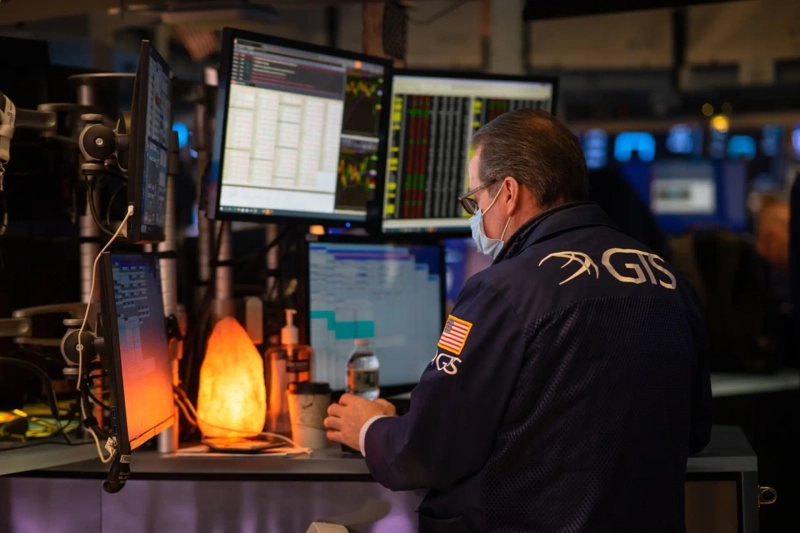
U.S. President Donald Trump's announcement of mutual tariffs against global trading partners led to a sharp decline in the three major indices of the New York Stock Exchange on the 3rd (local time). Analysts say the high tariffs imposed by the Trump administration have intensified the global trade war, reflecting concerns about a significant impact on the U.S. economy.
On this day, the Dow Jones Industrial Average at the New York Stock Exchange (NYSE) closed at 40,545.93, down 1,679.39 points (3.98%) from the previous session. The Standard & Poor's (S&P) 500 index plunged 274.45 points (4.84%) to 5,396.52, and the tech-heavy Nasdaq Composite Index fell 1,050.44 points (5.97%) to close at 16,550.61.
The Dow and S&P500 indices recorded their largest daily declines since June 2020, and the Nasdaq since March 2020. With the decline on this day, the S&P500 fell about 12% from its peak in February, re-entering the correction phase and hitting a new low since President Trump's election victory in November last year.
The Wall Street Journal (WSJ), citing Dow Jones Market Data, reported that about $3.1 trillion (approximately 4500 trillion won) in market capitalization evaporated from the U.S. stock market in a single day.
The Russell 2000 index, which focuses on small and mid-cap stocks, fell 6.59% on this day, recording a 22% drop from its peak in November last year, entering a technical bear market.
President Trump signed an executive order imposing a 10% basic tariff on all countries and additional rates on trading partners with large U.S. trade deficits.
The unexpectedly high tariffs triggered fears of retaliatory tariffs from counterparties, ultimately leading to inflation and recession in the U.S. economy, which sparked a sell-off in the New York stock market.
Major companies with high production dependence on supply chains outside the U.S. were hit hardest. This shock did not spare large tech stocks.
Nike plummeted 14.44%, and discount retailer Five Below fell 27.81%. Clothing brands like Gap also recorded a 20.29% drop. Market cap leader Apple fell 9.25%, and NVIDIA dropped 7.81%.
The Chicago Board Options Exchange (CBOE) Volatility Index (VIX), known as the 'fear index,' reached 30.2 on this day, the highest level since August last year.
Amid growing recession fears, bond yields plunged. According to electronic trading platform Tradeweb, the yield on the 10-year U.S. Treasury note fell sharply by 0.13 percentage points to 4.05% compared to the close of the New York stock market the previous day.
Reporter Goh Jung-sam, Hankyung.com jsk@hankyung.com

Korea Economic Daily
hankyung@bloomingbit.ioThe Korea Economic Daily Global is a digital media where latest news on Korean companies, industries, and financial markets.