

China cuts interest rates, Japan considers supplementary budget... Taiwan to inject "22 trillion"
Summary
- China has hinted at the possibility of cutting the benchmark interest rate, planning to mitigate the tariff impact through monetary easing measures.
- Japan plans to respond to the economic shock from tariffs by formulating a supplementary budget and expanding financial support for small and medium-sized enterprises.
- Taiwan is considering injecting 22 trillion won into the Financial Stabilization Fund as part of its measures to address the tariff conflict with the U.S.
'Black Monday' triggered by tariffs... Asian stock markets devastated
KOSPI plunges by 5% 'sidecar'... Japan, China, Taiwan also plummet
Trump's 'tariff spree' coupled with global recession fears
Hang Seng -13%, Nikkei -7.8%... Worst since COVID-19
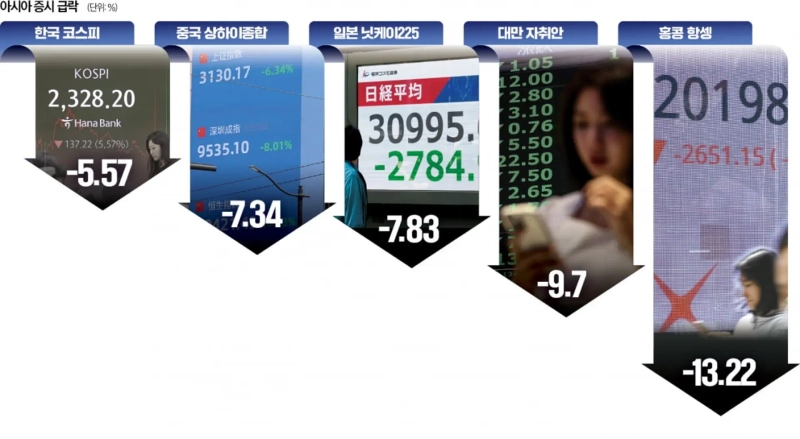
The fear that the U.S. will fall into a recession due to the global tariff war has engulfed Asian stock markets. Panic selling ensued in stock markets in Korea, Japan, Taiwan, and others, reminiscent of the sharp declines during the 2020 COVID-19 pandemic.
On the 7th, the KOSPI index closed at 2328.20, down 5.57%. At 9:12 a.m., a sell-sidecar (a five-minute suspension of program sell orders) was triggered on the KOSPI market. It was the first time in eight months since last August. The KOSDAQ index closed at 651.30, down 5.25%.
The declines in other major Asian stock markets were even greater. Taiwan's TAIEX fell by 9.70%. The Taiwanese stock market, which was closed for the Qingming Festival holiday on the 3rd and 4th, recorded its largest single-day drop since 1990 as it digested the impact of mutual tariffs for the first time. Japan's Nikkei 225 index fell by 7.83%, China's Shanghai Composite Index by 7.34%, and Hong Kong's Hang Seng Index by 13.22%.
As U.S. President Donald Trump's high-intensity tariff policy, which was considered a 'negotiation card,' became a reality, concerns about a global economic retreat have grown uncontrollably. President Trump, speaking to reporters on a plane from Florida to Washington, D.C., the previous day, declared, "The U.S. trade deficit with China is $1 trillion," and "I will not negotiate until the problem is resolved." This means that the 'Trump put' (a stock market stimulus) investors hoped for has become elusive.
President Trump separately wrote on his social media, "We have massive (trade) deficits with China, the European Union (EU), and many other countries," and "The only solution is tariffs."
Jung Yong-taek, chief research fellow at IBK Securities, explained, "Everything, including the final tariff rates of each country and the impact of tariffs on the global economy, is shrouded in mystery."
On this day, Kim Byung-hwan, chairman of the Financial Services Commission, emphasized at a meeting with the five major financial holding companies and policy financial institutions, "We will do our best to execute the 100 trillion won market stabilization program." China is also poised to unveil measures to mitigate the impact of the 'Trump tariffs.' The People's Daily reported that Chinese authorities are preparing monetary easing measures such as lowering the benchmark interest rate and the reserve requirement ratio.
Stock market crash triggered by tariffs... Countries scramble to prepare countermeasures China may ease monetary policy as early as the 21st... Expected to lower reserve ratio and expand fiscal spending
Amid the 'Black Monday' triggered by U.S. President Donald Trump's tariff bomb on the 7th, China hinted at the possibility of cutting its benchmark interest rate. Attention is focused on whether the benchmark interest rate will be cut at the regular policy decision meeting of the People's Bank of China, which will be held as early as the 21st of this month. Japan has decided to consider formulating a supplementary budget, and Taiwan has announced that it will inject 22 trillion won to stabilize the market. Countries are preparing measures to minimize the impact of the 'Trump tariffs.'
◇China focuses on boosting domestic demand
The People's Daily, the official newspaper of the Chinese Communist Party, stated in a front-page commentary on the same day regarding President Trump's high tariffs, "The Chinese government can lower the benchmark interest rate and the reserve requirement ratio of financial institutions, expand the fiscal deficit, and issue special government bonds and local government special bonds if necessary." The Loan Prime Rate (LPR), which serves as China's benchmark interest rate, is announced on the 20th of each month or the next business day if it falls on a holiday. This suggests the possibility of China unveiling monetary easing measures such as lowering the benchmark interest rate and the reserve requirement ratio as early as the 21st.
The People's Daily also stated, "Emergency measures to expand domestic demand and substantial policies to stabilize the capital market will be implemented," and "Measures to restore market confidence will also be pursued sequentially." It added, "Not only the central government but also local governments will provide tailored support to industries and companies affected by tariffs," urging companies to develop strategies centered on domestic demand and markets other than the U.S.
After the inauguration of the second Trump administration, the U.S. imposed an additional 20% tariff on China, followed by a recent 34% mutual tariff. In response, China imposed retaliatory tariffs of up to 15% on U.S. crude oil, coal, and up to 15% on agricultural products, and decided to counter with a 34% mutual tariff on all U.S. products. As the U.S.-China trade war intensifies, the possibility of Chinese export companies being directly hit has increased. Amid prolonged domestic demand sluggishness and the intensification of the tariff war, pessimism is spreading that achieving the Chinese government's '5% growth rate' target for this year will not be easy. This is the background for the Chinese government's mention of cutting the benchmark interest rate.
◇Japan and Australia step in to rescue companies
Japan has decided to consider formulating a supplementary budget. This is due to concerns that the Japanese economy, which is just beginning to emerge from a slump, could collapse again as the U.S. imposes a 24% mutual tariff on Japanese products. In particular, Japanese Prime Minister Shigeru Ishiba stated at the House of Councillors' Budget Committee on the same day regarding the Trump tariffs, "This tariff can be said to be a national crisis," and "I will visit the U.S. as soon as possible and, if necessary, hold talks with President Trump." This is to lower the tariff rate imposed by the U.S. on Japan through a summit meeting. Prime Minister Ishiba chaired a meeting of party representatives for the first time since taking office on the 4th. This is because bipartisan cooperation is needed to respond to the tariff shock. The Japanese Ministry of Economy, Trade and Industry announced plans to expand financial support for small and medium-sized enterprises by setting up consultation centers in over 1,000 locations nationwide.
Taiwan is also poised to unveil measures to minimize market shock. According to Taiwanese media such as the United Daily News, Taiwanese Premier Zhuo Rongtai (equivalent to South Korea's Prime Minister) stated at a high-level meeting attended by the central bank governor and finance minister on the 5th, "We must be mentally prepared and ready for (market) shocks." The United Daily News suggested the possibility of injecting 500 billion Taiwan dollars (about 22 trillion won) into the National Financial Stabilization Fund at the meeting. Taiwan has been imposed a 32% mutual tariff by the U.S.
The Australian government also plans to provide interest-free loans worth $1 billion to respond to U.S. mutual tariffs. Prime Minister Anthony Albanese announced the 'Economic Resilience Program' on the 3rd, stating that companies expected to be affected by tariffs will be supported to take advantage of new export opportunities.
Interest-free loans worth $1 billion (about 1.4 trillion won) will also be provided to companies expected to be affected by tariffs. Part of the existing $15 billion National Reconstruction Fund will be diverted for this purpose. In addition, the government will prioritize purchasing Australian-made steel and aluminum when procuring strategic reserves.
Reporter Shim Sung-mi / New York Correspondent Park Shin-young / Reporter Lee Hye-in / Tokyo Correspondent Kim Il-kyu smshim@hankyung.com

Korea Economic Daily
hankyung@bloomingbit.ioThe Korea Economic Daily Global is a digital media where latest news on Korean companies, industries, and financial markets.