

"The Reason China Retaliated Quickly..." A 'Terrifying Warning' in the Tariff War
Summary
- U.S. President Trump announced that if China does not withdraw its retaliatory tariffs against the U.S., he will impose an additional 50% tariff.
- China immediately retaliated, announcing six countermeasures and stating it will not back down in the trade war with the U.S.
- Due to the strong confrontation between the two countries, concerns about a global economic downturn are growing, and informal dialogue channels are reportedly not functioning.
Trump Hits China Again... "50% Additional Tariff"
"Will Take Effect on the 9th if Retaliatory Tariffs Are Not Withdrawn"
"Negotiations" with Other Countries... Two-Track Strategy
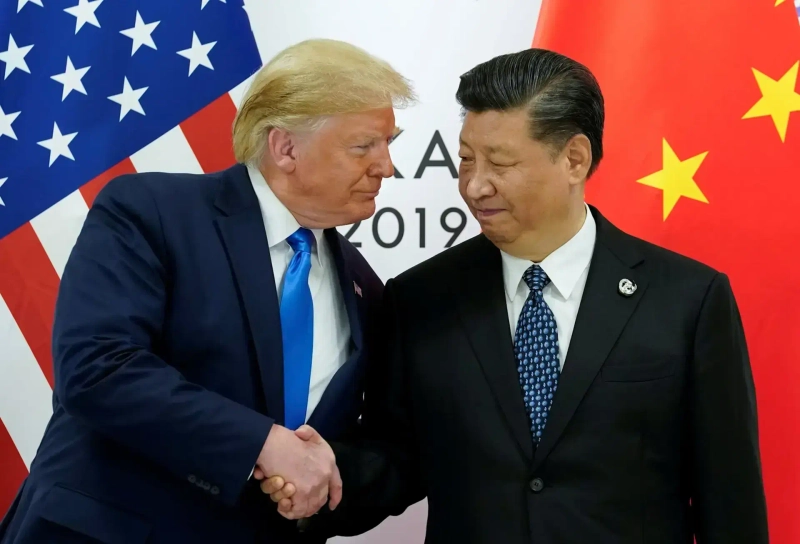
U.S. President Donald Trump announced that if China does not withdraw its retaliatory tariffs against the U.S., he will impose an additional 50% tariff, while immediately entering tariff negotiations with other countries. This is a 'two-track strategy' to separate China from other countries in the tariff war.
On the 7th (local time), President Trump stated on social media, "If China does not withdraw the 34% retaliatory tariff against the U.S. by the 8th, the U.S. will impose an additional 50% tariff on China," adding, "It will take effect from the 9th." He said that if China does not accept this, all dialogues requested by China with the U.S. will be canceled. He also mentioned that negotiations with other countries that have requested consultations will begin immediately, urging attention to this issue.
Since taking office, President Trump has imposed an additional 20% tariff on China on top of the existing tariffs (about 13% on average), and announced that a 34% reciprocal tariff will be imposed from the 9th. If an additional 50% tariff is added, the tariff on Chinese products will rise to an average of 117%.
The Chinese government immediately announced that it would fight to the end against "bullying." The Chinese state-run Xinhua News Agency, citing sources, disclosed 'six countermeasures' that China could take against the U.S.'s 50% additional tariff increase. These include significantly increasing tariffs on U.S. agricultural products such as soybeans and sorghum, banning poultry imports, investigating intellectual property rights targeting U.S. companies with monopolistic positions in China, and reducing or banning U.S. film imports. Measures to restrict U.S. companies from participating in government procurement projects in China and blocking legal consulting and other services were also mentioned. As the U.S. and China clash head-on, there are predictions that the trade war between the two sides will escalate into a 'chicken game.'
U.S., 'Two-Track Strategy' in Tariff War
The Chinese government strongly opposed the U.S.'s threat of a 50% additional tariff as soon as it was announced. The Chinese Ministry of Commerce immediately posted a statement on its website, stating, "China firmly opposes the U.S.'s 50% tariff increase," and "If the U.S. implements this, we will firmly retaliate to protect our rights and interests." They also criticized the U.S.'s tariff threat as "blackmail" and declared they would fight to the end.
The Chinese Ministry of Foreign Affairs also stated in a regular briefing, "We believe the U.S. has not shown a willingness to engage in serious dialogue," and "If the U.S. stubbornly pursues a tariff war and trade war, ignoring the interests of both countries and the international community, China will definitely fight to the end." The mention of six countermeasures by the Chinese government in response to the U.S.'s additional tariffs, as cited by the state-run Xinhua News Agency, is in the same context.
It is known that China has been preparing for a second trade war with the U.S. even before the inauguration of the second Trump administration. As such, experts predict that the possibility of negotiations between the two sides being reached in a short period is not high. Moreover, if the reciprocal tariff of 34% and the additional 50% tariff imposed by the U.S. on China so far are added, the tariff rate on Chinese products imported into the U.S. will rise to an average of 117%. This is more than nine times higher compared to before the inauguration of the second Trump administration. Experts evaluate that trade is difficult at this level of tariff rate.
A representative from a Chinese research institution said, "It is as if the U.S. has declared strategic decoupling (separation of supply chains, etc.) from China," and "In such a situation where pressure is intensifying, it is not easy for China to withdraw retaliatory measures or find a path to negotiations in a short period."
As the tariff war between the U.S. and China escalates into a direct confrontation, concerns about a global economic downturn are growing, but it is known that informal dialogue channels between the two countries are not functioning at all. Larry Hu, chief economist at Macquarie Group China, also said, "China's swift retaliation means there is no intention to rush into negotiations."

Korea Economic Daily
hankyung@bloomingbit.ioThe Korea Economic Daily Global is a digital media where latest news on Korean companies, industries, and financial markets.