

China Threatens to 'Fight' Against Trump's 50% Tariff Threat... Will the US-China Trade War Prolong?
Summary
- Chinese authorities are reportedly allowing yuan weakness to enhance export competitiveness.
- The possibility of a prolonged US-China trade war has increased as China vows to fight against President Trump's 50% tariff threat.
- The Chinese government is reportedly supporting the market through stock market stabilization measures and boosting domestic demand.
China Attempts to Enhance Export Competitiveness by Allowing Yuan Weakness
Also Promotes Stock Market Stimulus and Domestic Demand
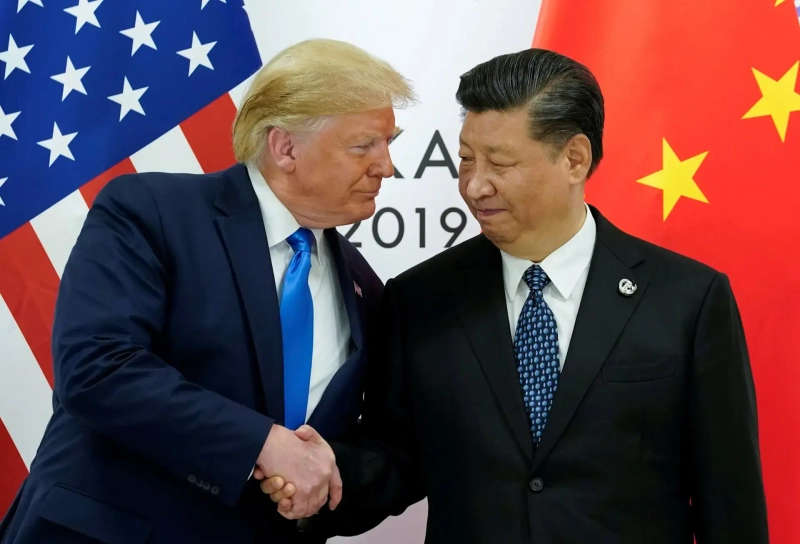
China has declared it will fight to the end against another 50% tariff threat from Trump, increasing the risk of a prolonged trade war between the world's two largest economies.
On the 8th (local time), China's Ministry of Commerce issued a statement regarding Trump's additional 50% tariff threat, stating, "If the US insists, we will fight to the end." President Trump had threatened a few hours earlier to impose an additional 50% tariff if China did not withdraw its retaliatory 34% tariff imposed in response to Trump's 34% tariff.
In addition, Chinese authorities expressed their intention to support the market by allowing yuan weakness and stabilizing the stock market. The central bank has relaxed yuan controls to enhance export competitiveness, and state-owned holding companies and investment firms have started buying stocks. Government officials are reportedly considering early execution of loans and economic stimulus measures to stabilize the market.
The Hong Kong Hang Seng Index, which had fallen the most since 1997 the previous day, surged 3.7% on this day.
According to Bloomberg, the People's Bank of China set the fixed exchange rate at 7.2038 yuan per dollar on this day. The yuan fell to its lowest level since September 2023 in onshore trading following the authorities' remarks on allowing weakness. It also hit a two-month low in offshore trading. China's allowance of yuan weakness could offset the impact of Trump's tariff increases.
Michelle Lam, a China economist at Societe Generale, pointed out, "Investors may need to prepare for trade decoupling between the two countries."
A White House official stated that the additional 50% tariff mentioned by Trump the previous day would be added to the 34% reciprocal tariff effective from the 9th and the 20% increase implemented earlier this year. In this case, the cumulative tariff rate on Chinese goods this year would be 104%, effectively doubling the price of all Chinese products shipped to the US.
The Chinese government has announced plans to increase domestic consumption, anticipating that tariffs will impact exports. Last year, exports accounted for one-third of China's economic growth.
The top eight listed index funds (ETFs) in China saw a net inflow of 42 billion yuan (8.44 trillion won) the previous day. Additionally, a significant number of publicly controlled listed companies announced plans to buy back their shares.
According to Reuters, Chinese regulatory agencies also encouraged such moves. China's State-owned Assets Supervision and Administration Commission stated that it would guide state-owned enterprises to contribute to market stability. The financial regulatory agency announced plans to raise the stock investment limits for insurance companies.
Ding Shuang, chief economist for China and North Asia at Standard Chartered, noted, "The tariffs on China are at a level where additional increases will have diminishing effects at 65%." Most of China's exports to the US have already been affected, and tariffs will have no effect on price-insensitive goods regardless of how high they go.
According to data obtained by Bloomberg from China's Ministry of Transport, China's cumulative port cargo volume (MMT) and cumulative port container throughput (TEU), as well as international freight, showed a decline earlier this year but have been recovering since March.
Nevertheless, China's Ministry of Commerce urged dialogue to resolve the dispute in its statement. As tensions rise, the possibility of a call between Trump and Xi Jinping has decreased. Trump has not yet spoken with the Chinese president since starting his second administration. This marks the longest period a US president has gone without speaking to China after taking office.
Jung-A Kim, Guest Reporter kja@hankyung.com

Korea Economic Daily
hankyung@bloomingbit.ioThe Korea Economic Daily Global is a digital media where latest news on Korean companies, industries, and financial markets.