

"This Could Lead to Our Demise" Mutual Destruction Crisis... US-China 'Big Deal' Two Days After Negotiations
Summary
- The United States and China announced that they have concluded the tariff war of the past several months through tariff reductions.
- The US will leave a 20% tariff related to China's fentanyl, and China will take reciprocal measures to lower retaliatory tariffs to 10%.
- This negotiation settlement exceeds market expectations and is expected to increase the possibility of economic recovery for both countries.
US-China Joint Statement Released
Tariff Rates Reduced by 115% Over 90 Days
US Leaves Only 30% Including Fentanyl
China Also Responds with 10% Basic Tariff
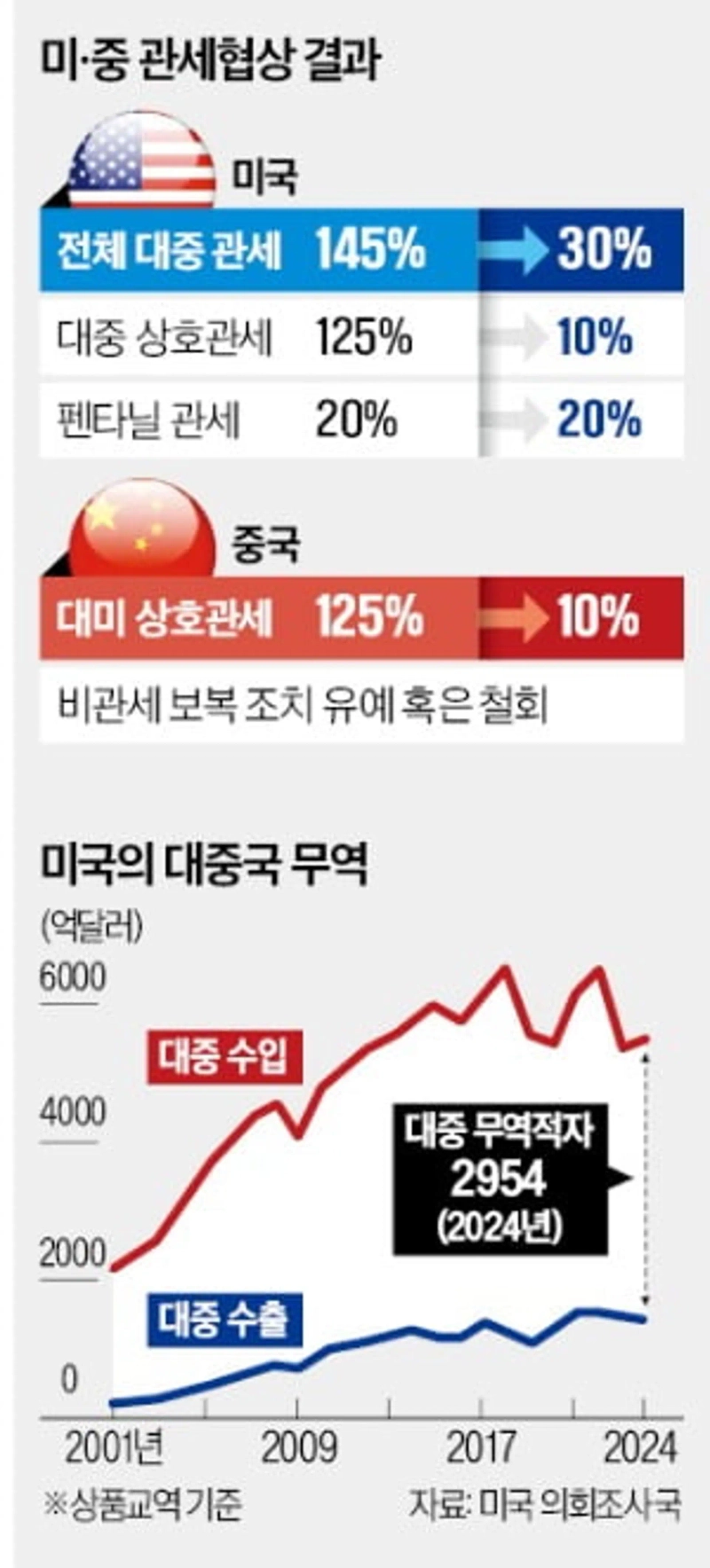
The negotiation results announced by the United States and China on the 12th in Geneva, Switzerland, signify the end of the US-China tariff war that has lasted for several months. The two countries have agreed to lower the ultra-high tariffs that had been raised to the level of 'trade severance.' The US decided to leave only a 20% tariff on fentanyl and a 10% basic tariff, while China also decided to lower the tariffs imposed as retaliation for US reciprocal tariffs to 10%. This measure will be applied for at least 90 days starting from the 14th.
◇"Complete Reset" in Two Days of Negotiations
"This Could Lead to Our Demise" Mutual Destruction Crisis... US-China 'Big Deal' Two Days After Negotiations US President Donald Trump stated on social media on the 10th that the two countries had made "great progress" and that "a complete reset negotiation was conducted in a friendly and constructive manner." Until then, there was little expectation that the two countries would actually agree on a 'big deal.' The Chinese side also showed an aggressive attitude, stating that they would never respond to threats disguised as negotiations during the process of attending this meeting.
On the other hand, the US took a cautious approach. Even when announcing the Swiss meeting plan on the 6th, they did not use expressions that would provoke China, and did not frequently use the word 'tariff,' stating that "this meeting will focus more on easing tensions than on the trade negotiations themselves."
However, during the two days of negotiations, the two countries made faster progress than expected. According to Reuters, the negotiations held in Geneva lasted 10 hours on the 10th and several hours on the 11th. US Trade Representative (USTR) Jamieson Greer said on the 11th, "It is important to understand how quickly we reached an agreement," adding, "This probably reflects that the differences between the two countries are not as large as thought."
The Chinese side also showed satisfaction after the negotiations. He Lifeng, Vice Premier of the State Council, who served as the chief representative of the Chinese side, said, "The two sides have agreed to establish a mechanism for trade and economic consultations, and follow-up discussions will continue." Li Chenggang, China's representative for international trade negotiations at the Ministry of Commerce, said when asked about the timing of the announcement of the negotiation contents, "I believe that the world's response will be positive whenever it is announced."
◇US "Does Not Want Decoupling"
The content of this negotiation exceeds market expectations. Previously, the New York Post reported that the US side expected a tariff rate in the 50% range, and President Trump wrote on social media that 80% was appropriate. The final public tariff rate of 30% suggests that the Chinese side may have initially presented a highly forward-looking negotiation proposal to the US. China has decided to delete all retaliatory measures, including restrictions on rare earth exports.
The fact that the US and China reached a negotiation settlement faster than expected is because the economic situation is not favorable for both sides. After the tariff war, the US saw a plunge in bond prices (sharp rise in bond yields) and a weakening of the dollar value, increasing market confusion. Inflation concerns also grew within the US. China's situation was equally serious. In a situation where concerns about economic recession were already high, export companies were hit hard by the tariff war. In particular, China's manufacturing sector deteriorated to its lowest level since December 2023 last month. Bert Hofman, a professor at the National University of Singapore's East Asian Institute, told the BBC, "China realizes that having negotiations is better than not having them," adding, "They have taken a pragmatic perspective and started negotiations."
◇Will Trump and Xi Jinping Meet?
The two countries plan to pursue a more permanent trade agreement based on this agreement. There is also the possibility of forming a cooperation body to resolve issues such as fentanyl. One of the points to watch in the future is the impact of these tariff negotiation results on the relationship between Chinese President Xi Jinping and President Trump. If the economic issues between the two countries enter a thawing period, President Xi may have room to respond to President Trump's wishes for a phone call or meeting.
Minister Besant said at a press conference that day, "We want more balanced trade, and both sides are committed to achieving this." He added, "Neither side wants 'decoupling.'" The US Federal Reserve's monetary policy, which predicted economic slowdown and inflation based on high tariff rates, is likely to become more accommodative.
Washington = Lee Sang-eun / Beijing = Kim Eun-jung Correspondent selee@hankyung.com

Korea Economic Daily
hankyung@bloomingbit.ioThe Korea Economic Daily Global is a digital media where latest news on Korean companies, industries, and financial markets.