

PiCK
Trump: "Complete Reset of Trade Relations with China"... Markets Say "No Concessions from China, US Defeated"
Summary
- The US and China agreed to a tariff war truce, reducing mutual tariffs for 90 days.
- In future negotiations, the US is expected to focus on reducing its trade deficit.
- It was reported that if negotiations fail after the 90-day suspension period, a 54% tariff could be imposed on Chinese goods.
US-China Tariff Bomb 90-Day Suspension... Three Major Questions
(1) Who is the Winner of the Trade Negotiations?
Foreign media say "Both sides are cornered,
but the US essentially backed down first."
(2) What are the Issues for the 90-Day Negotiations?
US focuses on reducing trade deficit
Fentanyl exports and rare earths may also be issues
(3) What Happens if Negotiations Fail?
Tariffs on China could rise to 54%
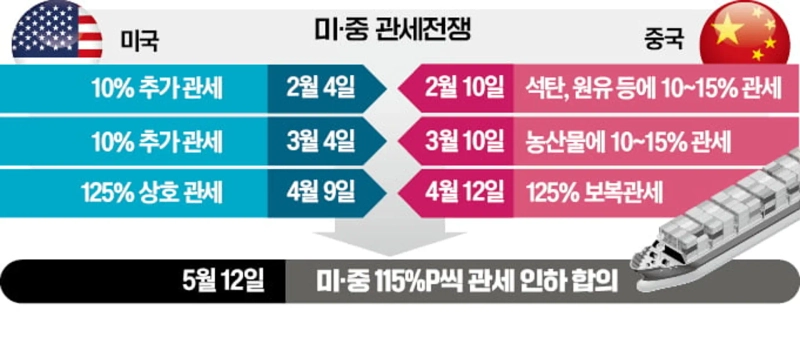
As the US and China agreed to a tariff war truce, reducing mutual tariffs by 115 percentage points each for 90 days, attention is focused on who the winner of this negotiation is, what the issues for the 90-day negotiations are, and what results may occur if the negotiations fail.
◇ Both US and China Claim Victory
The Financial Times (FT) reported on the 12th that "who backed down first in the US-China tariff war could significantly impact future negotiations," and both sides are claiming victory. US President Donald Trump claimed victory in a press conference regarding the agreement to suspend the tariff war with China for 90 days, stating, "We have achieved a total reset of trade relations with China." Trump emphasized, "The biggest achievement is that China has agreed to open its market," adding, "China will suspend and eliminate all non-tariff barriers and has agreed to do so."
On the other hand, Hu Xijin, a famous Chinese commentator and former editor-in-chief of the Global Times, claimed on Chinese social media Weibo that "this agreement is a major victory for China," asserting that "China is the only country that has maintained the 'principle of equality' in negotiations with the US."
However, major foreign media outlets assess that both countries are cornered by the tariff war, with the US essentially backing down first. In this negotiation, Trump agreed to reduce tariffs by 115 percentage points just over a month after imposing a 145% tariff, but failed to secure specific concessions from China beyond the tariff rate. It is assessed that the recent simultaneous decline in US stocks, bonds, and currency, increasing financial market turmoil, significantly impacted the negotiations. China was also in an uncomfortable situation due to sluggish consumption and worsening unemployment among young and low-income groups, but had advantageous aspects due to its communist state characteristics. The pro-Trump New York Post also evaluated that "this negotiation is not a victory but a tourniquet to stop economic bleeding."
◇ "China May Also Sign a US Goods Purchase Agreement"
There is also interest in what negotiations will take place between the US and China during the 90-day suspension period. According to the Wall Street Journal, even reflecting this tariff reduction agreement, the effective tariff on China is estimated to be about 39%. Jamie Greer, a representative of the US Trade Representative (USTR) involved in this negotiation, explained that "the focus of the negotiations with China was on keeping tariffs at a level that is not prohibitive while pursuing the goal of reducing the US trade deficit." Accordingly, it is expected that the US will focus on reducing its trade deficit in the subsequent negotiation process. The WSJ reported that "in the subsequent negotiation process, it is also expected that the US may promise China to purchase US goods on a large scale, similar to what was agreed during Trump's first term."
Additionally, the export of fentanyl raw materials from China, restrictions on the export of rare earths and magnets, and other key minerals are also expected to be issues. Wendy Cutler, Vice President of the Asia Society Policy Institute (ASPI), stated in a statement that "the three-month (suspension period) is an extremely short time to resolve the various contentious trade issues remaining between the US and China," explaining that "the issues include China's overcapacity in manufacturing, excessive subsidies to Chinese companies, and attempts by Chinese companies to transship (circumvent tariffs)."
Concerns are also raised that if there is no additional agreement on tariff reduction after the 90-day suspension period, subsequent conflicts may arise. There is also analysis that the US may gain an advantageous position in additional negotiations due to China's burden of solidifying a 54% tariff on Chinese goods after 90 days. Chief Economist Neo Wang diagnosed that "China may lose more in future negotiations," adding that "economic and political burdens are increasing, especially ahead of the Chinese Communist Party Politburo meeting."
Kim Dong-hyun, Reporter 3code@hankyung.com

Korea Economic Daily
hankyung@bloomingbit.ioThe Korea Economic Daily Global is a digital media where latest news on Korean companies, industries, and financial markets.