

Plunge Due to 20-Year Treasury Auction Shock... 'Sell America' Continues [New York Stock Market Briefing]
Summary
- It was reported that major stock indices plummeted due to weak demand in the U.S. 20-year Treasury auction.
- High-yield Treasury issuance and credit rating downgrade issues have created anxiety among investors.
- Almost all sectors except communication services showed a downward trend, and it was analyzed that UnitedHealth Group's stock price fell sharply due to HSBC's downgrade of its investment rating.
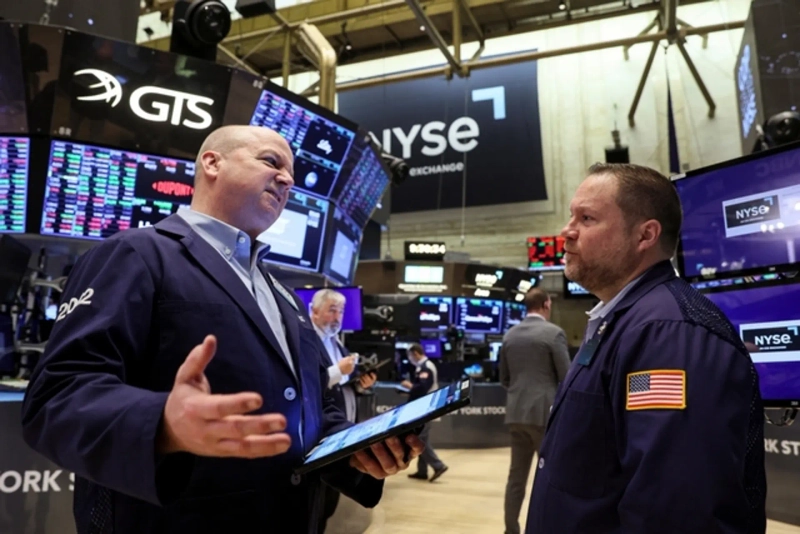
The three major indices of the New York Stock Exchange plummeted. It is interpreted that concerns are growing due to the re-ignition of the persistent 'Sell America' phenomenon, amid confirmed weak demand in the U.S. 20-year Treasury auction.
On the 21st (local time) at the New York Stock Exchange (NYSE), the Dow Jones Industrial Average closed at 41,860.44, down 816.80 points (1.91%) from the previous day. The S&P 500 index fell 95.85 points (1.61%) to 5,844.61, and the Nasdaq Composite Index closed at 18,872.64, down 270.07 points (1.41%).
The shock to the stock market was caused by the results of the U.S. 20-year Treasury auction held at 1 p.m.
In the 20-year auction conducted by the U.S. Treasury Department for $16 billion, the issuance yield was set at 5.047%. This is a sharp increase of 23.7bp compared to the 4.81% in last month's auction and the highest since October 2023. It also exceeded the pre-issuance trading (When-Issued trading) yield by 1.2bp.
The 20-year auction was the first coupon bond auction held after the international credit rating agency Moody's downgraded the U.S. credit rating. Therefore, Wall Street was paying attention to whether the impact of the credit downgrade would appear.
Peter Cardillo, chief market economist at Spartan Capital Securities, analyzed after the 20-year Treasury auction, "We seem to be sinking," adding, "If Treasury yields rise so sharply amid lingering concerns about tariffs and budget battles, it could be a tough headwind for stocks."
The results of the 20-year auction are causing greater concern in conjunction with the tax cut bill pushed by U.S. President Donald Trump. The 30-year Treasury yield also rose above the 5% mark again due to concerns about the Republican tax cut plan.
Brian Mulberry, client portfolio manager at Zacks Investment Management, pointed out, "The issue depends on how much growth will be achieved and what revenue sources will be secured to support the debt issued by the U.S. government," adding, "The current situation, combined with uncertainty surrounding the U.S. economic outlook, is enough to burden stocks."
By sector, all sectors except communication services collapsed. The 'Magnificent 7', referring to seven giant tech companies, all fell except for Alphabet.
Google's stock rose nearly 3% on expectations of AI realization as it unveiled a new form of Google Glass combined with artificial intelligence (AI) services.
UnitedHealth Group, the largest U.S. insurer, fell 6%. This was due to HSBC's downgrade of its investment rating and lowering of the target price from $490 to $270.
The stock of Target, a major U.S. retailer, fell over 5% after announcing disappointing first-quarter results.
Nike, a sports goods company, saw its stock fall more than 4% on news that it is considering raising prices for some high-end sneakers.
Reporter Shin Min-kyung, Hankyung.com radio@hankyung.com

Korea Economic Daily
hankyung@bloomingbit.ioThe Korea Economic Daily Global is a digital media where latest news on Korean companies, industries, and financial markets.