

Despite Tax Cut Bill Passing the House, Treasury Yields Fall... Major Indices Close Mixed [New York Stock Market Briefing]
Summary
- The Republican tax cut bill passed the House, reducing some market uncertainty, but Treasury yields fell, failing to completely alleviate market anxiety.
- The tax cut bill passed by the House includes personal income tax rate and corporate tax rate cuts, and is expected to increase the federal fiscal deficit by $3.8 trillion over the next 10 years.
- Christopher Waller of the Fed hinted at the possibility of a rate cut in the second half of the year, which could be a noteworthy factor for investors.
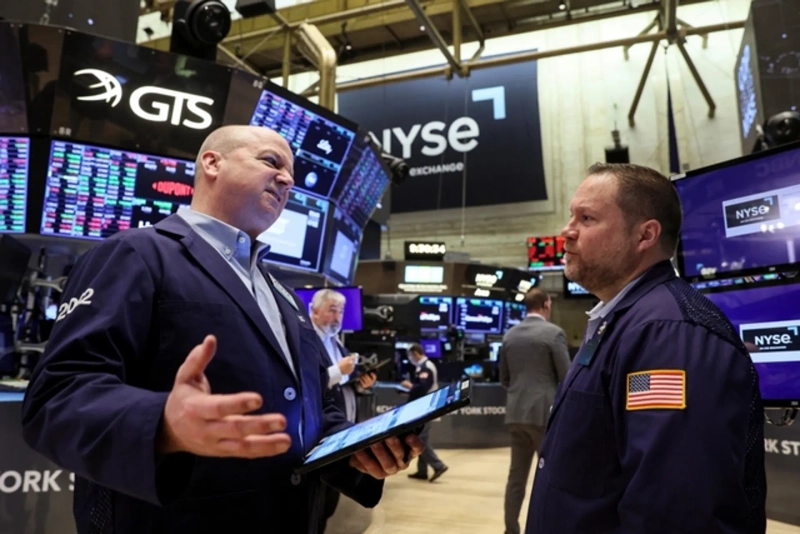
Major indices on the New York Stock Exchange closed mixed. Although the Republican tax cut bill passed the House, reducing some uncertainty, U.S. Treasury yields fell, failing to completely alleviate market anxiety.
On the 22nd (local time) at the New York Stock Exchange (NYSE), the Dow Jones Industrial Average closed at 41,859.09, down 1.35 points (0.00%) from the previous day, the Standard & Poor's (S&P) 500 index fell 2.60 points (0.04%) to 5,842.01, and the Nasdaq Composite Index rose 53.09 points (0.28%) to 18,925.73.
As the tax cut bill pushed by U.S. President Donald Trump passed the House, concerns about the fiscal deficit led to a rise in Treasury yields. As a result, the indices showed a sluggish trend in early trading.
The tax cut bill passed by the House includes extensions of personal income tax rate and corporate tax rate cuts, and tax credit expansions. The Congressional Budget Office (CBO) predicted that if this bill is finalized in the Senate, the federal fiscal deficit will increase by $3.8 trillion over the next 10 years.
However, as the details of the tax reform bill became known, the stock market began to accept the House's passage of the tax reform bill as a reduction in uncertainty. As a result, bond buying led to a decline in Treasury yields, and as the dollar index recovered to the 100 level, major indices also showed an upward trend.
However, a sudden wave of selling in the late session caused the major indices to give up much of their gains.
By sector, consumer discretionary, technology, and communication services showed strength. In contrast, utilities fell 1.4%.
Among the 'Magnificent 7', which refers to seven giant tech companies, only Apple fell. Google rose more than 1% as expectations remained after unveiling its latest products and services, including Google Glass with artificial intelligence (AI) features, the previous day.
With the Republican tax cut bill passing, major solar-related stocks plummeted. In particular, Sunrun's stock price plunged 37%, SolarEdge fell 25%, and First Solar dropped 4%.
U.S. cloud-based data analytics company Snowflake saw its stock jump 13% on strong first-quarter results.
Christopher Waller, a member of the U.S. Federal Reserve (Fed), hinted at the possibility of a rate cut in the second half of the year in an interview with Fox Business. He said, "If tariffs are lowered by close to 10% and everything is confirmed, completed, and implemented by July, we could be in a good situation in the second half," adding, "If so, the Fed would be in a good position to implement a rate cut in the second half."
The U.S. economy showed expansion in both the service and manufacturing sectors in May. S&P Global announced that the preliminary U.S. services Purchasing Managers' Index (PMI) for May was 52.3. The preliminary manufacturing PMI for May also exceeded the previous month's 50.2, reaching the highest level since June 2022.
The U.S. Department of Labor reported that the number of weekly initial jobless claims for the week ending on the 17th was 227,000. This was below both the previous week's level (229,000) and the market expectation (230,000), indicating a decrease from the previous week.
According to the Chicago Mercantile Exchange (CME) FedWatch Tool, the probability of the federal funds rate remaining unchanged in July was reflected at 73.1%. This was slightly up from the previous day's close.
The Chicago Board Options Exchange (CBOE) Volatility Index (VIX) fell 0.59 points (2.83%) to 20.28.
Hankyung.com reporter Han Kyung-woo case@hankyung.com

Korea Economic Daily
hankyung@bloomingbit.ioThe Korea Economic Daily Global is a digital media where latest news on Korean companies, industries, and financial markets.