

Trump Tells Apple to "Move Factories".. "Samsung Will Be Included" [Global Market A/S]
Summary
- President Trump has threatened tariffs on Apple unless it manufactures in the U.S., and suggested that Samsung and other companies might also be targeted.
- Apple's stock fell 3.02% due to this tariff pressure, and future price increases are expected.
- Trump's remarks led to a decline in European stock markets and increased economic uncertainty.
President Donald Trump resumed tariff pressure on the European Union and Apple, causing significant market fluctuations. Despite the risk of increased fiscal deficit due to the tax cut bill passed by the U.S. House the previous day, U.S. long-term Treasury yields fell.
On the 23rd local time at the New York Stock Exchange (NYSE), the S&P 500 index closed at 5,802.82, down 0.67% from the previous trading day, and the tech-heavy Nasdaq fell 1% to 18,737.21 due to the decline in Apple stock. The Dow Jones Industrial Average closed down 0.61% at 41,603.07.
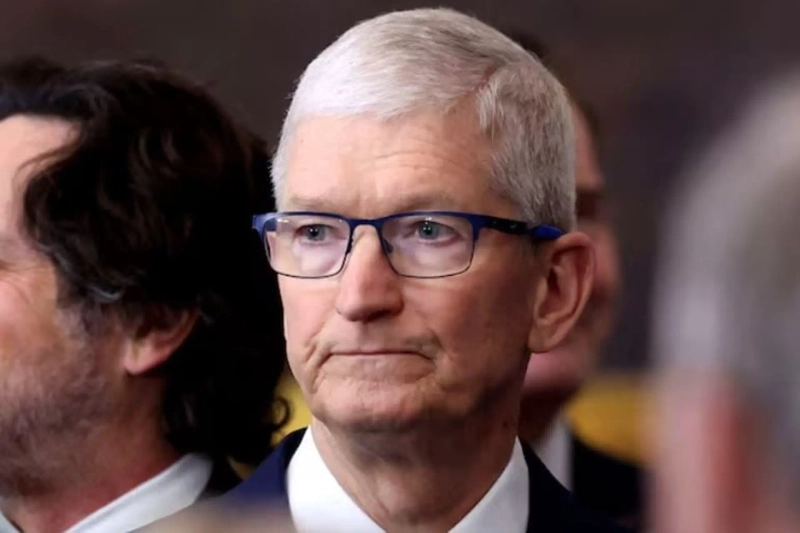
President Trump stated on his social media platform, Truth Social, around 7 a.m. that "I have long told Tim Cook that iPhones sold in the U.S. should be manufactured in the U.S., not in India or anywhere else," and "If not, Apple will have to pay at least a 25% tariff."
Apple has established a large-scale manufacturing and supply chain in Zhengzhou, China, and relocating its component supply chain from countries like South Korea and Taiwan is virtually impossible. KeyBank analyst Brandon Nispel predicted, "This is a clear negative factor, making price increases inevitable for the next product, iPhone 17." Apple, which fell about 4% before the market opened, ended the day down 3.02%.
President Trump reaffirmed this stance at a press conference following an executive order on additional nuclear power plant construction held at the White House at 2 p.m. Trump said it is possible to impose tariffs on single companies like Apple and American companies, stating, "There will be more, and all companies like Samsung that make such products will be included."
Trump said, "Otherwise, it's not fair," and set a deadline for tariff implementation, telling Apple to "be properly prepared by the end of June." Trump emphasized, "Tim Cook said he would build a factory in India, but it cannot be sold here without tariffs." He also argued that if American companies like Walmart and Apple bear the tariffs, it will not burden consumers with price increases.
After the tariff deferral agreement with China, Trump began adjusting the level of tariff negotiations with each country again. He recommended imposing a 50% tariff on the European Union (EU) from June 1, criticizing, "They have imposed strong trade barriers, value-added taxes, and excessive penalties on companies to win against the U.S., resulting in an annual trade deficit of $250 million, which is unacceptable."
Due to Trump's tariff pressure, European stocks fell nearly 2%, and Germany's Volkswagen also fell more than 3% on its domestic stock market. In the U.S. stock market, TSMC, a commissioned semiconductor manufacturer, fell 2.15%, and Qualcomm and ARM also recorded declines of over 1%. Among the top seven tech companies, Microsoft, Nvidia, Alphabet, Amazon, and Meta all fell over 1%, dragging down the index.
Amid Trump's tough stance, U.S. Treasury Secretary Scott Besant stepped in to mitigate market shocks. In an interview with Bloomberg, Secretary Besant explained that the tax cut bill passed by the House the previous day is a measure to control spending and lower the fiscal deficit ratio to GDP. He emphasized, "We have talked about a fiscal deficit ratio to GDP in the 3s by 2028," and "Our job is to change the trajectory so we can go down."
Secretary Besant also mentioned tariffs, saying, "There are 18 important trade partners, and everyone really needs to focus," adding, "I think several large-scale negotiations will be unveiled in a few weeks." However, he noted, "The EU issue is because each of the 27 countries has different demands," and predicted that Germany's new government could break the deadlock in negotiations.
As economic uncertainty due to tariffs grows, the Federal Reserve's caution is also deepening. Chicago Fed President Austan Goolsbee expressed concern, saying, "Even a 10% tariff would have been the highest tariff rate in the world in 90 years, but a 50% tariff is on a different scale." He stated, "If we receive a new tariff rate every few weeks, it could disrupt supply chains and raise inflation risks similar to those after 2020." According to the Chicago Mercantile Exchange Group, the probability of the Fed holding rates steady at the Federal Open Market Committee on June 18 is 96%.
President Goolsbee pointed out, "One concerning aspect is that indicators are delayed," suggesting that policy changes could be slow, as "the price index comes out a month later, and GDP data comes out a quarter later, so something could already happen."
Meanwhile, President Trump approved an investment by Japan Steel in US Steel, a symbol of American manufacturing, later that afternoon. After reviewing security threats by the Committee on Foreign Investment in the United States (CFIUS), the final approval of the partnership was made, causing US Steel's stock to surge 21% that day.
With the signing of an executive order to quadruple U.S. nuclear capacity, small nuclear power developers such as Oklo and NuScale Power jumped 23% and 19%, respectively, and uranium supplier Cameco surged 11% on the New York Stock Exchange. Constellation Energy also recorded a 2% rise as the plan to add 10 large nuclear plants by 2030 was included.
Reporter Jonghak Kim jhkim@wowtv.co.kr

Korea Economic Daily
hankyung@bloomingbit.ioThe Korea Economic Daily Global is a digital media where latest news on Korean companies, industries, and financial markets.