

"Korea's Growth Rate to Drop by 1%p Due to US Tariff Uncertainty"
Summary
- It is forecasted that Korea's GDP growth rate will drop by up to 1 percentage point due to the imposition of US tariffs and the expansion of trade uncertainty.
- It was stated that high-intensity tariffs on automobiles and steel are scheduled, raising concerns about economic shock.
- A won appreciation strategy is expected in the tariff negotiations with the US, and cooperation for response is advised.
Capital Market Research Institute Forecast
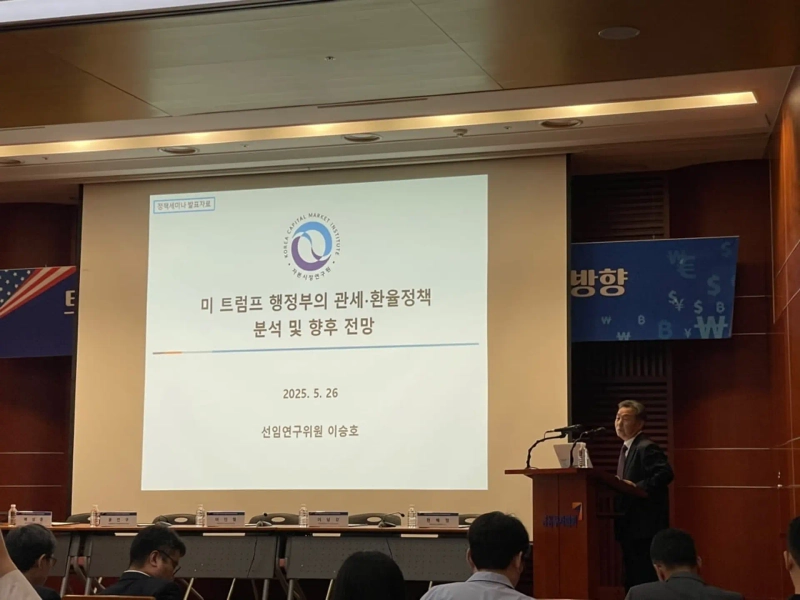
There is a forecast that Korea's Gross Domestic Product (GDP) growth rate will drop by 1 percentage point due to the imposition of US tariffs and the resulting expansion of trade uncertainty.
Researcher Jang Bo-seong of the Capital Market Research Institute said at a seminar on the impact and response direction of the Trump administration's foreign economic policy held at the Yeouido Financial Investment Center at 2 p.m. on the 26th, "The US is the second-largest country in terms of export share (19%), and key items such as automobiles are exposed to high-intensity tariff threats," he said.
Researcher Jang predicted that if US tariff uncertainty persists, this year's domestic GDP growth rate will fall by 0.6 percentage points from the previous forecast. Recently, the International Monetary Fund (IMF) lowered Korea's growth forecast for this year from 2.0% to 1.0%. It is pointed out that if the country's mutual tariff policy (Korea 25%) deferred for 90 days is officially implemented, the economic shock will be even greater. The figure assumes that a 25% item tariff is applied to Korean automobiles and steel, and a basic tariff of 10% is applied to other items.
He said, "It has been shown that the mere expansion of uncertainty in US trade policy negatively affects domestic real economic activity," and advised, "It is necessary to conclude trade negotiations before the mutual tariff deferment deadline and buffer the impact of uncertainty with a monetary easing fiscal policy."
Senior Researcher Lee Seung-ho of the Capital Market Research Institute predicted that the US would pursue a 'won appreciation' strategy in the tariff negotiations with Korea.
Researcher Lee said, "Korea is in a suitable situation as a priority negotiation target as it records a trade surplus with the US," and predicted, "Soon, the US may pursue an exchange rate adjustment strategy using tariffs and defense costs as leverage." He continued, "When the won appreciation is demanded, Korea should strive to ensure that the magnitude and speed of the won's appreciation compared to the currencies of competing export countries are not excessive."
He explained that it is necessary to persuade that structural factors such as external uncertainty and the private sector's overseas securities investment boom make it difficult for the authorities to artificially adjust the exchange rate.
He added, "If the US promotes a multilateral exchange rate agreement, it should seek a joint response plan through cooperation with ASEAN (Association of Southeast Asian Nations) +3 (Korea, China, Japan)," and "It should be noted that the past Plaza Accord was the starting point of the 'Lost 30 Years' (the long-term recession of the Japanese economy since the early 1990s)."
Reporter Jo Ah-ra rrang123@hankyung.com

Korea Economic Daily
hankyung@bloomingbit.ioThe Korea Economic Daily Global is a digital media where latest news on Korean companies, industries, and financial markets.