

Is the New Government Starting to Compile an Additional Supplementary Budget of Around ₩30 Trillion?
Summary
- It was reported that the new government is likely to pursue an additional supplementary budget of around ₩30 trillion, attracting significant attention from investors.
- It was stated that since the OECD is expected to downgrade Korea's economic growth forecast, uncertainty in the investment environment will likely increase.
- It was reported that major economic indicators affected by interest rate cuts at home and abroad and sluggish business conditions will play an important role in investment decisions.
Monday Outlook
Jeong Young-hyo, Deputy Editor, Economics Department

It is expected to be a week in which the course of the Korean economy will change significantly, with the presidential election on the 3rd serving as a major turning point. Attention is focused on what kind of economic policies the new government will introduce to overcome deteriorating trade conditions and sluggish domestic demand.
Over the next two months, the new government is scheduled to announce its economic policy direction, tax reform plan, and the 2026 budget proposal one after another. Amid all this, the second supplementary budget is drawing particular interest. Both Lee Jae-myung of the Democratic Party of Korea and Kim Moon-soo of the People Power Party have pledged an additional budget of around ₩30 trillion to revitalize the sluggish economy, so it is expected that a large-scale supplementary budget will be announced regardless of who is elected.
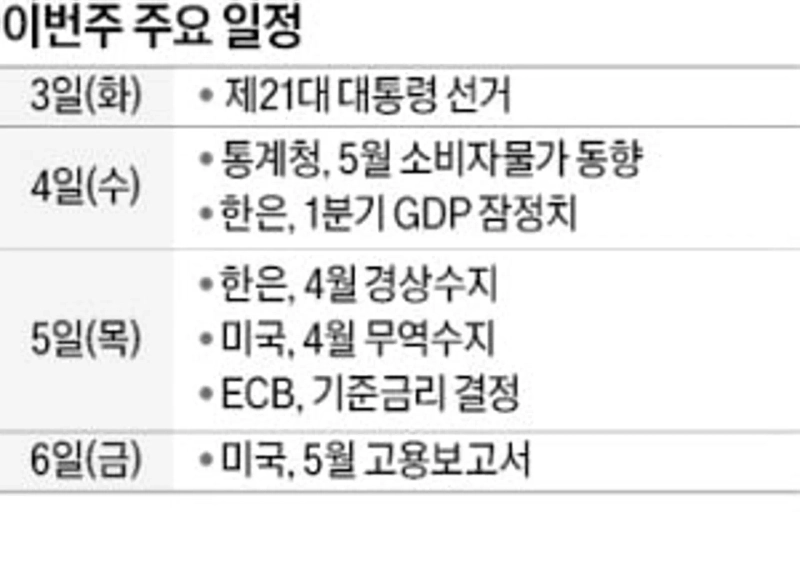
On the day of the presidential election, the Organisation for Economic Co-operation and Development (OECD) will also announce its economic outlook. In its 'Interim Economic Outlook' last March, the OECD projected Korea's economic growth rate for this year at 1.5%. With major domestic and international institutions having lowered their growth forecasts for Korea to the 0% range over the past 2–3 months, it is virtually certain that the OECD will join this round of downward adjustments.
On the 4th, Statistics Korea will release the consumer price index trends for May. So far this year, the inflation rate has shown stable movement in the low 2% range. In both March and April, prices rose 2.1% compared to the same period last year. However, perceived inflation remains high. Due to rising import prices, processed food and dining out prices continue to increase in the 4% range. The outlook is that this high perceived inflation will persist in May, while consumer prices will remain stable. Variables that could affect inflation include the prolonged Donald Trump–initiated tariff war and continued sluggishness in the domestic market.
The Bank of Korea will announce preliminary first-quarter GDP figures on the 5th. In the preliminary estimate released on the 24th of last month, Korea's economy posted negative growth for the first time in three quarters (down 0.2% from the previous quarter), which came as a shock. As various economic indicators such as the March industrial activity trend—not adequately reflected in the initial estimate—also showed weak consumption and investment, many expect the preliminary figure will be unlikely to improve over the advance estimate. On the same day, Korea's April current account and the U.S.'s April trade balance will be announced, providing a chance to closely observe the ripple effects of the Trump-led tariff war.
The European Central Bank (ECB) will also decide the base rate that day. Since September last year, the ECB has lowered the base rate for six consecutive times. The market expects the ECB to cut the rate from 2.25% per annum to 2.0% for a seventh consecutive cut on the 5th.

Korea Economic Daily
hankyung@bloomingbit.ioThe Korea Economic Daily Global is a digital media where latest news on Korean companies, industries, and financial markets.