

Kim Moon-soo "Golden Cross"・Lee Jun-seok "Kim Lost"... What is happening with the 'internal opinion poll'? [Politics Inside]
Summary
- During the poll blackout period, each party is focusing on mobilizing its support base by citing internal opinion polls.
- The People Power Party and Democratic Party of Korea each forecast a decisive final battle, emphasizing changes in the race and the convergence of party support rates.
- Lee Jun-seok's camp highlighted that increasing his vote share could benefit him in shaping the future conservative political landscape.
Mention of Each Party's Internal Opinion Polls
Effect of Mobilizing Support Base
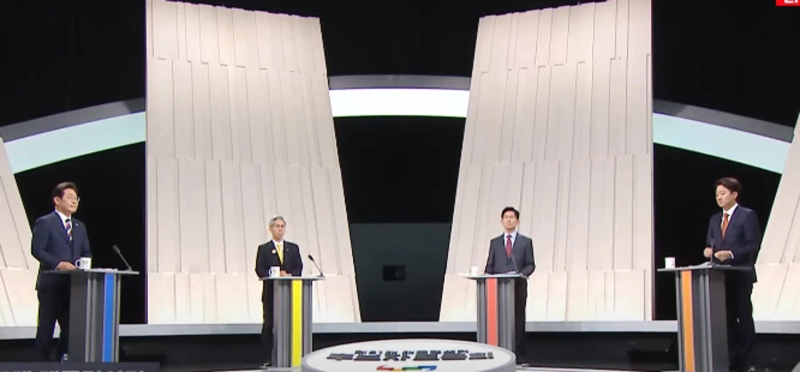
During the so-called "blackout period," when the publication of presidential opinion poll results is prohibited, each political party is mentioning internal opinion polls to encourage and mobilize their supporters.
According to political circles on the 2nd, the previous day, Kim Moon-soo, the People Power Party presidential candidate, upon completing a campaign rally in Uijeongbu, Gyeonggi Province, stated, "Results from several opinion polls show a 'Golden Cross' where I have surpassed Lee Jae-myung, the Democratic Party of Korea presidential candidate. The game has flipped and a great reversal is underway." He claims that recent internal polls have shown public opinion turning in his favor.
Beginning his campaign in Gwanggyo New Town, regarded as one of his major achievements during his term as Gyeonggi Governor, Kim remarked, "This place is more than ten times larger than Daejang-dong, which is less than 300,000 pyeong, but unlike Daejang-dong—which is said to have the most corruption and suspicions since ancient times, with many deaths and arrests—not a single person has died here." He intended to highlight himself by comparing his performance to that of Lee Jae-myung, who succeeded him as Gyeonggi Governor.
The Democratic Party of Korea's position is that "People Power Party has no grounds to be confident about a 'Golden Cross.'" Previously, Cheon Jun-ho, head of strategy at the Democratic Party's Central Election Committee, said at a press briefing on the 30th of last month, "When we combined the results of publicly available opinion polls just before the publication ban based on telephone interviews, the current opinion poll landscape is as expected—major candidate support rates are converging to their party support rates." He added, "We expect that trend to continue. Both sides' supporters are likely to rally in the final stages of the election. Therefore, results different from those predicted by polls cannot be ruled out. We will remain vigilant and observe developments until the very end." He also stressed, "The overall election structure does not change."
On the same morning, Lee Jun-seok of the Reform New Party said on Facebook, "Based on detailed investigation and data analysis, Kim Moon-soo has already clearly lost. Regardless of unifying candidacy, he cannot win by any means," and that "A vote for me, Lee Jun-seok, is seed money for the conservative bloc to start anew with youth."
During the blackout period, each campaign conducts internal polls to develop strategies. The regulation on the publication of opinion poll results from six days before election day has been in effect since 2005. Previously, in 1992 the limit was 28 days before the election, and in 1994 it was 22 days prior. The restriction aims to prevent fairness concerns such as the bandwagon effect (voters rallying to the predicted winner) and the underdog effect (support for the perceived loser) if poll results are released right up to the election. However, most major countries do not have such blackout periods. According to the World Association for Public Opinion Research, among countries including the United States, United Kingdom, Canada, and Japan, 34% have no publication ban, 25% limit the period to 1–6 days, and 18% set a blackout period of 7 days or more.
Such messages from each campaign are interpreted as attempts to rally their support base. The People Power Party is trying to shift voter sentiment by framing the contest as "an election that is still winnable," even as polls show Lee Jae-myung ahead.
From the Democratic Party of Korea's perspective, the position is, "This election is like a civil war, so the victory must come with a definitive margin." Broadcaster Kim Eo-jun said on his YouTube broadcast on the same day, "In the previous presidential election, when the results were revealed, the difference was just 0.7 percentage points. Until then, most polls had shown a difference of over 10 points, which lowered the turnout among Lee Jae-myung’s main support group in their 40s. The politically engaged saw such news and thought, 'Maybe this election will be tough,' so they didn't vote, having been gaslighted." He urged core supporters to go and vote.
With opinion polls indicating Lee Jun-seok of the Reform New Party in third place under a three-way structure, the party appears intent on maintaining the upward momentum seen before the blackout period, with support rates rising to as much as 10%. Even if he loses, the calculation is that a higher-than-expected vote share will strengthen Lee Jun-seok's position in the conservative landscape after the election.
Shin Hyun-bo, Hankyung.com reporter greaterfool@hankyung.com

Korea Economic Daily
hankyung@bloomingbit.ioThe Korea Economic Daily Global is a digital media where latest news on Korean companies, industries, and financial markets.