

OECD: This year, global economy to grow by 2.9%... Korea's growth limited to 1.0%
Summary
- The Organisation for Economic Co-operation and Development (OECD) lowered this year's global economic growth rate forecast to 2.9% and downgraded Korea’s growth to 1.0%.
- The OECD stated that rising trade barriers, deteriorating financial conditions, declining consumer confidence, and heightened policy uncertainties have contributed to the slowdown.
- The OECD emphasized the need for efforts such as strengthening supply chain resilience, promoting competition, and easing policy uncertainty to aid growth recovery.
Korea’s forecast downgraded: 2.1% → 1.5% → 1.0%
"Trade wars, financial conditions, declining consumer confidence, and low investment slow growth"
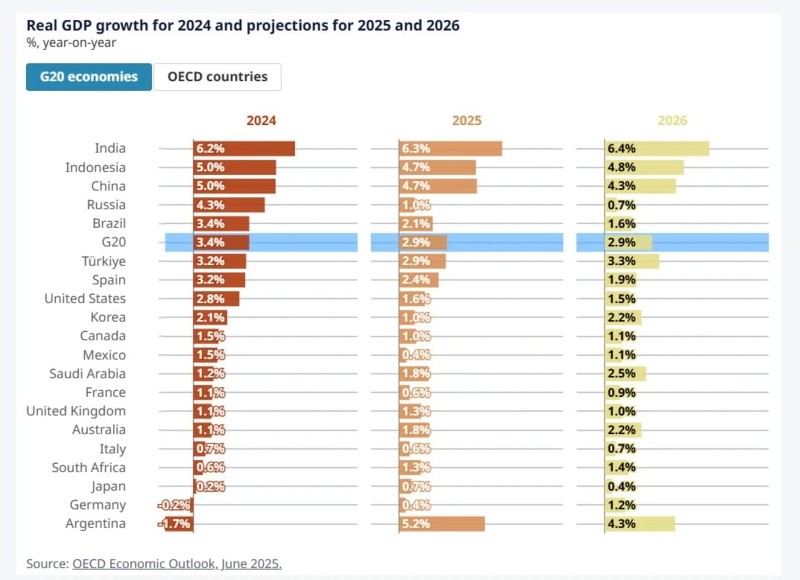
The Organisation for Economic Co-operation and Development (OECD) once again revised its 2024 global GDP growth outlook downward from 3.1% in the March report to 2.9%. Korea's growth forecast for this year was lowered from 2.1% at first to 1.5% in March, and now again to 1.0%.
This outlook was presented in the OECD’s 2025 economic outlook report, released on the 3rd (local time). The report is based on tariff rates as of May. The OECD diagnosed that this year, economic growth is being threatened by a surge in trade barriers, deteriorating financial conditions, weakening business and consumer confidence, and increasing policy uncertainty.
In last year’s outlook, Korea was expected to grow by 2.1% this year, but after the Trump tariffs, the March report lowered this to 1.5%, and now again to 1.0%. This is less than half of last year's 2.1% growth rate. Korea's inflation is forecast at 2.1% for this year.
The US GDP growth rate was also further downgraded from 2.2% projected in March to 1.6%, recording the largest drop among G20 countries. US headline inflation is forecast at 3.2% this year, likely exceeding expectations of the Federal Reserve and the market.
China is expected to grow by 4.7% this year, down from 5.0% last year.
The OECD pointed out that this slowdown in growth was greatly influenced by weak investment due to increased uncertainty. It also mentioned that, in many countries, a slowdown in housing and public investment has weakened housing affordability and public infrastructure.
Assuming tariff rates as of mid-May remain, the OECD expects global GDP growth to slow from 3.3% last year to 2.9% this year and remain at 2.9% next year. The March report projected global growth at 3.1% for this year and 3% for 2026.
Korea is forecast to recover to 2.2% next year, but the US is estimated to grow only 1.5% next year, slightly weaker than this year.
OECD: "This year, global economy to grow by 2.9%... Korea's growth limited to 1.0%"
The OECD’s inflation outlook reveals significant differences between the US and other major economies.
While G20 countries are expected to see inflation ease to 3.6% in 2025 from the March estimate of 3.8%, the US figure was revised up from the previous 2.8% to 3.2%. The OECD stated that US inflation could approach 4% by the end of 2025.
The OECD stated that international efforts are needed to prevent further increases in trade barriers in order to restore growth rates. It also indicated that reforms to promote diversification among suppliers and buyers for businesses, and to strengthen the resilience of supply chains, are needed in parallel.
Additionally, it mentioned that central banks should not let their guard down against inflation during times of heightened uncertainty and rising trade costs. At the same time, it stressed the need to keep public debt at sustainable levels, implement fiscal reforms, reduce policy uncertainty to boost corporate investment, promote competition, lower entry barriers, and support entrepreneurship.
Jungah Kim, contributing reporter kja@hankyung.com

Korea Economic Daily
hankyung@bloomingbit.ioThe Korea Economic Daily Global is a digital media where latest news on Korean companies, industries, and financial markets.