

The Smallest Presidential Election Vote Gap Was 0.73%P During Yoon's Election... The Largest Gap Was 22.53%P During Lee Myung-bak's Election
Summary
- In South Korean presidential elections, the vote gap is a crucial variable that determines the stability and speed of government operation after the election.
- If the vote gap is large, as in the 2007 election, policy implementation and reform drives proceed more smoothly.
- In contrast, when the gap is narrow, there is a rise in cooperation and appointments/legislation tasks due to opposition party checks.
The Gap with the Runner-up Determines Governmental Momentum
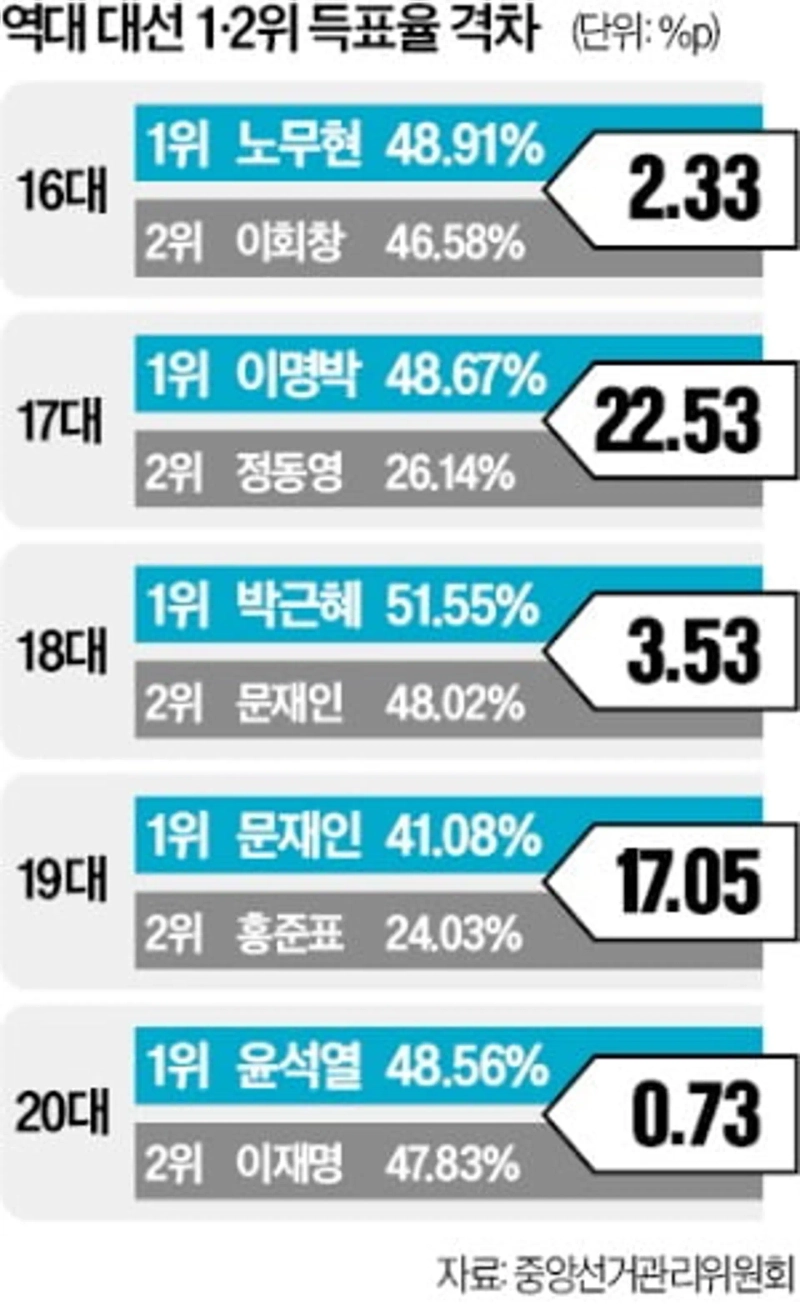
Looking back at past presidential elections in Korea, the 'vote gap' has been a variable as important as the winner in impacting the future political landscape. The president is decided even by a single vote, but the percentage gap between the president and the runner-up has played a major role in determining the pace and stability of national governance.
The smallest presidential election vote gap was 0.73%P during Yoon's election... The largest gap was 22.53%P during Lee Myung-bak's election. A representative case is the 2007 17th presidential election. At that time, the Grand National Party candidate Lee Myung-bak recorded a 48.67% vote share, beating Chung Dong-young of the United New Democratic Party (26.14%) by a whopping 22.53 percentage points. With overwhelming support as political legitimacy, former President Lee rapidly pushed forward major policies such as deregulation, the Four Rivers Project, and public enterprise reforms. Although there was opposition from the minority parties, he was able to drive bold reforms based on public support.
The 2022 presidential election was just the opposite. Candidate Yoon Suk-yeol received 48.56%, and Lee Jae-myung received 47.83%—a gap of only 0.73 percentage points, the smallest in Korean presidential election history. From the formation of the Presidential Transition Committee, Yoon faced strong resistance from the opposition, and confirmation hearings for the Prime Minister and ministers were blocked repeatedly in a divided parliament.
Factors influencing the vote gap include the 'candidate array' and the 'regime judgment theory.' In the 2007 election, the conservative camp fielded a single candidate, Lee Myung-bak, while the Democratic side was divided among Chung Dong-young, Moon Kook-hyun, Lee In-je, and Kwon Young-ghil. This led to the large final vote gap.
However, in 2022, Yoon Suk-yeol and Lee Jae-myung together took 96.4% of all valid votes, forming a clear two-way race. Both sides' support bases solidified, narrowing the gap. The push for regime change also affected the final vote difference.
In this upcoming June 3 early election, various polls up to the 27th of last month have consistently shown Lee Jae-myung of the Democratic Party of Korea in first place. A political insider said, "If Lee wins by a double-digit margin, he can start from a relatively advantageous position for driving reforms and leading appointments or legislation. On the other hand, if the margin is slim, he will have to prioritize cooperation with the opposition."
Yang Hyun-joo, reporter hjyang@hankyung.com

Korea Economic Daily
hankyung@bloomingbit.ioThe Korea Economic Daily Global is a digital media where latest news on Korean companies, industries, and financial markets.