

Seoul and Gyeonggi voter turnout nears 80%... Strong 'judgment on administration' sentiment among moderates
Summary
- This presidential election saw a nationwide turnout of 78.9%, marking the highest since the 2000s.
- The turnout in Seoul and Gyeonggi, including the capital region, neared 80%, reflecting strong moderate sentiment for judgment on the administration.
- Regional increases in turnout, such as in Gwangju, Honam, Daegu, and Ulsan, highlighted voters' desire for administration change or judgment.
Gwangju No.1... Jeonnam, Sejong, Jeonbuk in order
Conservative Daegu and Ulsan also surpass 80%
Lee and Kim support bases show growing consolidation
Capital region turnout exceeds previous election
Polls also show a lead for 'administration change'
Jeju 'lowest' ... Chungcheong falls below average
21st presidential election turnout at 78.9% ... Highest since the 15th election
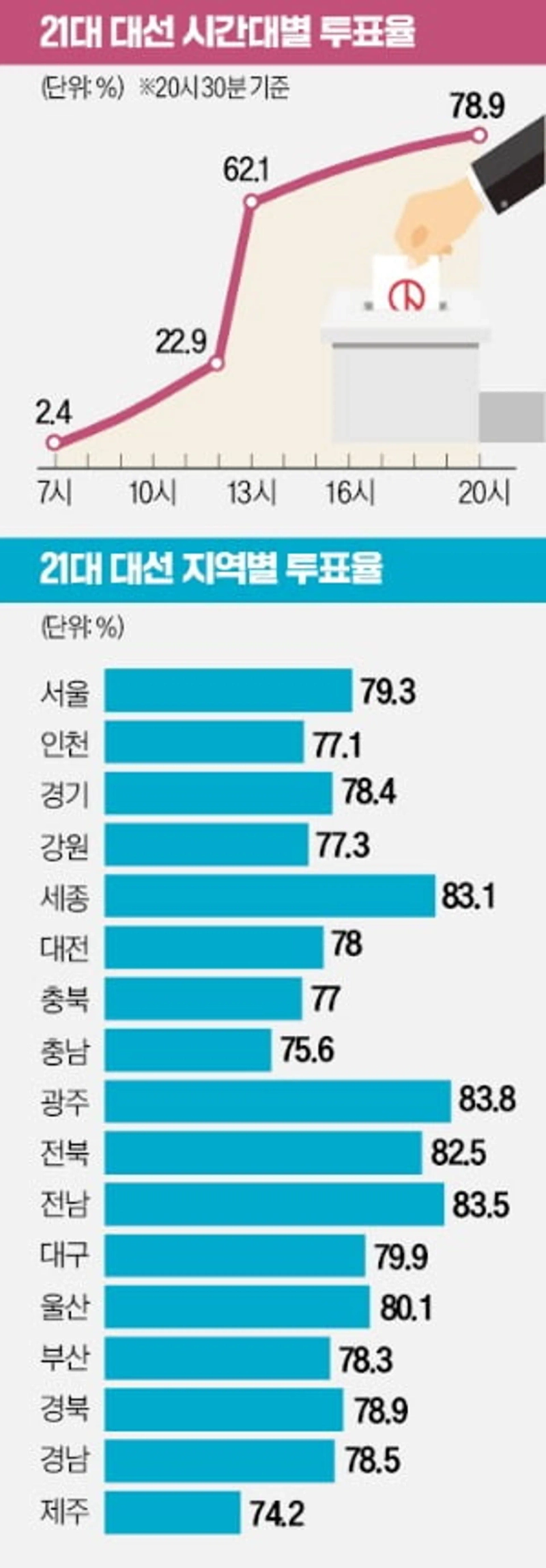
As of 8:30 p.m. on the 3rd, the day of the 21st presidential election, the provisional nationwide voter turnout was tallied at 78.9%, 1.8% points higher than the 20th presidential election. This is the highest since the 15th election in 1997 (80.7%). It surpassed the record of the 19th election in 2017 (77.2%). By region, Honam, which showed heated early voting enthusiasm, was overwhelming, while conservative-leaning Daegu and Ulsan also exceeded the average. With the call for judgment on the administration, sparked by former President Yoon Suk-yeol’s 12·3 emergency martial law incident, growing strong, it particularly drove progressive voters to the polls, while conservatives also rallied in response to calls for an administration change.
◇ Highest turnout among 2000s elections
Seoul and Gyeonggi voter turnout nears 80%... Strong 'judgment on administration' sentiment among moderates
According to the National Election Commission, a total of 35,004,540 out of 44,391,871 eligible voters cast their ballots at the 14,295 polling stations nationwide between 6 a.m. and 8 p.m. The 78.9% turnout is the highest among presidential elections held since 2000. The turnout for presidential elections in the 2000s was as follows: 19th (77.2%), 20th (77.1%), and 18th (75.8%). Including the 16th and 17th elections, the average turnout for the 2000s was approximately 73%.
Voter turnout remained higher throughout the morning than in the previous election. It started at 2.1%, 0.3% points higher than at the same time in the 20th election, with the gap widening to 0.7% points at 8 a.m., 1.1% at 9 a.m., 1.7% at 10 a.m., 2.3% at 11 a.m., and 2.6% at noon. By 1 p.m., when early voting (34.74%) and overseas/shipboard/absentee voting (undisclosed) were included, the gap narrowed to 0.8% points. This is believed to be due to the 20th election’s historically high early voting turnout of 36.93%.
◇ Gwangju 'No.1', Daegu and Ulsan also exceed average
Seoul and Gyeonggi voter turnout nears 80%... Strong 'judgment on administration' sentiment among moderates
By region, Gwangju recorded the highest turnout among the 19 metropolitan cities and provinces at 83.8%. Jeonnam, Sejong, and Jeonbuk followed at 83.5%, 83.1, and 82.5%, respectively, all above 82%. Except for Sejong, all Honam areas showed early voting rates above 50%, boosting the overall average. In the 20th election as well, Gwangju (81.5%), Jeonnam (81.1%), and Jeonbuk (80.6%) recorded high turnouts.
Analysts say the strong desire for judgment and change of administration, especially in progressive-leaning Honam, led to higher turnout rates. Disappointment in the Yoon Suk-yeol administration, fueled by martial law, insurrection, and impeachment, translated into greater participation at the polls. Previous polls also showed greater support for administration change than for its continuation.
Turnout was also higher in the capital region, considered the biggest battleground, compared to the previous election, suggesting that the desire to judge the administration was a major factor. Seoul, which posted a 77.9% turnout in the previous election, climbed to 79.3%. Gyeonggi, the political base for both Democratic Party candidate Lee Jae-myung and People Power Party candidate Kim Moon-soo, reached 78.4%, only 0.4% points below the average, as in the previous election. The lowest figures were in Jeju (73.4%), followed by Chungnam (74.8%) and Chungbuk (76.1%). Both regions also fell below average in the 20th election.
Ulsan topped 80% at 80.1%, the only Yeongnam region to do so, and Daegu, which had the lowest early voting (25.63%), climbed to 79.9%. Gyeongnam came in at 78.5%. Separate from voter disappointment with the ruling People Power Party, there was also significant sentiment that the Democratic Party’s Lee Jae-myung should not be elected president.
Ji-eun Ha / Jin-kyu Kang / Seong-soo Bae hazzys@hankyung.com

Korea Economic Daily
hankyung@bloomingbit.ioThe Korea Economic Daily Global is a digital media where latest news on Korean companies, industries, and financial markets.