

"Promoting on SNS, payment via Bitcoin"... 60% of Drug Offenders Are in Their 20s and 30s
Summary
- Drug transactions using cryptocurrencies such as Bitcoin based on online platforms are rapidly increasing among people in their 20s and 30s.
- Prosecutors analyze that increased drug distribution on anonymous platforms like the Dark Web and Telegram can pose associated risks for investors.
- Cases of domestic drug manufacturing and distribution by foreigners are on the rise, with authorities announcing plans to step up international joint investigations and crackdowns.
Supreme Prosecutors' Office '2024 White Paper on Drug Crimes'
14,000 young people exposed
'One-stop' transactions with just a smartphone
Share of 20s/30s up 11 percentage points in 4 years
44% of foreign inmates are drug offenders
With smuggling blocked, domestic manufacturing is even attempted
Prosecution: "We will strengthen international investigative cooperation"
Early last month, in an alley of a multi-family house in Noryangjin-dong, Seoul. Person A, a dropper (drug courier) in his 20s wearing a black hoodie and cap, opened a water meter cover and slipped in a black plastic bag containing liquid marijuana. He then took a photo of the meter and sent it via Telegram. A short time later, the buyer arrived, checked the surroundings, picked up the bag, and left. Payment was completed to a Bitcoin wallet designated by seller B.
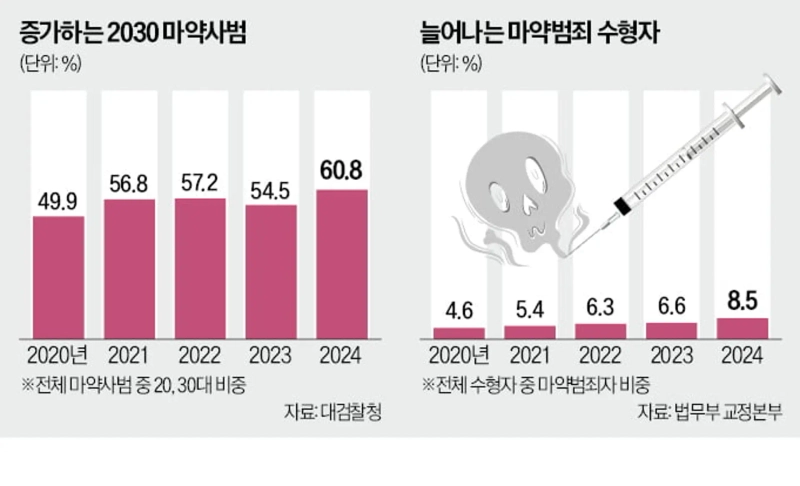
Young people in their 20s and 30s are rapidly entering an 'online drug distribution network' based on anonymity, such as Telegram and the Dark Web. The spread of drug crimes using untraceable cryptocurrencies and anonymous online platforms has steadily increased the proportion of drug offenders in correctional facilities.
◇Expansion of online, contactless drug transactions
According to the '2024 White Paper on Drug Crimes' published by the Supreme Prosecutors' Office on the 15th, people in their 20s and 30s accounted for 60.8% (13,998 people) of all drug offenders last year. This is an increase of 10.9 percentage points compared to 49.9% (9,009 people) in 2020.
Prosecutors analyzed that the proliferation of online-based, contactless transactions is the main reason for the younger age profile of drug offenders. Drug distribution using anonymous SNS such as Telegram and cryptocurrencies such as Bitcoin is rapidly spreading among young people who are familiar with smartphones.
A representative case is the Dark Web-based drug distribution website uncovered by the Seoul Central District Prosecutors' Office last July. Crimes through this site involved the pattern of 'SNS promotion → dropper (courier) concealment → cryptocurrency payment.' A large portion of purchasers were in their 20s and 30s.
As drug transactions have evolved to focus on younger generations, law enforcement is now coming up with countermeasures. The Police plan to supply industrial endoscope cameras to anti-drug teams nationwide in the second half of the year, focusing on cracking down on so-called 'throwing' concealment methods—where droppers hide drugs in water meters or air vents. The prosecution will also utilize a specialized Dark Web investigation team and the AI-based 'E-drug Monitoring System' to monitor anonymous SNS such as Telegram and reinforce joint international drug trafficking investigations.
◇Increasing number of foreign drug offenders
One problem is the noticeable rise in the number of foreign criminals in domestic drug distribution and trade. According to prosecutors, while the number of drug users (9,528 people) and suppliers (7,738 people) dropped by 12.6% and 15.4% respectively from the previous year, the number of drug manufacturers jumped more than threefold from 6 to 19. With crackdowns on overseas smuggling increasing, attempts by foreigners to import raw materials for direct domestic manufacture and distribution have also risen. Last year, 1,173.2 kg of drugs were confiscated—a 17.6% increase over the previous year. Of this, 63.6% was caught at the border during smuggling attempts.
Nearly half of foreign inmates in correctional facilities are drug offenders. According to the '2025 Correctional Statistics Yearbook' published by the Ministry of Justice on the 10th, 897 out of 2,039 foreign inmates (44%) last year were serving prison sentences for drug-related crimes. The number of foreign drug offenders detected by prosecutors the same year set a new record at 3,232. By nationality: Vietnam 836 people, China 771, Thailand 705.
A prosecution official stated, "The systematic smuggling attempts by overseas organizations continue to increase the number of foreign drug offenders," adding, "We will thoroughly inspect not only the crackdown networks at airports and ports, but also the joint investigation cooperation system with related agencies such as the Police, Coast Guard, and Korea Customs Service."
Hee-Won Jung / Seo-Woo Jang, reporters tophee@hankyung.com

Korea Economic Daily
hankyung@bloomingbit.ioThe Korea Economic Daily Global is a digital media where latest news on Korean companies, industries, and financial markets.