

Trump mentions 'regime change' a day after airstrikes… Maximum pressure on Iran
Summary
- President Trump raised the pressure by mentioning the possibility of 'regime change' in Iran for the first time since the airstrikes on Iranian nuclear facilities.
- Within the Republican Party, there is growing concern about internal division over U.S. involvement in the Middle East and President Trump's remarks.
- Experts assessed that the latest airstrikes and hints of regime change could have a major long-term impact on Iran and regional dynamics.
Trump changes his words again
Trump: "The current Iranian regime...
cannot make Iran great"
Message at odds with his aides
As the principle of 'America First' breaks down
Internal division within MAGA is brewing
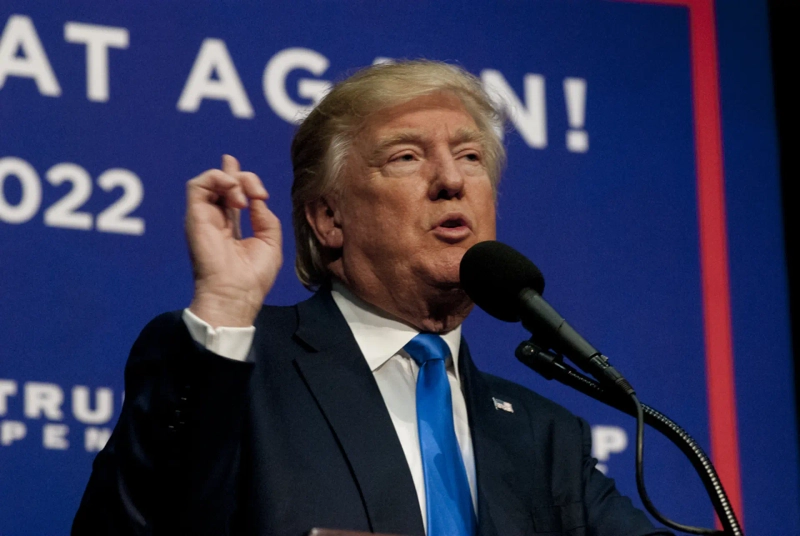
U.S. President Donald Trump mentioned the possibility of 'regime change' in Iran following U.S. Air Force strikes on Iranian nuclear facilities. Previously, senior officials in the U.S. administration had drawn a clear line, stating that the objective behind striking Iran was "not regime change," but President Trump has contradicted this stance. While this is interpreted as an attempt to increase pressure on the Iranian government to dismantle its nuclear program, there are growing signs of conflict within the Republican Party regarding U.S. involvement in Middle Eastern issues.
◇Shaking up the aides' message
On the 22nd (local time), President Trump wrote on his own social network, Truth Social, "It's not politically correct to use the term 'regime change,' but if the current Iranian regime cannot make Iran great again, why wouldn’t there be regime change?" He wrapped up by using his campaign slogan 'MAGA', writing, "MIGA!!! (Make Iran Great Again)." This was the first time he mentioned the possibility of regime change in Iran since the war between Israel and Iran began on the 13th.
In another post, President Trump also boasted about the outcomes of the U.S. strikes on Iranian nuclear facilities. He wrote, "As you can see in the satellite images, all nuclear facilities in Iran have sustained monumental damage," and added, "Annihilated is the accurate description." He specifically emphasized, "The greatest damage occurred well below ground level," countering Iran's claims that damage at the Fordow nuclear facility was not significant.
President Trump’s suggestion of regime change in Iran contradicts the message previously put out by his aides, causing increased confusion. Vice President JD Vance, Secretary of State Marco Rubio, and Defense Secretary Pete Hegseth have all emphasized that the U.S. objective is not escalation but nuclear control. On the same day, Vice President Vance appeared on ABC, explaining, "We have taken a very narrow and limited approach to destroy Iran's nuclear program," and "the President is more concerned than anyone about the prolonged risks of military conflict." Secretary Rubio, in an interview on Fox News, was asked whether the U.S. is at war with Iran and answered, "This is not a war against Iran," adding, "What we want now is simply to ensure that Iran can never acquire nuclear weapons."
The U.S. political outlet Politico commented on President Trump’s remarks, saying they "undermined the coordinated message sent by top White House aides." It also pointed out, "It clearly shows that there is a perception within the administration that the situation could ultimately end up in the collapse of the Iranian regime."
◇Republican Party conflict likely to intensify
President Trump criticized the Neocon (neoconservative) faction of the Republican Party, which advocates regime change in countries such as Iran and Iraq, reaffirming the principle of 'America First' and declaring non-intervention in foreign affairs. The MAGA base has echoed this sentiment, insisting that the U.S. should not get involved in the current conflict between Israel and Iran. However, defying opposition from his MAGA supporters, President Trump carried out airstrikes on three Iranian nuclear facilities and for the first time raised the possibility of regime change in Iran, increasing the pressure.
The airstrikes—labeled as 'limited measures'—did win some support from the Republican Party, but as the potential for regime change was also hinted at, there is growing concern about the expansion of divisions within the party. Representative Marjorie Taylor Greene (Republican, Georgia) wrote on X, "I am tired of the U.S. getting involved in foreign wars," and added, "U.S. soldiers have lost their lives and have been permanently physically and mentally scarred for regime change, foreign wars, and the interests of the military-industrial complex."
Israel is welcoming the prospect of regime change in Iran. Axios described regime change in Iran as the 'Israeli government's tacit goal.' Israeli Prime Minister Benjamin Netanyahu said in a press conference that military operations against Iran could lead to a major expansion of the Abraham Accords, claiming "an incredible opportunity is opening up." The Abraham Accords refer to Israel's normalization of diplomatic relations with historically hostile Arab and Islamic states in the Middle East.
The U.S. also has ambitions to expand pro-American forces in the Middle East. However, CNN pointed out that even if the regime in Iran were to change, a moderate government desired by the U.S. and Israel may not emerge. On the contrary, it suggested that the shockwaves from regime change could spread worldwide.
There is also concern that the U.S. attacks could provoke Iran. Richard Haass, President Emeritus of the Council on Foreign Relations (CFR), analyzed, "Iran might perceive that if it only had nuclear weapons, it would not be subject to U.S. attacks," and warned that Iran could accelerate its nuclear weapons development in the long term, becoming an even greater threat to the international order in the future.
Reporter Hangyeong Han hankyung@hankyung.com

Korea Economic Daily
hankyung@bloomingbit.ioThe Korea Economic Daily Global is a digital media where latest news on Korean companies, industries, and financial markets.