

Summary
- The US stock market is said to have reversed its trend upward as investors began buying the dip after oil price rallies subsided.
- It was stated that major assets, including stocks, bonds, and Bitcoin, all showed gains along with a strong dollar.
- The market is reportedly showing a pattern of investors calmly buying the dip despite the geopolitical crisis.
Dollar Strengthens, Stocks and Bonds Both Rise
"Investors Capitalize on Geopolitical Crisis by Buying the Dip"
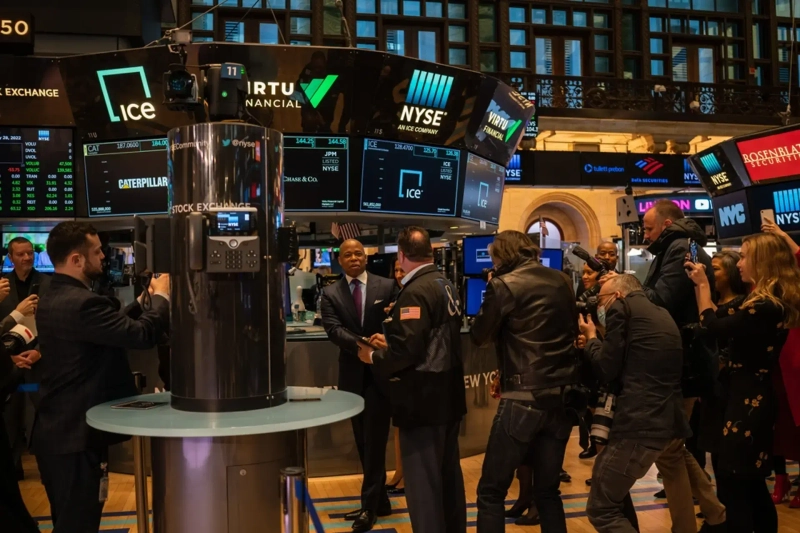
As the surge in oil prices following the US attack on Iran eased, US stock markets opened higher on the 23rd (local time). As of 10 AM Eastern Standard Time, the S&P 500 was up 0.5% and the Nasdaq Composite Index rose 0.4%. The Dow Jones Industrial Average also advanced by 0.4%.
International oil prices trimmed their gains after crude futures hit a five-month high on Sunday night. At one point Brent Crude Oil, the global benchmark, had soared over 5% to more than $81 per barrel, but it was up 0.5% at around $77.45 per barrel. West Texas Intermediate (WTI) also eased its rally, rising 0.5% to $74.25.
The 10-year US Treasury yield fell by 3 basis points (1bp=0.01%), ending at 4.34%. The dollar strengthened against major currencies, rising 0.5%.
Bitcoin, which had dropped below $100,000 immediately after the US attack on Iran, rebounded by 1.6% to reach $101,188.26 on the day.
Meanwhile, Tesla operated its long-awaited Robotaxi service in Austin, Texas, inviting ten influencers a day prior. Tesla shares surged 7.1% to trade at $345.
AMD rose 3% to $132 after Melius Research upgraded its investment rating to 'Buy.' NVIDIA added 0.2%, while Broadcom fell 0.2%.
The United States struck three Iranian nuclear facilities in Fordow, Isfahan, and Natanz last Saturday. One day prior, President Trump surprised investors hoping for diplomatic negotiations by saying, "I will decide within the next two weeks whether to strike Iran."
The market is watching to see if Iran will retaliate. Iran could attack US military forces stationed at nearby bases or blockade the Strait of Hormuz. In that case, global oil flows would be seriously disrupted. If the Strait of Hormuz remains blocked for a prolonged period, oil prices could soar above $100 per barrel. US Secretary of State Marco Rubio, in an interview with Fox News on Sunday, urged the Chinese government to intervene and prevent Iran from blocking the key trade route. China is Iran's largest customer.
The prevailing view in the US market is that a complete blockade of the Strait of Hormuz is unlikely. Bloomberg noted that investors are maintaining a 'buy the dip' strategy, ignoring geopolitical shocks unless a major supply chain disruption or fiscal or monetary policy response is triggered.
Adam Crisafulli of Vital Knowledge stated, "It is appropriate that investors do not panic over a disaster in the oil market." He pointed out, "Although geopolitical risk in the Middle East is elevated, Iran and its partners lack military strength and have few allies, so a sudden disaster severely disrupting oil supplies is unlikely."
Ed Yardeni, founder and chief investment strategist of Yardeni Research, assessed, "Despite tariff turmoil under Trump and the current Middle East war crisis, the US economy continues to show resilience, just as it did during the three years when the Federal Reserve strengthened monetary policy."
Reporter Jung-A Kim kja@hankyung.com

Korea Economic Daily
hankyung@bloomingbit.ioThe Korea Economic Daily Global is a digital media where latest news on Korean companies, industries, and financial markets.