

U.S. Defense Intelligence Agency: 'Iran's Nuclear Facilities Not Completely Destroyed'... Debate Over the Effectiveness of the Airstrike
Summary
- The U.S. Defense Intelligence Agency (DIA) stated that the airstrike on Iran's nuclear facilities only delayed its nuclear program by about six months and did not manage to completely destroy it.
- A significant amount of Iran’s enriched uranium and core facilities such as centrifuges remain, highlighting the limitations in destroying the nuclear sites.
- Although the White House and President Trump claimed to have demolished Iran’s nuclear weapons capability, differences from the initial intelligence assessments mean investors should closely monitor the ongoing debate over the effectiveness of the airstrike.
'Only Delayed Nuclear Development by Six Months'
Trump Refutes: 'Fake News'
DIA: 'Underground Facilities Remain Intact
Damage Limited to Equipment and Power Infrastructure
Enriched Uranium Was Moved Before the Airstrike'
Defense Secretary Claims: 'Nuclear Capability Annihilated'
Some Point Out 'Hard to Completely Destroy by Airstrikes Alone'
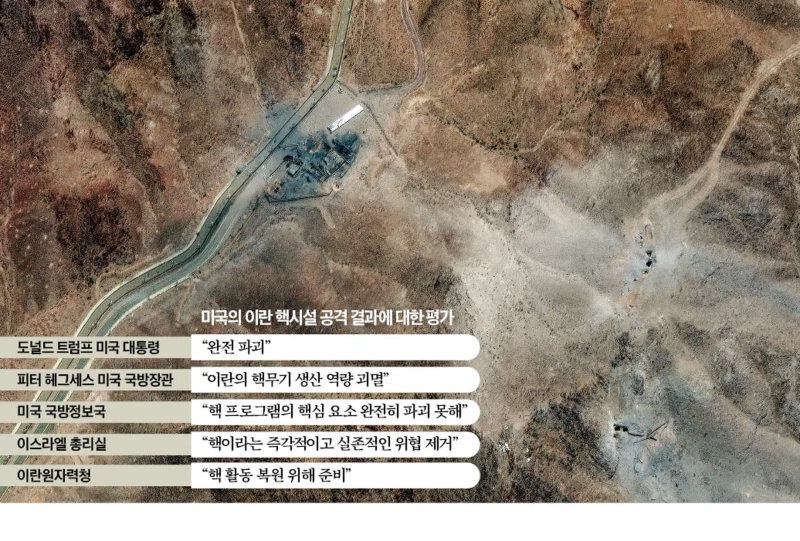
U.S. Department of Defense intelligence authorities have reportedly assessed that the initial evaluation of Iran's nuclear facilities attack, in which bunker-busters and other weapons were deployed, did not manage to completely destroy the core elements of Iran's nuclear program. President Donald Trump refuted these claims as 'fake news,' and the White House also condemned them as 'entirely incorrect information.' Although President Trump declared a ceasefire between Israel and Iran two days after the bombing, controversy has grown over the effectiveness of the airstrikes.
◇'Effect of Delaying the Nuclear Program by 6 Months'
CNN and The New York Times (NYT) reported on the 24th (local time) that the Defense Intelligence Agency (DIA), a U.S. Department of Defense intelligence unit, prepared its initial assessment based on the U.S. Central Command's evaluation of 'battle damage (damage to Iran),' and concluded that the bombing did not fully eliminate Iran's nuclear facilities. On the 21st, the U.S. military launched an operation targeting Iran's nuclear sites, code-named 'Midnight Hammer.' Utilizing seven B-2 bombers, they dropped 14 bunker-buster bombs and launched 30 cruise missiles from a submarine to strike three nuclear facilities: Fordow, Natanz, and Isfahan.
However, CNN quoted two informed sources as saying that Iran's stockpile of enriched uranium was not destroyed. If the enrichment level is increased, enriched uranium can serve as 'nuclear weapon material.' Last month, the International Atomic Energy Agency (IAEA) announced that Iran had stockpiled a total of 408.6 kg of 60% enriched uranium, which is near weapons-grade.
Another source interviewed by CNN said that most of the centrifuges, the core equipment for uranium enrichment, were preserved, noting, 'The DIA's assessment is that the U.S. likely set back (Iran's nuclear program) by, at most, several months, rather than completely destroying it.' CNN relayed that the DIA's initial evaluation indicated the destruction at Iran's nuclear facilities was mostly limited to above-ground structures.
NYT reported that the DIA's report included that a significant portion of Iran's enriched uranium was relocated to other locations prior to the airstrike. The DIA also assessed that the bombing delayed Iran’s nuclear program, but that the delay was less than six months, according to NYT. Before the bombing, U.S. intelligence agencies had evaluated that 'if Iran hurried, it would take about three months for Iran to possess a nuclear weapon.'
◇White House: 'Completely Incorrect'
The White House pushed back. White House spokesperson Karoline Leavitt stated that CNN's report on the DIA's initial assessment was 'entirely incorrect.' U.S. Secretary of Defense Peter Hegseth was also cited by NYT as saying, 'I observed the entire process,' and 'our bombing annihilated Iran's capability to produce nuclear weapons.' Immediately after the airstrike, President Trump described the action against Iran's nuclear facilities as having 'obliterated' them, and, en route to the North Atlantic Treaty Organization (NATO) summit held in the Netherlands aboard Air Force One, he refuted, 'that report is fake news.' The Prime Minister's Office of Israel announced the previous day, 'Israel has eliminated two immediate and existential threats from Iran: nuclear and ballistic missiles.'
◇Ultimately, a Diplomatic Solution?
From immediately after the attack, Iran has claimed that there was no significant damage to its nuclear facilities. Mohammad Eslami, head of the Atomic Energy Organization of Iran (AEOI), stated the day before, 'We had already prepared a series of measures to restore nuclear activities and set plans to prevent the interruption of nuclear industry production and operations,' adding, 'We are assessing the scale of the damage at the nuclear facilities that were attacked.'
Some point out that, due to the current lack of information, a cautious approach is required rather than an argument. Rafael Grossi, Director General of the IAEA, said in a statement the previous day, 'Given the particular sensitivity of the centrifuges to the explosive power and vibrations of (the bombs used), it appears that there was very serious damage in the underground nuclear facility at Fordow,' but also noted, 'At present, no one, including the IAEA, is in a position to fully assess the damage to the underground facility.'
The Wall Street Journal (WSJ) reported that it is not uncommon for classified reports from U.S. intelligence agencies to be revised as more information is collected, meaning initial assessments can change.
Iran’s nuclear issue is expected to remain controversial. If Iran’s nuclear program is not halted, further attacks by Israel and the U.S. cannot be ruled out. Some suggest that, ultimately, a diplomatic solution is necessary to restrain Iran’s nuclear development.
Reporter Kim Joo-wan kjwan@hankyung.com

Korea Economic Daily
hankyung@bloomingbit.ioThe Korea Economic Daily Global is a digital media where latest news on Korean companies, industries, and financial markets.