

"7 Major US IBs Expect One or Fewer Rate Cuts This Year…Caution Over Inflation From Tariffs"
Summary
- Seven major US investment banks expect the number of rate cuts by the Fed to be one or fewer this year.
- Due to inflationary factors such as tariffs, the Fed is expected to remain cautious about cutting rates.
- This year's US GDP growth forecast has been revised down to 1.4%, signaling an economic slowdown.
US Economy Expected to Achieve Soft Landing Despite Tariff Shocks
"Labor Market Remains Robust Despite Declining Immigrant Influx"
"US GDP Outlook Revised Down for This Year"
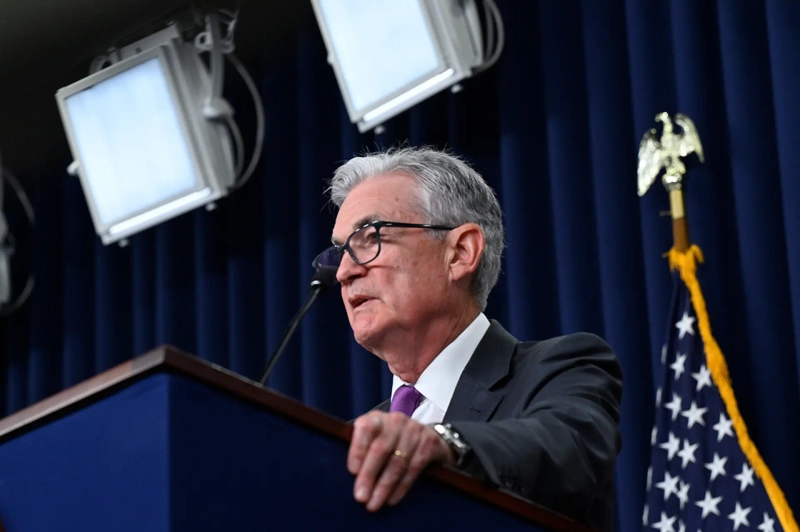
Seven major investment banks (IBs) on Wall Street forecast that the US Federal Reserve (Fed) will cut rates no more than once this year. Among them, five expect a rate cut only by the end of the year, while two anticipate no cut at all. This outlook is even more conservative than the Fed’s own projection on the 18th, when, at the Federal Open Market Committee (FOMC), the dot plot indicated two rate cuts within the year.
According to the New York Office of the Bank of Korea’s report released on the 30th (local time), "2025 US Economic Trends and H2 Outlook," this was how major investment banks viewed US policy rate prospects.
According to the Bank of Korea’s tally, five institutions—Barclays, Goldman Sachs, J.P. Morgan, Nomura, and Deutsche Bank—forecast a 0.25% point rate cut within the year. Bank of America (BOA) and Morgan Stanley each expect rates to remain unchanged for the rest of the year. In addition, TD Bank projected a 0.5% point cut, while Citi and Wells Fargo each projected a 0.75% point reduction this year. Investment banks are expected to focus more on inflation than on the labor market—two of the Fed’s dual mandates—according to the Bank of Korea. The Bank of Korea explained that, within the Fed, with the Donald Trump administration unexpectedly showing willingness to negotiate tariffs with trade partners, relief is spreading in the market that trade conflicts won’t escalate to extremes. As a result, there’s more focus on inflation risk rather than concerns over an economic slowdown.
Meanwhile, investment banks expect next year’s policy rate cuts to be limited to three to four times. Despite constraints on consumer spending due to tariff shocks, factors such as the asset effect and fiscal policy are expected to limit the slowdown in household consumption and corporate investment.
The New York Office stated, “Investment banks are forecasting that the US economy will gradually slow, i.e., achieve a soft landing, rather than fall into a recession. They project that through 2026, rate cuts will be limited to three or four, with the final policy rate remaining in the mid–3% range.”
However, investment banks also expect inflation resulting from tariffs to be temporary. Inflation is generally expected to rise until late this year or early next year before declining. The New York Office of the Bank of Korea explains that, unlike during the pandemic when service prices soared, tariff-related price increases are concentrated on imported goods, which is likely to affect low-income households the most.
The US labor market is expected to see a significant decrease in employment due to sharply lower net immigration in the future. Citing the Congressional Budget Office (CBO), the New York Office of the Bank of Korea estimated US net immigration at 2.7 million last year and 2 million this year.
While IBs estimated last year’s net immigration at a similar level to the CBO, they expect a much steeper drop this year. Morgan Stanley, for instance, recently revised its estimate for this year’s immigrant inflow from 1 million to 800,000. Goldman Sachs expects the number of immigrants this year to be below 500,000.
Nevertheless, the New York Office has so far not observed any broad labor market weakness. Although the decline in immigrant inflows has already begun, the US job market remains robust. Labor force participation among existing immigrants is rising, and immigrant unemployment is falling, offsetting the decrease in labor supply.
In the second half of the year, the US economy is expected to slow under policy uncertainty and the impact of higher tariffs. According to the New York Office, 77 IBs revised their median US GDP growth forecast for this year to 1.4% as of June, down from the 2.1% projection made at the end of last year.
New York—Shinyoung Park, Correspondent nyusos@hankyung.com

Korea Economic Daily
hankyung@bloomingbit.ioThe Korea Economic Daily Global is a digital media where latest news on Korean companies, industries, and financial markets.