

President Lee Jae-myung: "'Stocks' as an Alternative Investment Means to 'Real Estate'"
Summary
- President Lee Jae-myung reaffirmed the policy stance to boost stocks as an alternative investment option to resolve the Korean economy's real estate concentration.
- Following the enforcement of strong loan regulations, this is the first time the President has mentioned policies for stock market vitalization and expanding dividends.
- President Lee expects that by alleviating the 'Korea Discount' and vitalizing the stock market, investors will diversify into various investment destinations, which will help stabilize housing prices and nurture domestic companies.
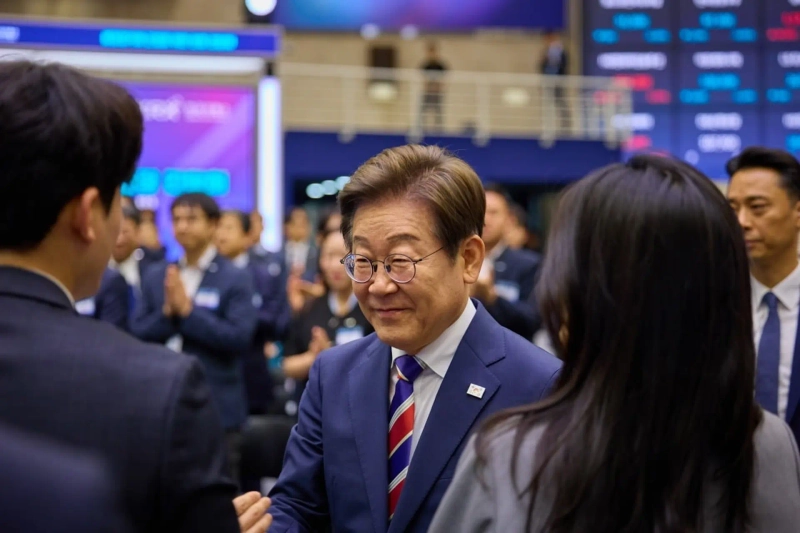
President Lee Jae-myung once again emphasized his policy stance to boost stocks as an alternative investment vehicle in order to resolve the concentration of funds in real estate within the Korean economy. This is the first related public statement made by the President since authorities tightened loan regulations.
At the start of the Cabinet meeting on the 1st, President Lee stated, "Since investment options have been limited to housing or real estate, housing has repeatedly become an investment or speculative vehicle, causing housing insecurity."
He continued, "As the financial market has been normalizing recently, stocks seem to be gradually establishing themselves as an alternative investment vehicle," adding, "We should maintain this momentum."
While running for president, Lee Jae-myung adopted a 'strategic silence,' refraining from actively announcing real estate policies. Many assessed that he showed caution, taking the failures of the Moon Jae-in government's tax-regulation-focused real estate policies as a lesson. However, instead of excessively regulating housing prices, he expressed his aim to vitalize the stock market and publicly stated, "The approach to housing price issues will differ from previous democratic administrations."
President Lee's idea is that mitigating the so-called 'Korea Discount' (undervaluation of the Korean stock market) and increasing dividends to vitalize the stock market could redirect domestic investors' attention toward a wider range of investment outlets, including stocks, which in turn could stabilize housing prices and foster domestic companies.
The unique phenomenon of 'real estate concentration' in the Korean economy is a chronic problem. When assets are tied up in illiquid real estate, the domestic economy contracts and household debt increases, raising instability in the financial system.
Immediately after his election, President Lee visited the Korea Exchange on the 11th of last month, announcing preparations for boosting dividends and tax reforms, and suggested, "Let’s usher in the era of a KOSPI 5000." He also accelerated the so-called 'AI Drive' by appointing AI experts to top government posts and making field visits.
Until the structural reform measures yield results, the issue of housing prices should be managed stably so it does not weaken the momentum of state affairs. For now, in response to the recent sharp increase in house prices—mainly in central areas of Seoul—the government has enforced strong loan regulations since the 28th of last month.
Lee Song-ryeol, Hankyung.com reporter yisr0203@hankyung.com

Korea Economic Daily
hankyung@bloomingbit.ioThe Korea Economic Daily Global is a digital media where latest news on Korean companies, industries, and financial markets.