

Will Bitcoin, which repeatedly fluctuated with Middle Eastern tensions, recover its previous high?
Summary
- Bitcoin prices have recently shown high volatility, reacting sensitively to geopolitical instability in the Middle East.
- It was noted that the U.S. government is driving up Bitcoin’s credibility with pro-crypto policies and by moving to institutionalize stablecoins.
- There are concerns that if global trade conflicts re-emerge, uncertainty in the Bitcoin market may increase.
Bitcoin Market Outlook and Investment Strategies
Plunged below $100,000 due to Iran airstrikes
Surged again by 7~8% after ceasefire agreement
U.S. crypto-friendly policy drives uptick
Stablecoin acceptance boosts credibility
Tariff suspension is also favorable
Latent trade conflicts remain investment risks
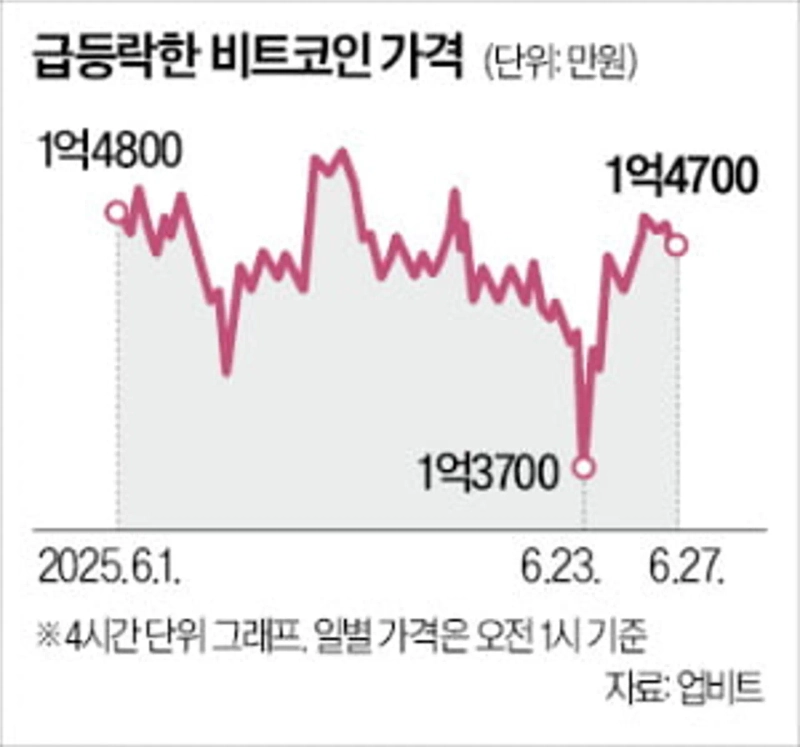
Bitcoin prices have shown high volatility as they respond sensitively to geopolitical unrest. When the U.S. carried out direct airstrikes on Iranian territory, citing Iran’s nuclear development, the global market saw Bitcoin prices plunge below $100,000. However, as concerns over escalation faded, Bitcoin rebounded by more than 8% within just one day, recovering rapidly.
In the domestic cryptocurrency market, Bitcoin prices also repeatedly surged and plunged with the level of tension in the Middle East. As military clashes between Iran and Western countries subsided, attention is turning to whether Bitcoin prices can surpass their previous high (₩152,350,000) as the U.S. moves in earnest to integrate cryptocurrency into the formal system.
◇ Fluctuating Amid Middle Eastern Instability
According to Upbit, Korea's top cryptocurrency exchange, as of 5:00 PM on June 20, Bitcoin was trading at ₩146,000,000. Yet, within just three days, by 1:00 AM on the 23rd, it had dropped to the ₩137,000,000 range, a nearly 6% decline. On June 22, the U.S. deployed seven B-2 stealth bombers to drop fourteen GBU-57 bunker busters on Iranian nuclear facilities, which directly triggered the steep drop in Bitcoin prices. Since Iran is a nation capable of blockading the crucial Strait of Hormuz for global oil shipments, this direct attack from the U.S. spurred global market risk aversion. According to Coinbase, on June 22 (U.S. Eastern Time) afternoon, Bitcoin prices slipped below $100,000.
Will Bitcoin, which repeatedly fluctuated with Middle Eastern tensions, recover its previous high? However, Bitcoin prices rebounded quickly. In Korea, as of 5:00 AM on the 24th, Bitcoin prices returned to the ₩146,000,000 level, restoring to pre-strike levels. As of the 29th, it recorded the ₩147,000,000 range.
A similar trend was seen in the U.S. market. According to Coinbase, at 5:00 AM on the 23rd, Bitcoin was at $98,236, but by 7:30 AM on the 24th, it had surged over 8% to $106,100 within just one day. Iran retaliated with a missile strike on a U.S. base, but this was largely symbolic, causing no American casualties. Once the two nations agreed to a ceasefire and Middle Eastern tensions eased quickly, funds flowed back into the crypto market.
◇ U.S. Institutional Embrace of Cryptocurrency
Another factor in Bitcoin’s uptrend is the U.S. government’s pro-crypto policy. On May 17, the Senate passed the GENIUS Act, which strengthens issuance and collateral requirements for stablecoins and imposes anti–money laundering duties. While strict, the act’s official inclusion of stablecoins within the formal system sent a positive signal to the market.
Stablecoins are cryptocurrencies designed to be pegged 1-to-1 to real assets like the U.S. dollar. They function as a reserve currency within the crypto ecosystem for payments, remittances, and asset transfers. Especially with the U.S.—the world's largest capital market—officially recognizing stablecoins, expectations are growing that confidence in major crypto assets including Bitcoin will rise.
Administrative measures are also under way. On May 25, the Federal Housing Finance Agency (FHFA) ordered government-sponsored mortgage institutions Fannie Mae and Freddie Mac to include cryptocurrencies in asset assessments for home loan applicants. FHFA Director William Pulte announced via X (formerly Twitter), “This move aligns with President Donald Trump’s vision of making the U.S. the ‘world’s cryptocurrency capital.’”
◇ Will Tariff Wars Become an Issue Again?
Growing optimism over Bitcoin is fueling continued inflows into related assets. According to Farside Investors, all 11 U.S.-listed Bitcoin spot ETFs recorded net buying for 12 consecutive trading days from May 9 to May 25.
However, there are also concerns that if global trade tensions flare up again, uncertainty in the Bitcoin market will increase. Bitcoin prices trended downward throughout January to April following President Trump’s inauguration and the announcement of high mutual tariffs. In particular, as tariff plans became clearer in early April, prices fell below $80,000.
After the U.S. postponed the reciprocal tariff measures, trade conflict worries eased somewhat, and Bitcoin prices rebounded. On May 8, when the U.S. and U.K. announced their first trade agreement, Bitcoin prices surged over 5% in a single day to recover to the $100,000 mark.
The expiration of the U.S. mutual tariff suspension on the 9th of this month is a variable closely watched by the Bitcoin market. As the U.S. is likely to use tariffs as a ‘card’ in trade negotiations, expectations are growing that the suspension will be extended. However, renewed tensions between the U.S. and major countries may destabilize Bitcoin prices again.
Jung Eejin, reporter justjin@hankyung.com

Korea Economic Daily
hankyung@bloomingbit.ioThe Korea Economic Daily Global is a digital media where latest news on Korean companies, industries, and financial markets.