

PiCK
Dollar Value Records Biggest Drop Since 1973… KRW-USD Exchange Rate Also Volatile [Hankyung FX Market Watch]
Summary
- It was reported that the dollar index fell 10.8% in the first half of this year, recording its largest drop since the adoption of the floating exchange rate system in 1973.
- The weak dollar was said to be a factor in decreasing the investment appeal of U.S. assets as well as raising import prices.
- Experts projected that the weak dollar could persist in the second half due to policy volatility and other factors.
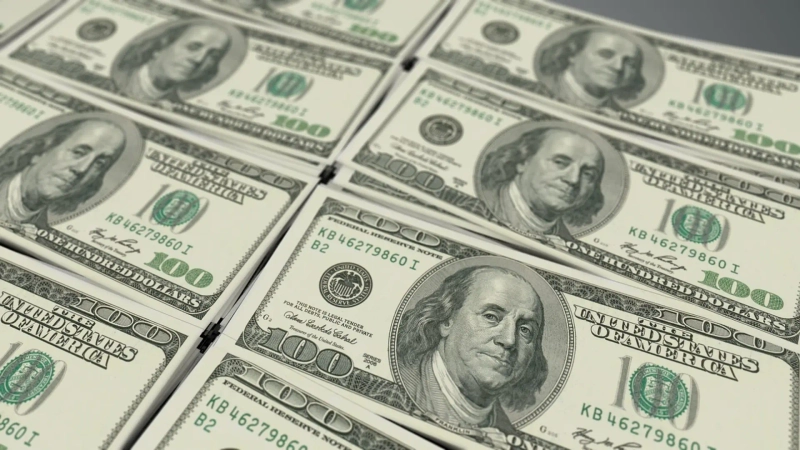
The KRW-USD exchange rate fluctuated in tandem with dollar movement. The dollar index, which measures the value of the U.S. dollar, dipped to its lowest level in 3 years and 4 months during the morning before rebounding in the afternoon. In the first half of the year, the dollar index declined by over 10%, marking its weakest performance since the introduction of the floating exchange rate system in 1973.
On the 1st at the Seoul foreign exchange market (as of 3:30 pm), the KRW-USD rate closed weekly trading at 1,355.90 won, up 5.90 won from the previous day. The rate opened at 1,351 won and fell to 1,348.50 won in the morning, influenced by the dollar's weakness.
The dollar index, which tracks the dollar's value against the currencies of six major countries, dropped to 96.607 at around 10:20 am. This was the lowest level since February 28, 2022 (96.508), a span of 3 years and 4 months.
However, as the global value of the dollar rebounded slightly, upward pressure was felt in the afternoon. By 3:30 pm, the dollar index had recovered to 96.742. The reduction in settlement flows from exporters, which had poured in at the end of the previous half-year but decreased on this day, is also believed to have contributed to the rise in the exchange rate.
Although the KRW-USD rate rose in response to the dollar index rebound this day, the dollar’s value has sharply dropped so far this year. According to Bloomberg on the 30th of last month (local time), the dollar index fell 10.8% in the first half of this year. For the first half, this is the steepest drop since the first half of 1973 (-14.8%), when the Bretton Woods system ended and the floating exchange rate was adopted. Over a six-month period, it is the biggest decline since the 2009 financial crisis.
In the first half of this year, the dollar lost 14.4% against the Swiss franc, 13.8% against the euro, 9.7% against the British pound, and 8.3% against the Korean won.
The dollar index had peaked at 110.176 in mid-January, just before Donald Trump’s inauguration as President. Since then, factors such as uncertainty in U.S. trade policy, downgrades in the national credit rating, concerns over massive tax cuts and widening budget deficits, and the possible weakening of the Federal Reserve's independence have all emerged at once, shaking the dollar's status as a safe-haven asset.
A weaker dollar boosts the export competitiveness of U.S. products, but also raises import prices and reduces the investment appeal of American assets.
Andrew Balls, Global Chief Investment Officer (CIO) for Global Fixed Income at PIMCO, said that while there is no significant threat to the dollar's status as the de facto reserve currency, dollar weakness can still occur under such circumstances. Rick Rieder, Global CIO of Fixed Income at BlackRock, noted, “Even if comprehensive de-dollarization were to occur, it is still far off,” but also pointed out that rising government debt could heighten such risks. Francesco Pesole, FX Strategist at ING, said, “Foreign investors are increasing their demand for hedges against dollar-denominated assets,” adding that this is one of the reasons for dollar weakness despite the rebound in U.S. equities.
Bloomberg forecasts that the dollar will weaken further in the second half of the year due to factors such as U.S. policy volatility. On the other hand, Guy Miller, Chief Strategist at Zurich, predicted that, since bets on a weak dollar are already popular among investors, the pace of dollar decline may slow down.
Jin-kyu Kang, Reporter josep@hankyung.com

Korea Economic Daily
hankyung@bloomingbit.ioThe Korea Economic Daily Global is a digital media where latest news on Korean companies, industries, and financial markets.