

PiCK
"Trump Threatens 35% Tariff on Japan"... Simultaneous Drop in Japanese and South Korean Stock Markets
Summary
- Due to U.S. President Trump’s threat of imposing tariffs of up to 35%, major stock markets including those of Japan and South Korea experienced a simultaneous decline.
- Market experts warned that if U.S.-Japan trade negotiations break down, the Nikkei 225 could drop by more than 4% and Japan’s GDP could decrease by 1.2%.
- While some experts believe the tariff impact could be exaggerated, they also noted that a large-scale sell-off could offer a buying opportunity for aggressive investors in the worst-case scenario.
For three consecutive days following the opening of the automobile and rice markets, Japan faces continued pressure tactics
"If no deal, Nikkei to drop to 38,000, GDP to decrease by 1.2%" forecast
Experts anticipate Japan will make further concessions to reach agreement
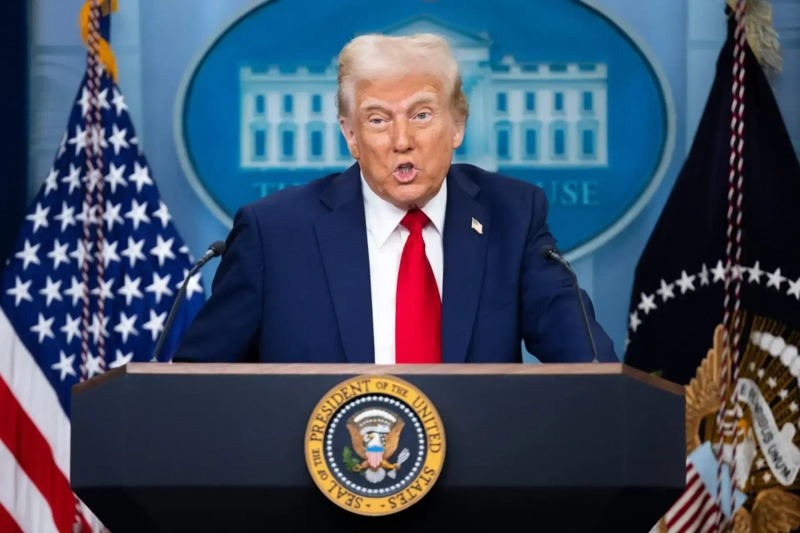
U.S. President Donald Trump has threatened to impose tariffs of up to 35%, surpassing the 24% reciprocal tariff rate he announced in April, if a trade agreement with Japan is not reached. As Trump’s pressure intensifies, the stock markets of countries like Japan and South Korea, which are facing similar trade deal demands, reversed to losses on this day.
The Nikkei 225 index closed down 0.56% at 39,762, while the Japanese Yen weakened about 0.3% to 143.88 against the dollar. Due to Trump’s remarks about a 35% tariff on Japan and similar burdens such as automotive and steel tariffs, South Korea’s KOSPI also dropped by 0.47%.
According to Bloomberg and other foreign media on the 2nd (local time), President Trump stated, "Japan will have to pay tariffs of 30%, 35%, or whatever amount we determine," indicating a possibility of tariffs higher than the 24% scheduled for July 9. He added, "I cannot be sure if a deal will be struck with Japan," and described Japan as "very tough and spoiled."
President Trump continued his criticism of the Japanese automobile market and rice market openings for three consecutive days, escalating his attacks by threatening a 35% tariff rate.
Market participants and analysts noted that Trump’s statements need not be taken at face value and expect that an agreement of some form will eventually be reached. However, it was also warned that Prime Minister Shigeru Ishiba’s administration may need to shift away from the current brinkmanship on both sides.
Kurt Tong, former U.S. senior diplomat for Asia and now Managing Partner at Asia Group, said, "If the U.S. reacts sharply, there’s a risk of tougher punitive measures." If that happens, Japan may have no choice but to retaliate with its own countermeasures.
In a no-deal scenario, some analysts predict the Nikkei 225 will drop by more than 4% from the current level to a range around 38,000. If a deal is reached, a rebound towards 40,000 is the dominant expectation.
Thus far, Japan has maintained its stance of calling for the elimination of industry-specific tariffs on automobiles, steel, and aluminum as well as all reciprocal tariffs overall. Given that the automobile sector accounts for nearly 10% of Japan’s GDP and employs about 8% of the national workforce, Japan is focusing efforts on scrapping auto tariffs.
Japan is pursuing a "win-win" negotiation strategy, proposing to address all tariffs in a comprehensive manner. In particular, Prime Minister Ishiba, worried about the potential impact on the upper house elections on July 20, prefers no agreement at all over an unproductive negotiation.
On this day as well, Prime Minister Ishiba emphasized that "Japan is the largest global investor in the U.S. and contributes the most to creating U.S. jobs, making it different from other countries."
Ichiro Fujisaki, Japan’s ambassador to the U.S., said, "To avoid tariffs being imposed from July 9, direct negotiations with President Trump are essential," adding that Tokyo had yet to present an offer sufficient to bring them to the negotiating table. He pointed out that while Japan lacks resources like rare earths, the U.S. also relies on certain Japanese products—for example, about half of the materials necessary for semiconductor manufacturing are supplied by Japanese industry.
Market participants assessed the potential scale of the losses.
Zuhair Khan, fund manager at UBP Investment, stated, "Risks for further deterioration are greater than market expectations, and there’s always the risk of policy mistakes on either side." Referring to the day the reciprocal tariffs were announced in April, when the Nikkei was at 32,000, he mentioned, "If the probability of a no-deal is 25%, the Nikkei could drop to 38,000."
Japanese economist Taro Kimura predicted that if Japan ends up paying tariffs higher than the 24% announced on the "day of liberation," the macroeconomic fallout would be significant. Based on projections using global trade models, he expects Japan’s medium-term GDP to fall by about 1.2%. This is nearly double the anticipated decline of 0.6%, which is expected under the current tariff scenario.
Philip Wool, Portfolio Manager at Railent Global Advisor, noted, "Deadlines in negotiations are always used to exert leverage, so it’s not surprising that President Trump is mentioning higher tariffs as the negotiation date approaches." He pointed out that Trump’s rhetoric on trade includes theatrical elements intended for voters, often making the situation sound more severe than it truly is. Nevertheless, he said that for negotiations to be truly successful, both sides need to leave the table with their dignity intact.
Wool cautioned against being too pessimistic or reacting impulsively to each of Trump’s comments. Should there be a large-scale sell-off in the worst-case scenario, he sees it as a good buying opportunity for long-term, active investors.
Strategists are divided on the outlook for the Japanese Yen. Marito Ueda of SBI Liquidity Market predicted that "risk-off sentiment could strengthen the Yen, and the Yen could appreciate to around 138 against the dollar." Some experts, however, see higher potential for further weakness.
Akira Moroga, Chief Market Strategist at Aozora Bank, said the stalemate in U.S.-Japan trade talks is likely to delay the next rate hike by the Bank of Japan. Especially if tariffs of up to 35% are imposed during this period, he expects the Yen to slow down after reaching the 145 level against the dollar, making a move past the 147 mark challenging.
Contributed by Jeong-Ah Kim (kja@hankyung.com)

Korea Economic Daily
hankyung@bloomingbit.ioThe Korea Economic Daily Global is a digital media where latest news on Korean companies, industries, and financial markets.