

Dramatic Settlement of Korea-U.S. Tariffs... 'Shipbuilding' Investment in the U.S. Made the Greatest Contribution [Korea-U.S. Tariff Negotiation Settled]
Summary
- Deputy Prime Minister Koo Yoon-cheol stated that investment in the U.S. shipbuilding industry was recognized as the largest contribution in the Korea-U.S. trade negotiations.
- The restructuring of shipbuilding supply chains and workforce training were key elements of the negotiation, and new growth opportunities are anticipated through the revival of U.S. shipbuilding.
- However, he noted that the tariff-free quota for steel was not included, falling short of industry expectations.
Trump: "Please invest in shipbuilding as soon as possible"
Persistent defense against opening of the agricultural and livestock market
Used mad cow disease incident photos to persuade
No tariff-free quota received regarding steel
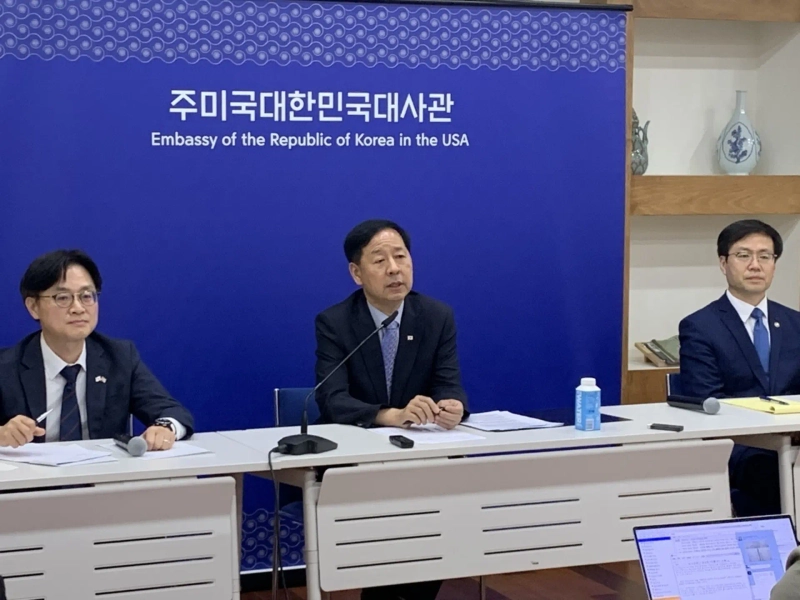
Koo Yoon-cheol, Deputy Prime Minister and Minister of Economy and Finance, stated on the 30th (local time) that the Korea-U.S. shipbuilding cooperation project, MASGA (Make American Shipbuilding Great Again), made "the greatest contribution" to the settlement of the trade negotiations.
Koo, who was the chief representative for Korea in the trade negotiations, explained at a briefing on the conclusion at the Embassy of the Republic of Korea in Washington, D.C., that "the MASGA project is the most significant contributor to today’s agreement," noting that “it covers the construction of shipyards in the U.S., △training of shipbuilding personnel △reconstruction of shipbuilding-related supply chains △maintenance and repair work in the shipbuilding sector, and more."
He added, “Our companies, with the world's leading shipbuilding capacity, will help the revival of the American shipbuilding industry and create new growth opportunities."
Reportedly, President Donald Trump also expressed a strong commitment to reviving U.S. shipbuilding. Deputy Prime Minister Koo stated, "President Trump highly appreciated South Korea’s shipbuilding capabilities and requested that Korean firms build vessels in the U.S. as quickly as possible."
There was a strong U.S. demand for the opening of the Korean agricultural and livestock market, but the Korean negotiation team persistently defended this sector. Koo explained, “The U.S. strongly pushed for reduction of non-tariff barriers and greater market access for agricultural and livestock products, with President Trump in particular questioning Korea’s inspection procedures for fruits and vegetables and showing interest. However, thanks to the team’s persistent explanation, the U.S. side understood the sensitivity of Korea’s agriculture and agreed not to pursue further market opening."
Notably, Yeo Han-gu, Deputy Minister for Trade Negotiations, reportedly persuaded the U.S. team by showing a photo he’d prepared of the large-scale protests near Gwanghwamun during the 2008 mad cow disease incident to highlight how sensitive market opening was to the Korean public.
The Korean team also emphasized that Korean investment in the U.S. is not as large as Japan’s. While Japan’s financial investment in the U.S. stands at $550 billion, Korea’s totals $350 billion—with just $200 billion excluding $150 billion invested in shipbuilding. Kim Jeong-gwan, Minister of Trade, Industry and Energy, commented, "Even when comparing the GDP of Japan and Korea, Korea’s financial investment share is smaller."
However, in the steel sector, the current item tariff of 50% could not be reduced further. Minister Kim said, "The U.S. showed very strong determination regarding the steel sector." Korea’s steel industry had hoped for a tariff-free quota like the European Union secured in the U.S., but this was not achieved in the results.
Deputy Prime Minister Koo appraised the overall agreement by saying, “We achieved a mutually beneficial outcome, strengthening and upgrading Korea-U.S. economic relations while protecting our national interests and enduring what had to be endured for practical diplomacy."
On this day, Korea and the U.S. reached a broad settlement in the trade negotiations following a meeting between Deputy Prime Minister Koo Yoon-cheol, Minister Kim Jeong-gwan, Deputy Minister Yeo Han-gu, and President Trump at the White House.
Washington, D.C. = Park Shin-young, correspondent nyusos@hankyung.com

Korea Economic Daily
hankyung@bloomingbit.ioThe Korea Economic Daily Global is a digital media where latest news on Korean companies, industries, and financial markets.