

Korea-US '15% Tariff' Agreement Reached...Korean Manufacturing Faces a Crucial Test
Summary
- The Korean government announced that it reached an agreement in tariff negotiations with the United States, pledging a $450 billion investment fund and energy purchases, and agreeing to reduce mutual and auto tariffs to 15%.
- With this agreement, steel and aluminum item tariffs remain at 50%, while auto tariffs are raised compared to the previous FTA, causing the stock prices of companies like Hyundai Motor Company and Kia Corporation to plummet, whereas shipbuilding-related stocks surged.
- The government assessed that, although the Korea-US FTA has been effectively terminated and the '2.5 percentage point tariff advantage' is gone, the sudden uncertainty in the export environment has been alleviated.
$350 billion investment in the US... $100 billion energy purchase commitment
Trump: 'Complete trade agreement with Korea...Summit with Lee within two weeks'
President Lee: 'Created conditions to compete on equal terms with major countries'
'Mutual zero tariffs' effectively abolished... 12 years of the Korea-US FTA come to an end
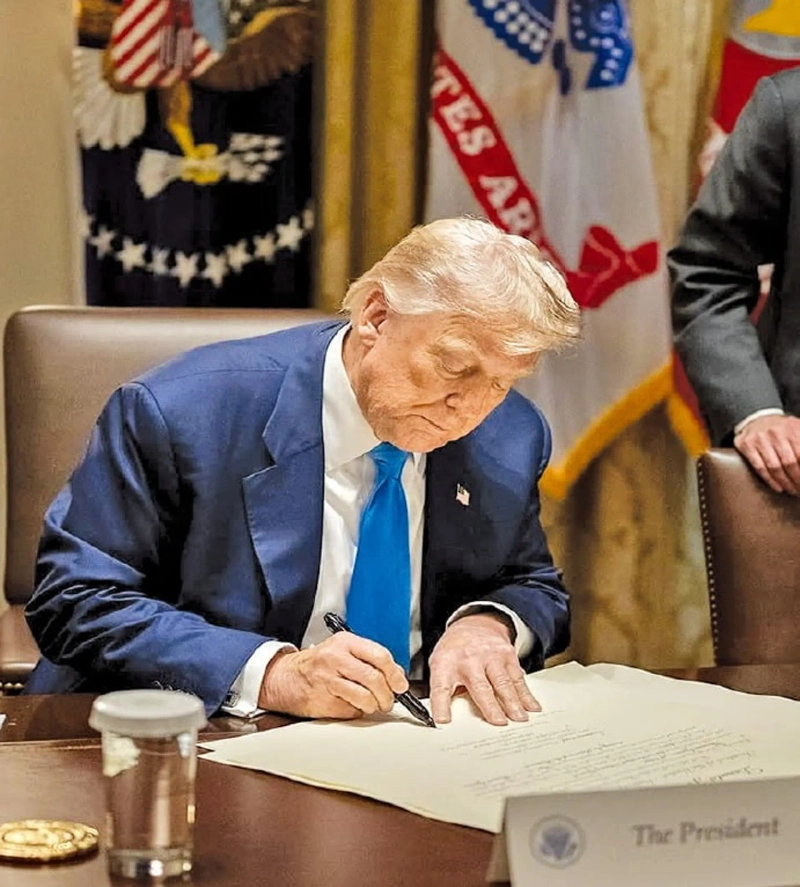
Korea and the United States have dramatically concluded their tariff negotiations. Korea has pledged a total of $450 billion (about ₩625 trillion) in investment funds and energy purchases such as liquefied natural gas (LNG) to the US, while the US has agreed to lower mutual tariffs and auto tariffs from 25% to 15% respectively. On the eve of the previously planned August 1 date for imposing 25% mutual tariffs, Korea succeeded in lowering tariffs to the level of Japan and the European Union (EU), who had previously reached agreements. Analysts say that the Korea-US Free Trade Agreement (FTA), which was based on 'mutual zero tariffs,' has been effectively dismantled.
On the 30th (local time), US President Donald Trump announced on Truth Social, after a meeting with Deputy Prime Minister and Minister of Economy and Finance Koo Yun-cheol and the Korean tariff negotiation team, that “the United States and Korea have reached a complete and comprehensive trade agreement.” President Lee Jae-myung also stated on Facebook, “We eliminated the uncertainties in the export environment and established the conditions to compete with the world’s leading countries on equal or better terms by matching US tariffs to the same or lower level than key rival exporters.”
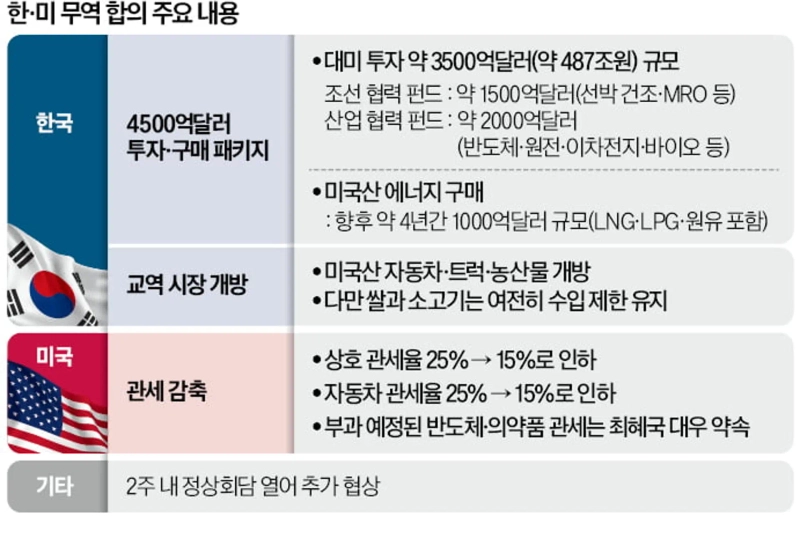
Korea will create a $350 billion (about ₩486 trillion) investment fund for the US. Of this, $150 billion is a shipbuilding cooperation fund to revitalize the US shipbuilding industry (MASGA) and help Korean companies enter the US shipbuilding market. In addition, Korea has also pledged to purchase $100 billion (about ₩139 trillion) worth of US energy, including LNG. The US will maintain steel and aluminum item tariffs at 50% as before, while Korea will not further open its agricultural market. The two countries agreed to hold a summit within two weeks to discuss the purchase of US weapons, the export of high-precision maps, and defense cost issues.
This agreement gives Korea some immediate relief. However, it is noted with regret that Korea did not receive the preferential 2.5 percentage point tariff advantage for auto items that non-FTA countries like the EU and Japan have. Kim Yong-beom, Chief Policy Officer at the Presidential Office, stated in a briefing, “We demanded a 12.5% auto tariff until the end, but that’s where it stopped,” adding, “The Korea-US FTA is being seriously shaken.” Yeo Han-gu, Deputy Minister for Trade at the Ministry of Trade, Industry and Energy, also commented, “This agreement is just a temporary relief,” and, “US protectionism and pressure to address non-tariff barriers will continue.”
On the day, the KOSPI index fell by 0.28%. The impact differed greatly by industry. Stocks of Hyundai Motor Company and Kia Corporation, which lost their 2.5 percentage point tariff edge over competitors, plummeted by 4.48% and 7.34% respectively. Meanwhile, shipbuilding stocks rose sharply on expectations of Korea-US cooperation. Hanwha Ocean and HD Hyundai Heavy Industries rose by 13.43% and 4.14%, respectively.
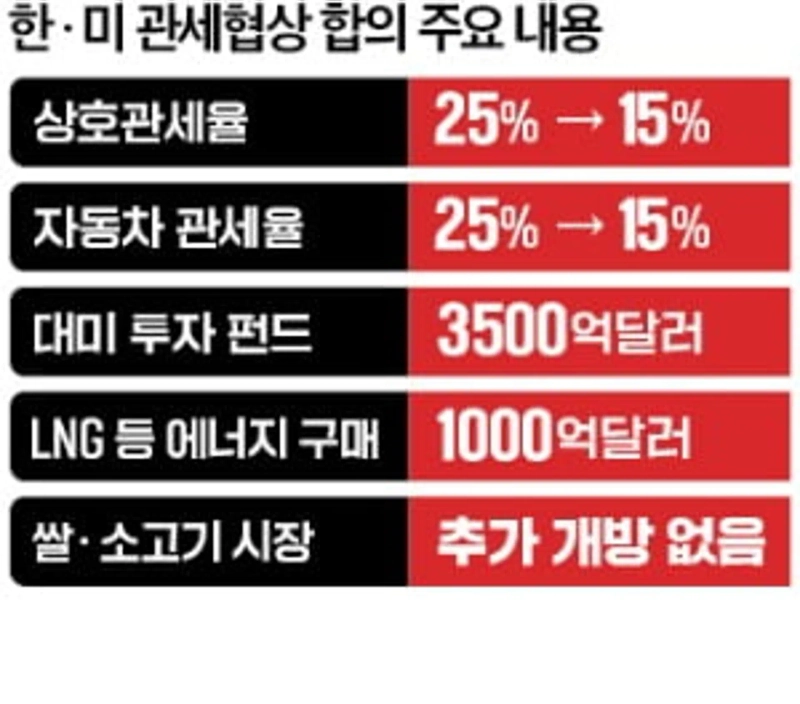
Tariffs Held at 15% Thanks to '$350B+$100B' Package...Major Hurdle Overcome
'Large-scale US investment' like Japan and the EU is the leverage
Korea barely succeeded in persuading President Donald Trump with an investment and energy purchase package totaling $450 billion (about ₩625 trillion). Immediate mutual and auto tariffs, which were to be imposed starting August 1, were lowered to 15%, while politically sensitive beef and rice market openings were avoided. However, there is analysis that the 'entrance fee' required to keep selling products in the US market is by no means small. ₩625 trillion amounts to 89% of this year’s total national expenditure (₩702 trillion) and 25% of last year’s Korean nominal GDP ($1.7903 trillion).
Japan’s US Investment Fund Becomes the 'Model'
Kim Yong-beom, Chief Policy Officer at the Presidential Office, explained at a tariff negotiation briefing on the 31st, “The mutual tariffs, which the US announced would be imposed on Korea starting August 1, are being lowered to 15%, and the auto tariffs on our main export items are also being reduced to 15%.” He also noted that tariffs on semiconductors and pharmaceuticals, due to be imposed later, would receive 'most-favored-nation' (MFN) treatment, avoiding disadvantage compared to other nations.
In return, the government promised a $350 billion 'US investment fund.' Kim explained that this fund, for investments, loans, and guarantees for Korean companies entering the US, is structured similarly to Japan’s, which previously finalized its agreement. He added, “The fund supports our companies’ entry into the US in competitive sectors such as semiconductors, nuclear power, batteries, and biotech. We analyzed Japan’s $550 billion US investment fund in detail, and have included considerably more safeguards in Korea’s version.”
In the final stages of negotiation, a $150 billion fund to revitalize the US shipbuilding industry (MASGA) was proposed, which Kim explained played a crucial role in convincing the US. “This fund will be invested across the entire US shipbuilding ecosystem, including ship construction, maintenance/repair/overhaul (MRO), and equipment, based on demand from our companies,” Kim said.
The $100 Billion Purchase Focuses on 'Energy'
The $100 billion purchase package Korea promised the US is centered on energy products such as LNG, liquefied petroleum gas (LPG), crude oil, and coal. The government is said to have pledged a four-year execution period for this.
When asked whether the total 'entrance fee' of $450 billion is excessive, Kim replied, “Excluding the $150 billion shipbuilding fund, in which our shipbuilders mainly participate, and the essential $100 billion energy purchase, the US investment fund is $200 billion, just 36% the size of Japan’s.”
Unlike Japan, the Alaska LNG project commitment was not directly included in this deal, but sources indicate there is room for further discussion. Yeo Han-gu, Deputy Minister for Trade, added, “There are strategic elements such as Arctic (development), so we have requested commercial viability data from the US side.”
Regarding the auto tariff rate, Korea argued for 12.5%, but the US insisted on a 'uniform 15%' tariff applied to all countries. Kim explained, "Japan’s 15% includes the existing 2.5% tariff, so it seems reasonable for Korea, which previously enjoyed 0% under the Korea-US FTA, to have 12.5%. However, the US position on keeping it at 15% was unwavering.”
The 50% item tariff on steel and aluminum was apparently President Trump’s “red line,” not a subject for negotiation. Yoon Sung-hyuk, Industrial Secretary to the President, said, “Tariffs on steel and aluminum under Section 232 of the US Trade Expansion Act were not a discussion topic, and tariffs on derivative products are applied based on the proportion of steel and aluminum.”
Inspection procedures for agricultural products and vehicle safety standards, which qualify as non-tariff barriers, are parts that will require further negotiation with the US. Deputy Prime Minister and Minister of Economy and Finance Koo Yun-cheol said, “(At the White House) President Trump also inquired about Korea’s inspection procedures for fruits and vegetables, showing interest,” and added, “We will continue technical consultations with the US on inspection procedure improvements and automotive safety standards.”
Kim Dae-hoon/Ha Ji-eun, Reporters/Washington Correspondent Park Shin-young daepun@hankyung.com

Korea Economic Daily
hankyung@bloomingbit.ioThe Korea Economic Daily Global is a digital media where latest news on Korean companies, industries, and financial markets.