

"With Trump's tariff bat, everything works"… US official proclaims Trump-style trade regime
Summary
- The Office of the United States Trade Representative (USTR) stated that the Trump administration's trade policies, centered on tariffs and manufacturing protection, are establishing a new world trade order replacing the existing WTO system.
- The Trump administration's high tariff policy is said to have contributed to easing the US trade deficit by opening up foreign markets.
- The administration claims that through the Trump Round, it has secured greater access to overseas markets than under the WTO system.
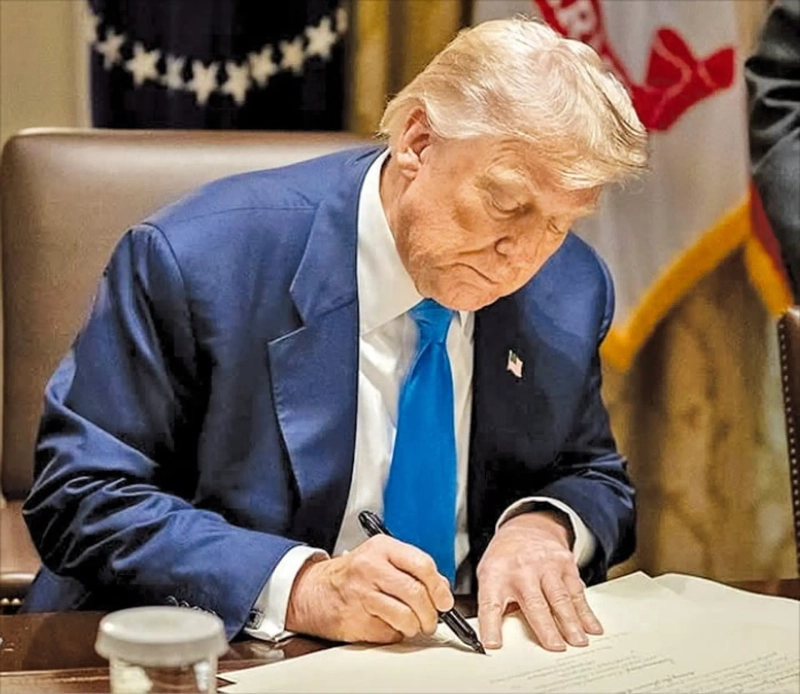
A US official announced the beginning of a new trade system, stating that "President Donald Trump's tariff policy is building a fairer world trade system."
Jamieson Greer of the Office of the United States Trade Representative (USTR) outlined in an op-ed in The New York Times on the 7th (local time) that the Trump administration's trade policies, centered on tariffs and protecting manufacturing, should be seen as a 'new world trade order' to replace the existing World Trade Organization (WTO) system. He argued that "the Bretton Woods system, introduced during World War II, and the Uruguay Round that led to the founding of the WTO, worked against the US and favored China."
He continued, "We are now witnessing the Trump Round," adding, "This has laid the foundation of a new world trade order for the United States." By referring to trade negotiations conducted with various countries since President Trump's announcement of reciprocal tariffs on April 2 as a new 'Round,' he drew parallels to previous multilateral trade talks. He emphasized that the Trump Round has enabled the US to secure greater access to foreign markets compared to the WTO regime.
The Bretton Woods system was established under US hegemony in 1944. Before and after the end of World War II, the US led the creation of an international monetary and trade order based on the dollar as the key currency. In 1948, the GATT system was established as the framework for trade liberalization, laying the foundation for multilateralism. The Kennedy Round (creation of anti-dumping rules), the Tokyo Round (kick-start of non-tariff barrier discussions), and the most-favored-nation principle are prime examples.
In particular, the 1986 Uruguay Round was a large-scale multilateral trade negotiation covering agriculture, services, and intellectual property rights, forming the basis for the establishment of the WTO in 1995. The WTO played a role in promoting free trade through dispute settlement among member countries and the formulation of trade rules. With China's accession to the WTO in 2001, the free trade system reached its peak.
However, after about 2010, the United States began questioning the WTO system as China's rapid growth coincided with the decline of US manufacturing and mounting trade deficits. As a result, the Trump administration introduced high tariff policies, which, according to the administration's mainstream view, have proven effective as a solution to the US trade deficit by opening up foreign markets.
Reporter Rian Kim knra@hankyung.com

Korea Economic Daily
hankyung@bloomingbit.ioThe Korea Economic Daily Global is a digital media where latest news on Korean companies, industries, and financial markets.