

Collapse of the global supply chain due to the 'Trump Round'... Korea also 'shaken' [Global Money X-File]
Summary
- The U.S. announcement of the 'Trump Round' and global supply chain reorganization are expected to lead to geopolitical inflation and higher production costs.
- The global division of labor in key industries like semiconductors and batteries is being disrupted, making direct impacts on Korea's major industries and exports inevitable.
- With supply chain uncertainty, companies are inevitably adopting strategies emphasizing resilience over efficiency, which could burden both consumer prices and corporate profitability.
'Invoice for the Trump Round Era ① Intensifying Geopolitical Inflation
![Collapse of the global supply chain due to the 'Trump Round'... Korea also 'shaken' [Global Money X-File]](https://media.bloomingbit.io/PROD/news/88ceb8f9-39f2-46a5-a9bc-f488ebb03809.webp?w=800)
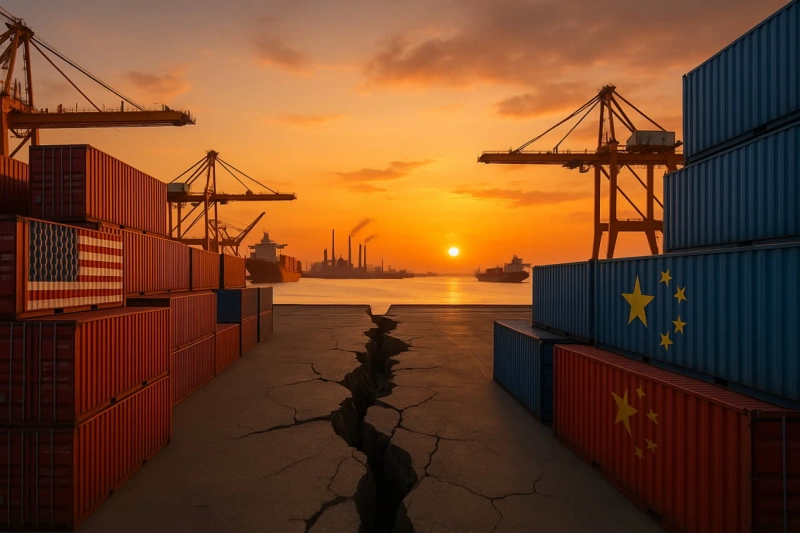
The global economy is facing a massive transformation, as the United States has announced the end of the World Trade Organization (WTO) system. The recent second Trump administration has declared it will establish a new trade order called the 'Trump Round.' We assess how the global trade landscape may be disrupted in the future.
U.S.: "Now the Trump Round"
According to Reuters and others on the 12th, Jamieson Greer, the U.S. Trade Representative (USTR) overseeing American trade policy, on the 7th highlighted the Trump administration's trade approach focusing on tariffs and manufacturing protection as a new order set to replace the current WTO system.
In an op-ed for the New York Times (NYT), Greer stated that the Trump administration seeks to reform the global trade order, which was established through the Bretton Woods system after World War II and the subsequent Uruguay Round leading to the creation of the WTO, as these frameworks have only disadvantaged the U.S. "We are now witnessing the Trump Round," he said.
President Trump, on April 2, announced reciprocal tariffs, likening ongoing trade negotiations with nations around the world to previous multilateral trade negotiations, hence dubbing them a 'Round.' Greer evaluated this as the U.S. laying "the foundation for a new world trade order."
This declaration goes beyond a mere policy shift. If the U.S. government’s intentions are realized, the era of 'hyper-globalization' that has dominated the post–Cold War global economy will end. The multilateral, rules-based system aimed at maximizing efficiency with global cooperation could disappear according to each nation’s interests.
![Collapse of the global supply chain due to the 'Trump Round'... Korea also 'shaken' [Global Money X-File]](https://media.bloomingbit.io/PROD/news/92a335e8-8b55-495f-921f-2689a5e07a43.webp?w=800)
The Bretton Woods system, established after World War II, and the Uruguay Round leading to the creation of the WTO, strengthened global interdependence based on multilateralism, nondiscrimination, and tariff reduction. However, USTR Greer criticizes this order, claiming it "only disadvantaged the U.S." This points to a shift in supply chains prioritizing national security and interests.
Signs Before the Second Trump Administration
First, with the rise of reshoring (relocation of supply chains back to the home country) and increased inventory, so-called 'geopolitical inflation' is expected. The signs of geopolitical inflation appeared even before this year’s global U.S. tariff pressure. It is now expected to intensify as the U.S. applies tariff pressure to its trade partners.
Previously, the U.S. led a liberal trade order from the 1980s to the 2010s. Recently, however, the country has pursued a strategy centered on high tariffs and domestic priorities. Even before Trump returned to the presidency, the Inflation Reduction Act (IRA) in 2022 and CHIPS Act in 2023 began incentivizing reshoring of key industries.
![Collapse of the global supply chain due to the 'Trump Round'... Korea also 'shaken' [Global Money X-File]](https://media.bloomingbit.io/PROD/news/3cb67731-9dc6-4b28-b732-067ac8ece0ad.webp?w=800)
Since the launch of the second Trump administration this year, the U.S. has taken broad tariff action, including announcing 'Liberation Day' across-the-board tariffs and reciprocal tariffs. The U.S. Treasury is also ramping up China export controls and sanctions using the dollar’s dominance. Under the guise of national security, the administration is imposing currency pressures, including labeling countries as currency manipulators. The U.S. is formalizing 'de-globalization' and pushing for the reorganization of the economic bloc centered on itself.
China is responding with its so-called 'dual circulation' strategy, focusing on domestic demand and technological self-sufficiency. Amid U.S.–China trade friction throughout the 2020s, China prioritized the domestic production of key technologies, such as semiconductors, as a top national agenda. The country is pouring enormous investments into strengthening its capabilities in developing and manufacturing domestic semiconductors and related equipment in response to U.S. export controls.
Against U.S. and EU containment, China is also promoting Asian economic integration using the RCEP (Regional Comprehensive Economic Partnership). It is deepening cooperation with BRICS and developing nations, aiming to construct a Renminbi (RMB) bloc. In the foreign exchange market, the People’s Bank of China (PBOC) actively intervenes to prevent sharp depreciation of the RMB.
Europe officially introduced 'open strategic autonomy' in 2023, aiming to reduce external dependencies. Even in its China policy, the focus has shifted from 'decoupling' to 'de-risking.' Europe aims to reduce dependence on China for critical industries without fully severing trade ties.
![Collapse of the global supply chain due to the 'Trump Round'... Korea also 'shaken' [Global Money X-File]](https://media.bloomingbit.io/PROD/news/1f701a0c-e8bc-4659-80d5-f843949c9f75.webp?w=800)
The EU is diversifying production and supply chains for semiconductors and batteries and countered the U.S. IRA with subsidies via the European Chips Act in 2023. To bolster trade measures, it has also introduced foreign investment screening systems and regulations (anti-subsidy controls, anti-coercion laws) to guard against unfair trade practices by countries like China.
Japan, for its part, has closely cooperated with the U.S., simultaneously pursuing economic security and multilateral trade. By implementing the Economic Security Promotion Act in 2023, it strengthened the safety of supply chains for advanced technology and infrastructure. Responding to U.S. requests, Japan also joined in restricting exports of advanced semiconductor equipment to China.
The Japanese government has attracted joint ventures with Taiwan’s TSMC to revive its domestic semiconductor industry. Through its semiconductor partnerships with the U.S., Japan is playing a pivotal role in ally supply chains. On the trade front, it participates in both the Comprehensive and Progressive Agreement for Trans-Pacific Partnership (CPTPP) and RCEP, expanding trade with both blocs.
![Collapse of the global supply chain due to the 'Trump Round'... Korea also 'shaken' [Global Money X-File]](https://media.bloomingbit.io/PROD/news/e1bf2cdb-861e-4cb3-8f4c-ca68db449022.webp?w=800)
Ultimately, U.S.–China Rivalry Is the Problem
These national developments have already triggered 'geopolitical decoupling' in the global economy. As the global division of labor in major industries fractures, widespread effects include the shrinking of economies of scale, redundant investment, and increased transaction costs—which worsen supply chain cost structures and push up consumer prices.
Ultimately, U.S.–China hegemonic rivalry is cited as the key background to 'geopolitical decoupling.' Countries are adopting 'friend-shoring'—supplying key items themselves or sourcing only from allies. This results in lower efficiency and higher costs.
Semiconductors are emblematic of this trend. The market is being fragmented by the U.S.-oriented semiconductor alliance and China’s independence efforts. To prevent leakage of semiconductor technology to China, the U.S. and its allies are banning exports of production equipment and sanctioning Chinese firms. The U.S. has also offered massive subsidies for domestic chip plant construction, while the EU and Japan are boosting their domestic shares with policies to foster local suppliers.
![Collapse of the global supply chain due to the 'Trump Round'... Korea also 'shaken' [Global Money X-File]](https://media.bloomingbit.io/PROD/news/c386aa5a-446e-403e-914f-23db42a732d3.webp?w=800)
Meanwhile, China is concentrating state resources—such as its National IC Fund—on the localization of materials and equipment, sometimes even attempting to smuggle in advanced foreign equipment from companies like ASML. Such duplicative investment between the two sides leads to enormous inefficiencies in the global semiconductor industry.
According to analysis by the Center for Strategic and International Studies (CSIS), U.S.-China technological decoupling will require each side to invest at least $1 trillion, alongside additional annual operating costs of $45–125 billion. Semiconductor prices are estimated to rise by 35–65% as a result.
Battery supply chains are also affected. The U.S. IRA only provides EV subsidies for cars using North American batteries, leading Korean and Japanese battery firms to set up plants in the U.S. and realign their supply chains. Europe, too, is encouraging local battery use and supporting the building of gigafactories within its borders.
![Collapse of the global supply chain due to the 'Trump Round'... Korea also 'shaken' [Global Money X-File]](https://media.bloomingbit.io/PROD/news/b67b09d3-2728-4e72-b944-a976d77a2f8e.webp?w=800)
Chinese firms such as CATL are also luring global companies to invest in Europe. Meanwhile, China is striving to secure crucial mineral resources—like lithium and nickel—to protect its domestic market and prevent technology outflow. The formation of battery ecosystems by bloc could hamper economies of scale and lead in the near term to higher EV production costs.
Consequences of Artificial Production Relocation
The essential driver of geopolitical inflation is the forced relocation of production bases. In the past, global firms sought to shave even 1% off production costs by scouring the world. However, the average U.S. tariff rate has soared from about 2.5% before the Trump administration’s return to 18.6% as of August 2025. Even allies now face reciprocal tariffs as high as 15%, making cost efficiency a secondary concern.
To survive, companies are likely to either bring production home (reshoring) or relocate to politically trusted allied countries (friend-shoring). The problem is that this process is inefficient. According to Goldman Sachs research, manufacturing cutting-edge semiconductors in the U.S. (as opposed to Taiwan) is estimated to cost 44% more in construction outlays. Across all industries—automobiles, batteries, pharmaceuticals—facing America’s new tariff regime, higher production costs are unavoidable.
![Collapse of the global supply chain due to the 'Trump Round'... Korea also 'shaken' [Global Money X-File]](https://media.bloomingbit.io/PROD/news/07db0b67-42d7-4489-a856-7734e1e57c9f.webp?w=800)
Another major driver of cost increases will be shifts in inventory management strategy. For decades, manufacturing relied on the "Just-in-Time" (JIT) model, minimizing inventory for maximum efficiency. But in an era of supply chain disruption and sudden tariffs, JIT can be a critical weakness.
Companies are expected to abruptly switch to a "Just-in-Case" (JIC) strategy, stockpiling more raw materials and parts to prepare for supply shocks. The Federal Reserve Bank of Richmond, in its April report "Supply Chain Resilience and Economic Shocks," noted that policies to strengthen supply chain resilience (reshoring, shifting to allied production, domestic production incentives, etc.) may raise both input costs and inflationary pressures.
Switching to JIC entails substantial financial costs. Increased warehousing means more working capital is tied up in inventory, potentially inflicting serious blows to corporate profitability in a high interest rate environment. In effect, JIC means paying an efficiency premium for the insurance of resilience—a cost that will invariably be passed on to consumers, creating a vicious cycle of inflation.
Impact on the Korean Economy
![Collapse of the global supply chain due to the 'Trump Round'... Korea also 'shaken' [Global Money X-File]](https://media.bloomingbit.io/PROD/news/d5c4694c-7dc5-4b9d-ae83-22012fb37c45.webp?w=800)
Global bloc-formation may deliver direct and indirect hits to Korea's key export industries. For semiconductors, curtailed exports to China and operational uncertainties at Korean plants there have increased due to U.S. and Chinese pressure. With American protectionism requiring local battery production, the automotive sector is also affected. Petrochemicals face weakening profitability from slower exports to China and protectionism, and material sectors like steel are likely to suffer setbacks in exports to the U.S. due to high tariffs.
Expectations for the impact on domestic prices are mixed. In the past, Korea saw only limited price effects from supply chain disruptions. Even when global supply bottlenecks drove price hikes in 2021–2022, Korea’s consumer prices rose just 5.1% for the year—lower than in advanced economies. This was aided by government policies like cutting fuel taxes, freezing public utility charges, and the buffer effect of a strong won.
But prolonged geopolitical inflation could intensify pressure on prices in the future. Currency-driven import price spikes will be reflected in consumer prices with a time lag. European Central Bank (ECB) President Christine Lagarde has warned that "supply chain fragmentation can push up import prices and spur inflation worldwide" and that structural shifts such as energy security and defense spending increases could drive up prices in the medium term.
[Global Money X-File highlights the movement of world money you need to know but may have missed. For the latest must-have global economic news, subscribe to the reporter’s page.]
Juwan Kim, Reporter kjwan@hankyung.com

Korea Economic Daily
hankyung@bloomingbit.ioThe Korea Economic Daily Global is a digital media where latest news on Korean companies, industries, and financial markets.