

"Introduction of short-term Treasury bonds needed for issuing KRW stablecoins"
Summary
- It was reported that there is a need to revitalize the market for short-term Treasury bonds with maturities of less than one year to introduce KRW stablecoins.
- Currently, South Korea lacks the infrastructure to issue and trade short-term Treasury bonds, and the National Finance Act is cited as an institutional obstacle.
- Discussions are underway regarding the introduction of short-term Treasury bonds or the composition of reserve assets to ensure sufficient reserves for large-scale stablecoin issuance.
What do you think?
US requires issuers to hold short-term bonds
Only mid- and long-term bond markets in South Korea
'Issuance amount' managed under the National Finance Act
Institutional obstacle to introducing a short-term market
Discussion on reserve asset composition needed before introducing KRW stablecoins
As discussions on the introduction of KRW stablecoins are gaining momentum, there are claims that revitalizing the short-term Treasury bond market is necessary. For the stability and liquidity of KRW stablecoins, it is necessary to use Treasury bonds with maturities of less than one year as reserve assets, but the South Korean government bond market currently lacks the infrastructure for issuing and trading short-term bonds. Under the National Finance Act, National Assembly approval is mandatory for government bond issuance based on the 'issuance amount', which is pointed out as an institutional obstacle to introducing short-term instruments.
◇ "Short-term bond market is active in the US"
Kim Pil-gyu, Senior Research Fellow at the Korea Capital Market Institute, stated at the 'Stablecoins and Short-Term Treasury Bonds' seminar held in Yeouido, Seoul, on the 11th, "When KRW stablecoins are introduced, reserve assets are needed to enhance payment stability and value storage functions," adding, "Short-term Treasury bonds, which help alleviate temporary government funding shortages, can fulfill this role."
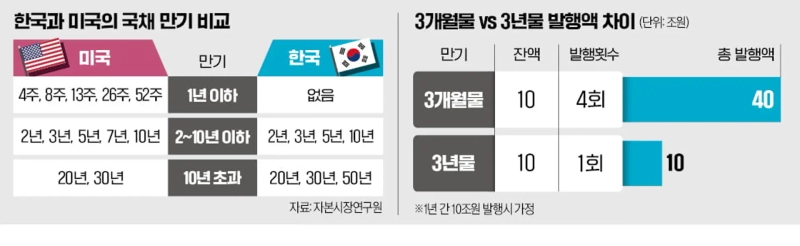
Short-term Treasury bonds refer to government bonds with maturities of less than one year. In the United States, short-term bonds with maturities from 4 weeks to 52 weeks are traded. According to the Genius Act, the stablecoin regulation law passed by the United States Congress last month, stablecoin issuers must hold reserve assets equivalent to the entire issuance amount in cash or safe assets such as US short-term Treasury bonds with maturities within 93 days. This is to ensure that they can promptly cash out and respond even if there is large-scale redemption or settlement demand for stablecoins.
In contrast, the South Korean government bond market focuses on mid- to long-term bonds with maturities ranging from 2 to 50 years. The government has mainly issued long-term bonds to secure interest rate management and stable financing. Short-term bonds are less efficient to manage because issuance and redemption procedures are frequent. Moreover, while US Treasury investors include banks, money market funds (MMFs), insurance companies, pension funds, overseas central banks, and corporations, South Korean investors, such as banks, insurance companies, and pension funds, mainly invest in long-term bonds.
◇ "Legal constraints also exist"
There is also a legal obstacle stemming from the National Finance Act, which hinders the creation of a short-term bond market in South Korea. According to the National Finance Act, the government must obtain National Assembly approval for government bond issuance based on the total issuance amount. The total issuance amount includes not only new issues but also refinancing issues when bonds mature. For example, if the government issues ₩10 trillion of 3-month bonds and refinances them four times over one year, the actual balance remains ₩10 trillion, but the total issuance amount is counted as ₩40 trillion. If the same amount is issued as 3-year bonds, the total issuance amount is ₩10 trillion. The shorter the maturity, the more frequent the refinancing, leading to a surge in the issuance amount. Therefore, even if actual debt does not increase, introducing short-term Treasury bonds can create political concerns due to a "significant increase in the issuance amount."
Kim further stated, "Short-term Treasury bonds carry lower risk even amid sudden interest rate changes or market demand fluctuations, and their relatively lower interest rates compared to long-term bonds contribute to more efficient fiscal funding and management," adding, "The debt management standard should be switched from issuance amount to net increase or balance."
Some argue "expanding the issuance of short-term bonds could undermine transparency in debt management." For this reason, existing risk-free bonds, such as monetary stabilization bonds, are also mentioned as alternative reserve assets. However, there are many views that these have limitations in issuance volume and accessibility, making it difficult to absorb stablecoin demand at scale. An official from the Ministry of Economy and Finance remarked, "Short-term Treasury bonds are just one of several alternatives being mentioned as solutions for reserve assets," adding, "We will discuss the composition of reserve assets, including this matter, with the Financial Services Commission."
Jo Mi-hyun/Nam Jeong-min, reporters mwise@hankyung.com

Korea Economic Daily
hankyung@bloomingbit.ioThe Korea Economic Daily Global is a digital media where latest news on Korean companies, industries, and financial markets.