

Powell: "Labor Market Risks Rising"... Hints at Fed Rate Cut in September
Summary
- Fed Chairman Jerome Powell hinted at a potential rate cut at the September FOMC meeting.
- After Powell’s dovish comments, the New York stock market immediately turned upward, and both the S&P 500 and NASDAQ indices rose sharply.
- The market reflected expectations of two to three rate cuts within the year, as seen in adjustments to interest rate futures prices.
Jackson Hole Meeting Keynote Speech
"Inflationary impact from tariffs is short-term
Policy direction may need adjustment"
Stock market opens higher on dovish comments
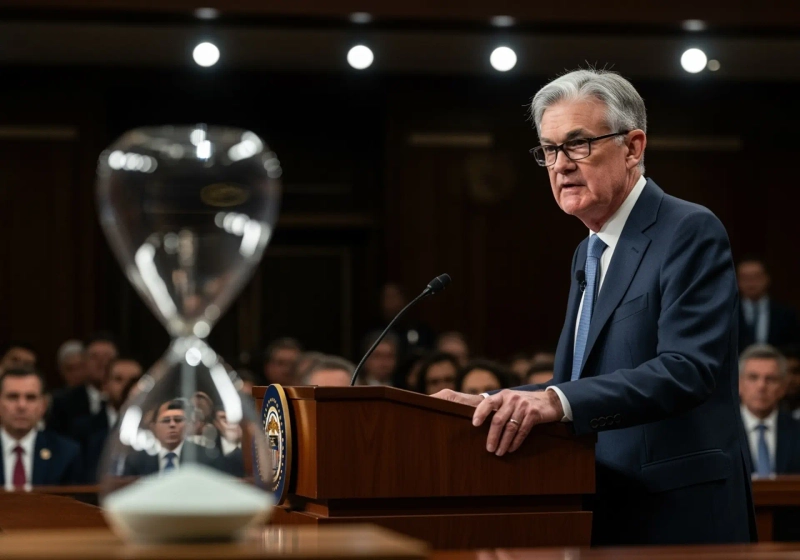
Jerome Powell, Chairman of the Fed, signaled a shift towards a rate cut on the 22nd (local time). As the likelihood of a rate reduction by the Fed at the upcoming September Federal Open Market Committee (FOMC) meeting increased, the U.S. stock market started on an upswing.
In his keynote address at the 'Jackson Hole Meeting' in Jackson Hole, Wyoming, Powell stated, "Downside risks are increasing in the labor market," projecting that tariff-related inflationary concerns could be offset. He noted, "An unusual balance of clear simultaneous slowdowns in both labor supply and demand has been observed due to the Trump administration's tariff and immigration policies." He further emphasized that "the labor market could quickly deteriorate in the form of a surge in layoffs and a rise in the unemployment rate."
Regarding inflation concerns, Powell said, "The impact of tariffs on consumer prices is becoming clear," but also expressed that "confidence is growing somewhat that this impact will be relatively short-term." This is the first time Powell has mentioned that the effects of tariffs could be short-lived. He added, "It takes time for tariff increases to be reflected in supply chains and distribution networks," and "there is a possibility that adjustments could be prolonged if tariff rates continue to change." This suggests that the impact of tariffs might be reflected multiple times rather than all at once.
Powell indicated that if workers, whose real wages have been reduced by tariff-driven price increases, demand higher wages from their companies, inflation could persist longer. However, he assessed that the probability is not high, given that downside risks in the labor market are increasing. Powell stated, "Policy direction may need to be adjusted as the risk balance changes." The market interpreted this as an intention to lower the base rate again after keeping it unchanged for eight months since December last year.
Immediately after Powell’s remarks, the S&P 500 Index rose by 1.6% and the NASDAQ by over 2% on the New York Stock Exchange (as of 11:20 am EST).
Emphasis on Employment Over Prices... Powell Turns Dovish
Market Cheers Powell’s Signal... U.S. 2-Year and 10-Year Treasury Yields Plunge
In his Jackson Hole speech on the 22nd (local time), Jerome Powell, Chairman of the Fed, put clear emphasis on employment stability over price stability. With his term set to end in May next year, his final Jackson Hole address suggested the possibility of resuming the rate cut cycle, which had been paused since December last year. Having previously maintained a rate hold in light of the effects of President Trump’s tariff policies on prices, Powell’s dovish pivot was met with strong market enthusiasm.
“Maintaining Long-Term Inflation Expectations”
Since becoming Fed Chairman in 2018, Powell has used his Jackson Hole address whenever he sought to significantly change policy direction. Because the FOMC meeting does not occur in August, he took advantage of the opportunity to minimize market shocks while providing long-term guidance.
It was through Jackson Hole that he judged the inflationary effects of COVID-19 in 2021 to be "transitory," and then, the following year, admitted that judgment was wrong and committed fully to curbing rising prices. After indicating a pivot toward rate cuts due to rising unemployment in last year’s August meeting, a “big cut” (a 0.5 percentage point reduction in the base rate at once) was implemented at the September FOMC.
At this year’s Jackson Hole, Powell compared the price-stimulating effect of the Trump administration’s tariff policies and the contractionary effect on the labor market. Having cited uncertain economic impacts and inflationary concerns throughout the first half of the year, Powell appeared convinced by the milder-than-expected rise in prices.
Powell stated, "In the short term, inflation risks are tilted to the upside, and employment risks to the downside," making it a difficult decision for the Fed given its dual mandate (price stability and maximum employment). However, he also said, "If the risk balance changes while the current base rate remains in restrictive territory, policy direction may need to be adjusted," highlighting the increased necessity of rate cuts.
Market Considers Rate Cuts a Done Deal
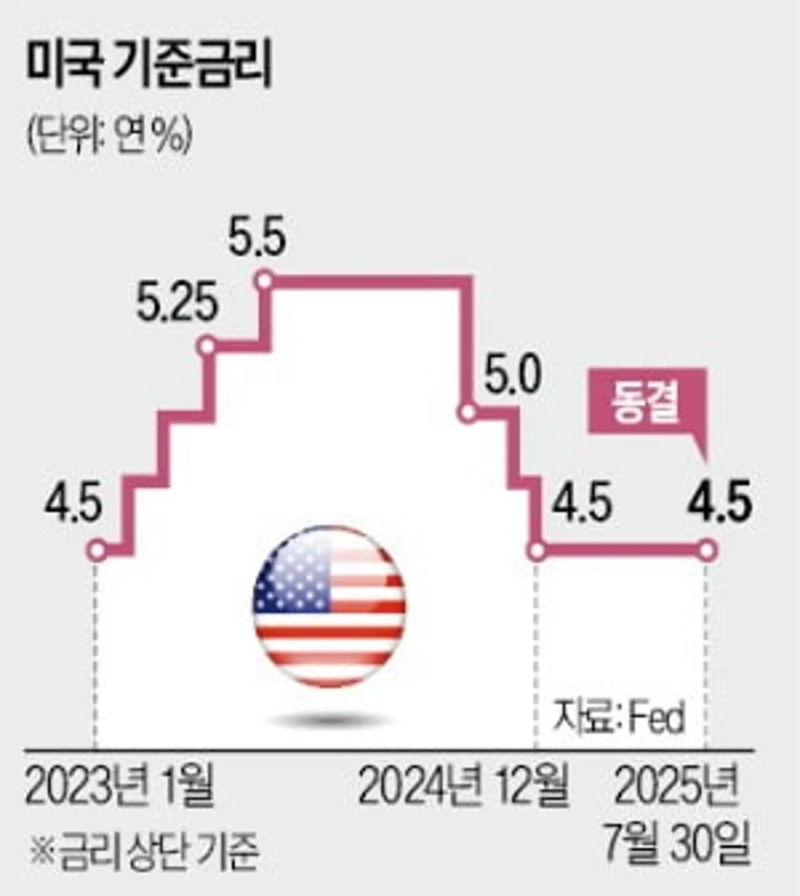
The atmosphere was different until the previous day. With major participants at Jackson Hole expressing caution, the market—which had anticipated a 0.25 percentage point cut in September—suddenly cooled.
Jeffrey Schmid, President of the Federal Reserve Bank of Kansas City, said in a CNBC interview on the 21st, "There must be decisive data to move policy rates," and "there is a lot to discuss between now and September."
Beth Hammack, President of the Federal Reserve Bank of Cleveland, told Yahoo Finance that inflation risks were larger than employment concerns. She said, "We are experiencing very high inflation rates, with continued upward momentum over the past year," and that if the (FOMC) meeting were held tomorrow based on her current information, "I would not find grounds to lower rates." She also predicted that while companies have deferred price increases related to tariffs, the full impact will show up next year.
There were some voices supportive of rate cuts. Susan Collins, President of the Federal Reserve Bank of Boston, focused more on the labor market in an interview with The Wall Street Journal (WSJ). She said, "If data released before the September FOMC suggest 'the risk of labor market deterioration outweighs the risk of rising inflation,' it may be appropriate to start lowering rates soon." Collins was also notably dovish in June.
With Powell underscoring the timing for focusing more on employment stability, expectations for the September FOMC shifted sharply. The probability of a rate hold, which had risen to 26.7% on the previous day based on Fed officials’ statements, plunged to 10.8% after Powell’s speech. The market, having taken the September rate cut as a given, became increasingly interested in "how many cuts" would occur by year-end.
Year-end forecasts for the Fed base rate, reflected in Chicago Mercantile Exchange (CME) interest rate futures prices, include a 0.5 percentage point cut (48.6%) and a 0.75 percentage point cut (39.8%). This suggests expectations for two or three cuts within the year.
The New York stock market surged instantly. After Powell’s speech, the S&P 500 increased immediately by 1.6%, and the NASDAQ by over 2%. The yield on the 2-year U.S. Treasury, which reacts sensitively to policy rate direction, fell by more than 0.1 percentage point to below 3.7% per annum. The yield on the 10-year Treasury also plunged by around 0.1 percentage point to about 4.25% per annum.
President Trump continues intensifying pressure on Chairman Powell, seeking to remove allied Fed Board members one after another. Despite Powell’s ‘dovish turn’, it is widely believed that Trump will not reduce his pressure.
Jackson Hole = Bin Nansae, correspondent / Han Gyeongje, reporter / Washington = Lee Sangeun, correspondent binthere@hankyung.com

Korea Economic Daily
hankyung@bloomingbit.ioThe Korea Economic Daily Global is a digital media where latest news on Korean companies, industries, and financial markets.