

The government says, "We will spend when we need to"... A budget of ₩730 trillion is coming
Summary
- The government announced a plan to expand next year's total budget expenditure to around ₩730 trillion.
- Accordingly, the scale of government bond issuance will also increase significantly, expected to surpass ₩200 trillion for the first time this year.
- Due to the expansionary fiscal policy, national debt is also projected to exceed an all-time high of ₩1,300 trillion.

With the government's fiscal policy turning toward 'expansionary finance,' the total government expenditure for next year's budget is expected to increase to around ₩730 trillion. While the Yoon Seok-youl administration focused on tightening belts and emphasizing fiscal soundness, the Lee Jae-myung administration is pursuing a policy of 'spending where necessary.’ Alongside the increased expenditure, government bond issuances are also expected to reach record levels.
According to related ministries on the 25th, the Ministry of Economy and Finance is finalizing the '2026 budget bill' and plans to announce it later this month. Deputy Prime Minister and Economy and Finance Minister Gu Yoon-cheol attended a plenary session of the Special Committee on Budget and Accounts at the National Assembly this day, stating, "Economic uncertainties at home and abroad remain high," and "The government will push for strong restructuring in low-performing sectors and will focus investment on high-performing ones."
He continued, "If we focus only on maintaining fiscal soundness, there is a risk that it could worsen in the medium to long term," stressing, "When it is time to revitalize the economy, we must actively increase expenditures."
Deputy Prime Minister Gu's remarks reflect the basic principles for formulating the 2026 budget. The government plans to cut wasteful and habitual spending, but will generously invest in areas that require expenditure.
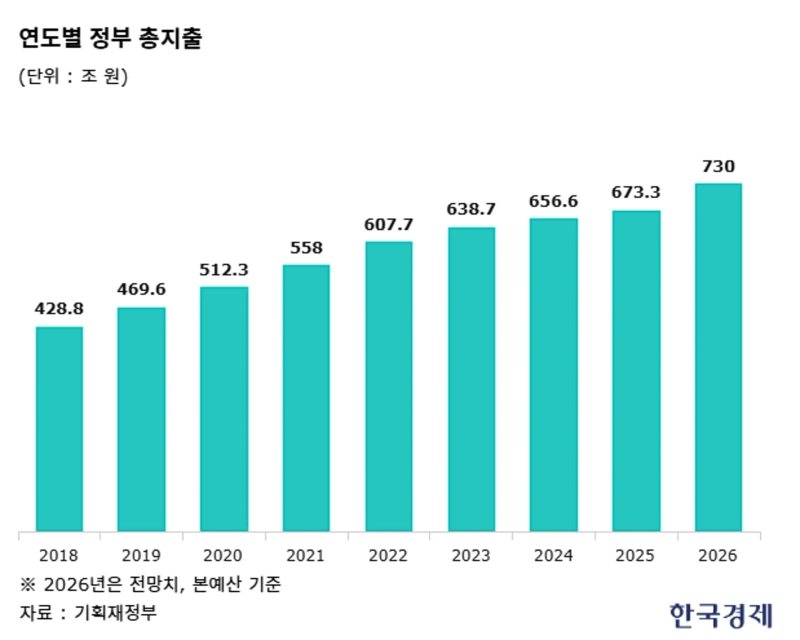
The Lee Jae-myung administration's first budget bill is expected to reach ₩720–730 trillion. Unlike the Yoon Seok-youl administration, which maintained a 2–3% annual expenditure growth rate, the Moon Jae-in administration previously showed a 7–9% growth per year. Considering this, Lee's government is also likely to set a similar scale. This year’s budget is ₩673.3 trillion. An 8% increase would lead to next year's budget being around ₩727 trillion, while a 9% increase would push it to about ₩733 trillion.
With a new administration, measures to secure resources are usually implemented intensively within the first 1–2 years for early impact. Assuming Lee Jae-myung’s first budget, next year's minimum artificial intelligence (AI) budget is expected to exceed ₩5 trillion. According to the State Affairs Planning Advisory Committee, ₩25 trillion is allocated for the country to leap into the global top three in AI over five years. Given the focus on investment in AI in the new administration's economic growth strategies, a simple calculation for five years means at least ₩5 trillion will be spent next year.
Next year's research and development (R&D) budget has been set at ₩35.3 trillion, representing a record increase of 19.3% over this year. For welfare, the child allowance will be ₩2.2201 trillion for next year. The age eligibility for the monthly ₩100,000 child allowance will be raised from children aged 0–7 (under 8) to 0–8 years old (under 9) from next year onward.
Additionally, with the strategy of providing National Pension childbirth credits in advance being included in the economic growth plan of the new administration, at least ₩700 billion is set to be added for this. The childbirth credit is a system that extends the National Pension subscription period for those who have children. Currently, the benefit is given after about 30 years, so the benefit isn’t immediately felt by families. There have been many cases where women with interrupted careers due to childbirth could not meet the ten-year minimum subscription period by their 60s and were excluded from credit eligibility. The government plans to address this by shifting to an advance support method where the state subsidizes a portion of the National Pension premium at the time of childbirth and reflects this in the budget.
Resources for balanced regional growth promoted by Lee Jae-myung’s government will also be included. According to the State Affairs Planning Advisory Committee, ₩15 trillion is allocated over the next five years for decentralized and balanced regional growth, which translates to at least ₩3 trillion in next year's local growth budget. It is likely that the current system of supporting ₩1 trillion per year for the regional extinction response fund will be reorganized.
Along with increasing certain expenditures, measures to cut wasteful and routine spending are also planned. Official development assistance (ODA) is cited as a representative example. With the ongoing investigation into Kim Keon-hee and suspicions over preferential treatment in the Cambodia Mekong River ODA project involving the Unification Church, this area is considered the top priority for restructuring. Budgets for programs such as the National Tomorrow Learning Card and university support are also reportedly being adjusted.

This is not only the first time total expenditure has exceeded ₩700 trillion, but also because of the accelerated growth, government bond issuances are expected to surge. National treasury bond issuances, the government’s official debt, soared from ₩97.4 trillion in 2018 to ₩180.5 trillion in 2021 due to the impact of COVID-19, and stood at ₩158.4 trillion last year.
This year, the issuance of government bonds is expected to surpass ₩200 trillion for the first time. This is because sluggish tax revenues have not been resolved, two rounds of supplementary budgets amounting to ₩45.6 trillion have already been drawn up, and next year’s budget exceeding ₩700 trillion is in preparation.
Consequently, national debt is also expected to rise. Central government debt surged from ₩651.8 trillion in 2018 to ₩819.2 trillion in 2020, ₩1,033.4 trillion in 2022, and ₩1,141.2 trillion last year. This year, national debt is expected to surpass a historic high of ₩1,300 trillion.
Reporter Nam Jeong-min peux@hankyung.com

Korea Economic Daily
hankyung@bloomingbit.ioThe Korea Economic Daily Global is a digital media where latest news on Korean companies, industries, and financial markets.