

"The first step is well taken... Follow-up discussions on trade and security are important" — Expert assessment of the U.S.-South Korea summit
Summary
- Experts evaluated that uncertainties remain regarding trade and security issues discussed at the U.S.-South Korea summit.
- The United States demanded that South Korea reduce digital trade barriers, open up its agricultural market, and increase its share of defense costs.
- They stated that future follow-up discussions and the establishment of expert-driven mechanisms could enhance the predictability of the investment environment.
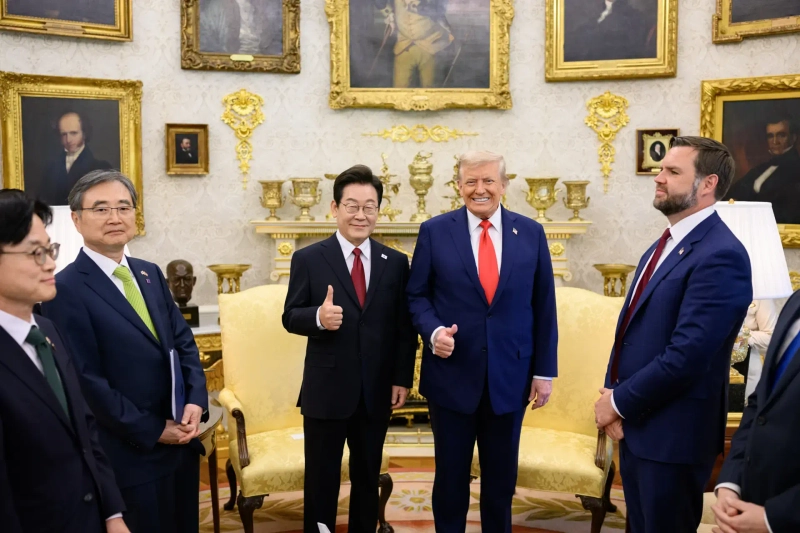
Experts on the Korean Peninsula in the United States gave a positive assessment of the outcome of the U.S.-South Korea summit. However, they noted that uncertainties still remain in the areas of trade and security. The analysis suggests that follow-up discussions between the two countries will be important moving forward.
According to Yonhap News Agency on the 26th, Andrew Yeo, Korea Chair at the Brookings Institution, stated, "It was an uneasy start after President Trump criticized South Korea in the morning, but the two leaders smiled and seemed to enjoy the spotlight," and, "President Lee gave high praise to President Trump. Overall, President Lee left President Trump with a positive impression of South Korea."
Robert Rapson, former Acting U.S. Ambassador to South Korea, also said, "There was some concern in the air because of President Trump's morning post on Truth Social, but the summit itself went well," and, "Their discussion and gestures were positive and friendly."
Gi-Wook Shin, director of the Walter H. Shorenstein Asia-Pacific Research Center (APARC) at Stanford University, commented, "It seems like the first step was well taken," adding, "There were some tense factors before the meeting, such as the ‘church search and seizure,' but those were resolved. In Washington, D.C., there were prejudices about President Lee Jae-myung being anti-U.S., pro-China, or pro-North Korea, but it appears he dispelled these smoothly. President Trump also offered very courteous hospitality to President Lee."
However, analysis indicates that uncertainties remain in the fields of trade and security.
Wendy Cutler, Vice President of the Asia Society Policy Institute (ASPI), said, "In the area of trade, both sides have differing interpretations regarding the structure and operation of the $35 billion investment fund for the United States announced last month," and, "South Korea, a U.S. FTA partner, is disappointed at not receiving preferential treatment regarding tariffs on automobiles and steel, while the United States is demanding that Korea reduce digital trade barriers and expand (U.S.) access to its agricultural market."
She continued, "On security, the Trump team is pressuring South Korea to increase its share of the cost for its own defense," adding, "President Trump even said today that the U.S. should own, not rent, military bases in South Korea, which is a politically difficult proposition for President Lee."
Patrick Cronin also stated, "While trade appears to be on the right track, unresolved issues remain—such as the possible semiconductor tariffs—and more concrete details on investment are necessary," and, "It is important for the United States to firmly commit to expert-driven mechanisms on trade and defense. By doing so, judgments will be made strategically rather than relying on ad hoc alliance management."
Regarding the North Korea issue, Andrew Yeo noted, "Both leaders want to engage with Kim Jong-un and seek denuclearization, but there were few concrete details on how exactly to persuade Chairman Kim to give up nuclear weapons," and added, "The U.S.-South Korea alliance will continue, but efforts to ‘modernize’ the alliance will need careful adjustment and coordination following this summit."
Song-ryeol Lee, reporter for Hankyung.com yisr0203@hankyung.com

Korea Economic Daily
hankyung@bloomingbit.ioThe Korea Economic Daily Global is a digital media where latest news on Korean companies, industries, and financial markets.